
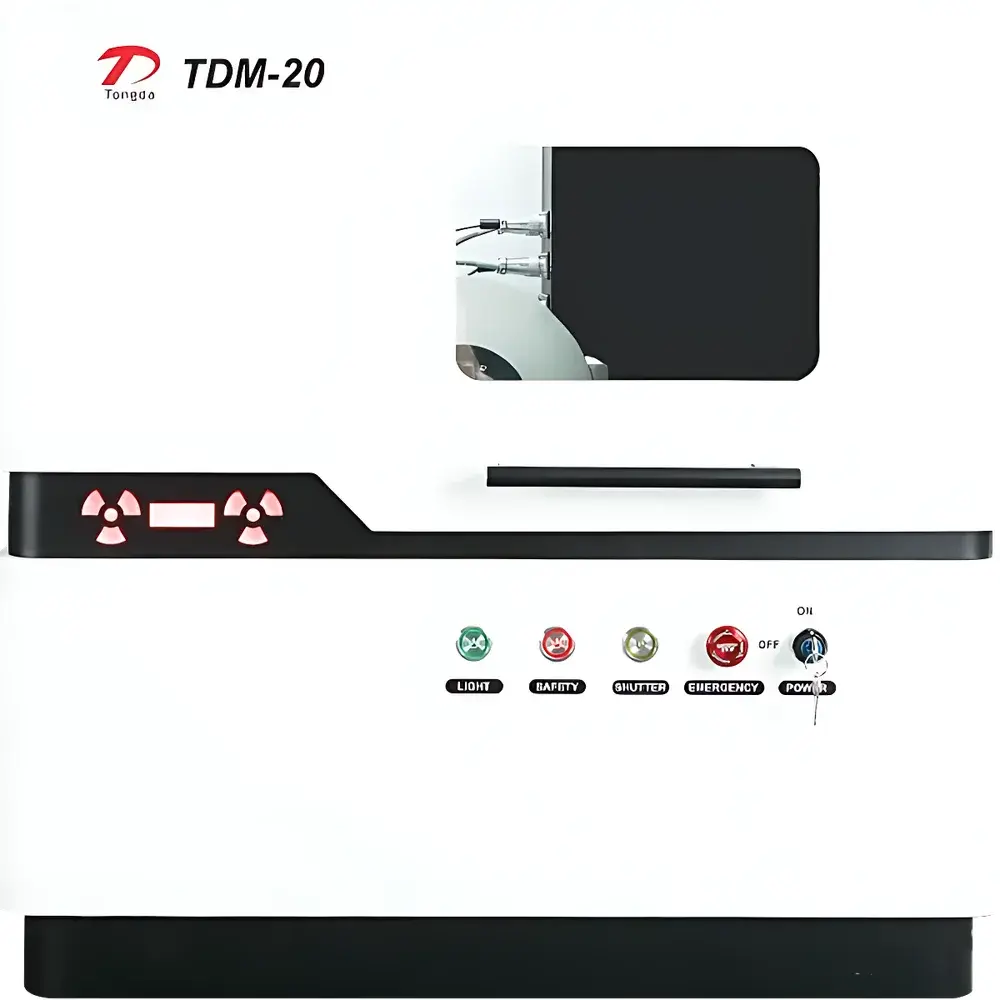
Tongda TDM-20 Benchtop X-ray Diffractometer
| Brand | Tongda |
|---|---|
| Origin | Liaoning, China |
| Manufacturer Type | Authorized Distributor |
| Regional Classification | Domestic (PRC) |
| Model | TDM-20 |
| Price Range | USD 45,000–87,000 |
| Instrument Type | Powder X-ray Diffractometer |
| Configuration | Benchtop |
| X-ray Generator Power | 3 kW |
| Angular Accuracy | ±0.0001° |
| Angular Resolution | 0.001° |
| Detector Type | High-Speed 1D Array Detector |
| Optional Accessories | Motorized Rotating Sample Stage, 6-Position Auto-Sampler, Proportional Counter |
Overview
The Tongda TDM-20 Benchtop X-ray Diffractometer is a compact, high-precision powder X-ray diffraction (XRD) system engineered for routine and research-grade phase identification, quantitative phase analysis (QPA), and crystallographic characterization of polycrystalline materials. Based on Bragg’s law and the fundamental principles of constructive interference in crystalline lattices, the TDM-20 employs Cu Kα radiation (λ = 1.5418 Å) generated by a sealed-tube X-ray source operating at up to 3 kW. Its optimized goniometric design ensures minimal mechanical drift and high angular fidelity, enabling reliable detection of subtle peak shifts associated with lattice strain, solid solution composition, or microstructural evolution. Designed specifically for laboratories with space constraints—such as QC labs in pharmaceutical manufacturing, university teaching facilities, or field-deployable analytical units—the TDM-20 maintains full compliance with ISO 17873:2021 (XRD instrumentation performance verification) and supports traceable calibration using NIST SRM 640e silicon standard.
Key Features
- Compact benchtop architecture (W × D × H ≈ 750 × 620 × 680 mm) with integrated shielding, requiring no dedicated vault or floor reinforcement
- High-stability θ–θ goniometer with optical encoder feedback and closed-loop motor control, delivering angular repeatability of ±0.0001° over extended measurement sequences
- 3 kW high-frequency generator with digitally regulated tube voltage (20–60 kV) and current (0–60 mA), supporting rapid thermal stabilization and low-noise output
- Fast-readout 1D linear array detector (256-channel) with 60% versus conventional scintillation counters
- Modular hardware interface supporting optional upgrades: motorized rotating sample stage (±0.005° positioning accuracy), 6-position automated sample changer (with barcode recognition), and dual-mode proportional counter for high-count-rate applications
- Comprehensive safety architecture compliant with IEC 61010-1 and GB/T 18801–2019, including interlocked shielding doors, beam-stop monitoring, and emergency power cutoff
Sample Compatibility & Compliance
The TDM-20 accommodates standard 25 mm and 32 mm diameter sample holders for loose powders, pressed pellets, thin films (on low-background Si wafers), and bulk metallic specimens. Its low-divergence incident beam geometry minimizes preferred orientation effects in anisotropic samples, while programmable scan strategies—including step-scanning, continuous scanning, and rocking-curve acquisition—support ASTM E975 (residual stress), ASTM E1423 (crystallinity index), and ISO 13126-2 (pharmaceutical polymorph screening). All instrument firmware and control logic are designed to meet GLP audit requirements, with configurable user access levels, electronic signature support, and full audit trail logging aligned with FDA 21 CFR Part 11 Annex 11 expectations.
Software & Data Management
The system ships with Tongda XRD Suite v4.2—a Windows-based application featuring intuitive workflow templates for Rietveld refinement (via integrated TOPAS engine), PDF-4+ database searching (ICDD licensed), and crystallite size/strain analysis (Williamson–Hall and Warren–Averbach methods). Raw data are stored in industry-standard .raw and .xye formats; processed reports export to PDF, CSV, and CIF with embedded metadata (instrument parameters, calibration history, operator ID). Network deployment enables centralized license management and remote diagnostics via TLS-encrypted HTTP(S) API endpoints. Data integrity is preserved through SHA-256 checksum validation on all acquired scans and automatic backup to NAS or cloud storage (AWS S3 or Azure Blob compatible).
Applications
- Pharmaceutical: Polymorph screening, excipient compatibility studies, and stability-indicating assay development per ICH Q5A and Q6A guidelines
- Materials Science: Phase quantification in cementitious systems (ASTM C1365), battery cathode degradation analysis (LiCoO₂ → Co₃O₄ transition monitoring), and ceramic sintering kinetics
- Geosciences & Mining: Rapid mineralogical fingerprinting of ore concentrates, clay speciation (smectite/illite ratio), and amorphous content estimation via internal standard method
- Food & Agriculture: Detection of adulterants (e.g., melamine in dairy powders), starch crystallinity assessment in processed grains, and soil mineral composition profiling
- Education: Hands-on XRD pedagogy with pre-loaded teaching modules covering Bragg’s law derivation, Miller index assignment, and structure factor calculation
FAQ
What is the minimum detectable crystallite size using the TDM-20?
The system achieves ~3 nm lower limit for crystallite size estimation using Scherrer analysis when combined with high-resolution scans (step size ≤ 0.005°) and optimal signal-to-noise conditions.
Does the TDM-20 support in situ heating or humidity-controlled stages?
Yes—optional accessory modules include a furnace stage (RT–1100 °C, ±1 °C stability) and environmental chamber (20–95% RH, ±2% RH control), both fully integrated into the software motion and data synchronization framework.
Is third-party software integration possible?
The instrument provides documented TCP/IP and RS-232 APIs, enabling bidirectional communication with MATLAB, Python (via PyXRD), and LabVIEW for custom automation and hybrid metrology workflows.
How often does the X-ray tube require replacement?
Under typical usage (≤ 4 h/day, 5 days/week), the sealed Cu tube has a rated lifetime of ≥ 15,000 hours, with predictive maintenance alerts triggered by cumulative dose and thermal cycling metrics.
Can the TDM-20 be used for residual stress analysis?
Yes—when equipped with the rotating sample stage and specialized sin²ψ mode, it complies with ASTM E975 for macrostress determination in metals and coatings, with measurement uncertainty < ±25 MPa (k=2) for Fe-α reference samples.




