
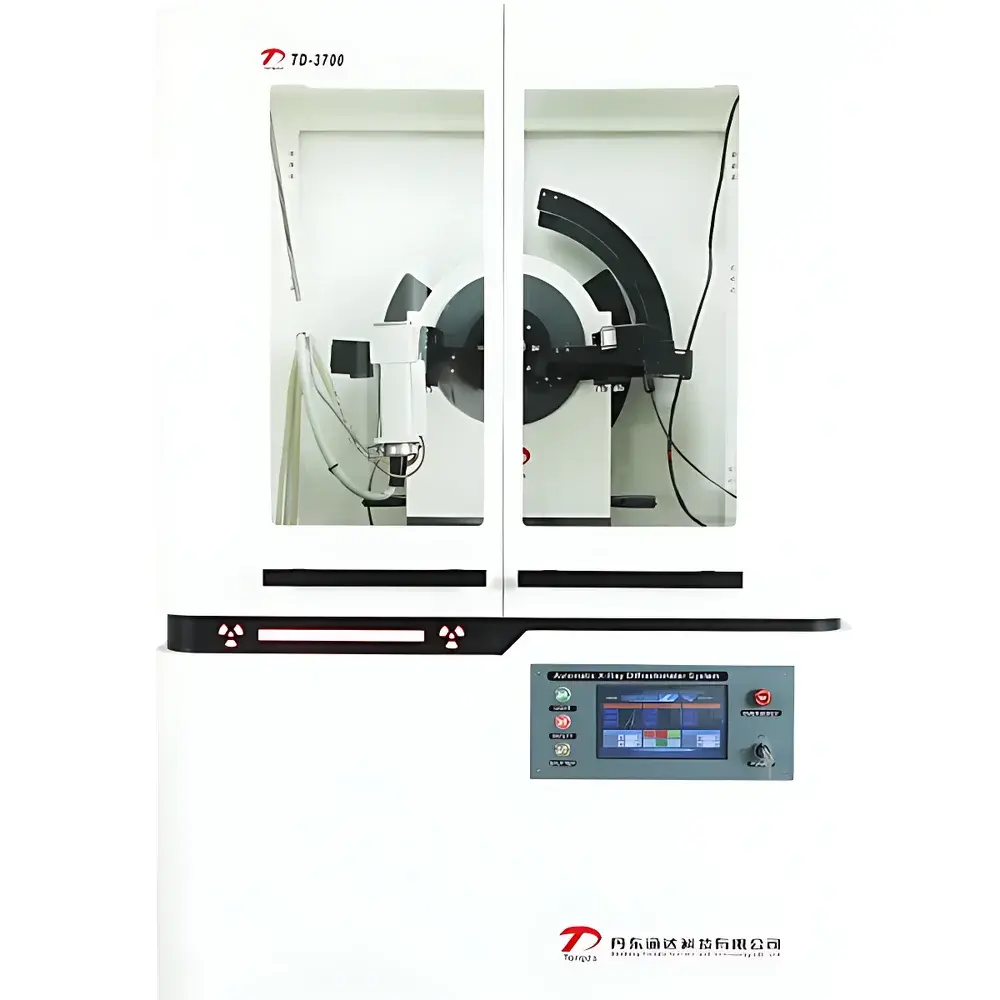
Tongda TD-3700 Benchtop Powder X-ray Diffractometer
| Brand | Tongda |
|---|---|
| Origin | Liaoning, China |
| Model | TD-3700 |
| Instrument Type | Powder X-ray Diffractometer |
| Configuration | Floor-standing |
| Angular Resolution | 0.0001° |
| Angular Accuracy | ±0.0001° |
| Minimum Step Size | 0.0001° |
| Detector Options | High-speed 1D array detector, 2D area detector, Silicon Drift Detector (SDD) |
| Measurement Modes | Bragg–Brentano θ/2θ reflection mode & transmission mode |
| Safety Compliance | Interlocked electronic lead shutter, dual-layer radiation shielding |
Overview
The Tongda TD-3700 is a floor-standing powder X-ray diffractometer engineered for high-resolution crystallographic analysis in academic research laboratories, materials science centers, and industrial quality control environments. It operates on the Bragg–Brentano θ/2θ geometry for conventional powder diffraction and supports an optional transmission geometry—enabling structural refinement of low-symmetry or microcrystalline phases where reflection-mode signal intensity is limited. The system utilizes Cu Kα radiation (λ = 1.5418 Å) generated by a high-frequency, stabilized X-ray tube with integrated cooling and voltage regulation. Its core measurement principle relies on constructive interference of monochromatic X-rays scattered by periodic atomic planes, governed by Bragg’s law (nλ = 2d sinθ). This enables precise determination of interplanar spacings (d-values), lattice parameters, crystallite size (via Scherrer analysis), and phase identification via Rietveld refinement against reference databases such as ICDD PDF-4+.
Key Features
- High angular resolution and accuracy: ≤0.0001° step size and ±0.0001° positional repeatability—critical for distinguishing closely spaced peaks in complex multiphase systems.
- Dual-mode operation: Switchable between reflection (Bragg–Brentano) and transmission geometries without hardware reconfiguration; transmission mode reduces preferred orientation effects and improves d-spacing precision for thin films, nanomaterials, or sub-milligram powder samples.
- Modular detector architecture: Supports interchangeable high-performance detectors—including a fast-readout 1D silicon strip array detector (hybrid photon counting), a 2D area detector for texture or stress mapping, and an SDD for enhanced energy discrimination and fluorescence suppression.
- Integrated safety system: Electromechanical lead shutter with real-time interlock monitoring, redundant radiation monitoring sensors, and automatic beam cutoff upon door opening—fully compliant with IEC 61010-1 and national radiation safety regulations.
- Intuitive human-machine interface: 10.1-inch capacitive touchscreen with embedded status dashboard, live goniometer position feedback, and guided workflow prompts for alignment, calibration, and acquisition.
- Plug-and-play modular design: Pre-aligned optical components, motorized sample stages, and hot-swappable detector modules eliminate routine recalibration and reduce instrument downtime.
Sample Compatibility & Compliance
The TD-3700 accommodates standard 25 mm Ø and 32 mm Ø powder holders, capillary tubes (0.3–1.0 mm ID), thin-film substrates, and irregular solid fragments using adjustable sample clamps. Transmission mode accepts samples as small as 10–50 µg, making it suitable for rare-earth compounds, catalyst precursors, or forensic trace evidence. All operational protocols align with ISO 17873:2022 (XRD qualitative phase analysis), ASTM E975 (standard practice for XRD residual stress measurement), and USP (residual solvent identification in pharmaceuticals). The system supports GLP-compliant audit trails when paired with validated software packages.
Software & Data Management
Acquisition and analysis are managed through Tongda XRD Studio—a Windows-based platform supporting automated batch processing, real-time background subtraction, peak deconvolution (Pseudo-Voigt fitting), quantitative phase analysis (QPA) via internal standard or reference intensity ratio (RIR) methods, and full-pattern Rietveld refinement (using GSAS-II or TOPAS integration). Raw data export adheres to CIF, XYE, and HDF5 formats. The software includes 21 CFR Part 11–ready features: role-based user access control, electronic signatures, immutable acquisition logs, and revision history tracking—essential for regulated environments including pharmaceutical QC and contract research organizations.
Applications
- Phase identification and quantification in ceramics, battery cathode materials (e.g., NMC, LFP), and metal alloys.
- Crystallinity assessment of polymers and amorphous–crystalline composites.
- Residual stress and texture analysis in rolled or additive-manufactured metallic components.
- Structural characterization of MOFs, perovskites, and layered 2D materials under ambient or controlled-atmosphere conditions.
- Pharmaceutical solid-form screening—including polymorph, hydrate, and co-crystal differentiation—per ICH Q5A and Q6A guidelines.
FAQ
Does the TD-3700 support in situ or operando experiments?
Yes—optional environmental stages (heating up to 1200°C, cooling to –180°C, humidity control, or gas flow cells) can be integrated via standardized flange interfaces and synchronized with acquisition triggers.
Is third-party software integration possible?
The instrument provides documented TCP/IP and DLL-based APIs for custom automation scripts and compatibility with MATLAB, Python (via PyMca or DiffPy-CMI), and LabVIEW-based control frameworks.
What maintenance is required for long-term angular accuracy?
No routine mechanical recalibration is needed due to factory-laser-aligned optical train and temperature-compensated encoder feedback; annual verification using NIST-traceable Si standard is recommended.
Can the system be upgraded to include microfocus optics or mapping capabilities?
Yes—the modular goniometer base supports retrofitting of microbeam collimators, XYZ motorized stages, and automated stage scanning firmware for 2D/3D diffraction mapping.
How does the SDD option improve data quality in fluorescent sample matrices?
The SDD’s superior energy resolution (<130 eV at Mn Kα) enables pulse-height discrimination to reject characteristic fluorescence peaks from Fe, Co, or Ni-containing samples—reducing background and improving detection limits for minor phases.





