
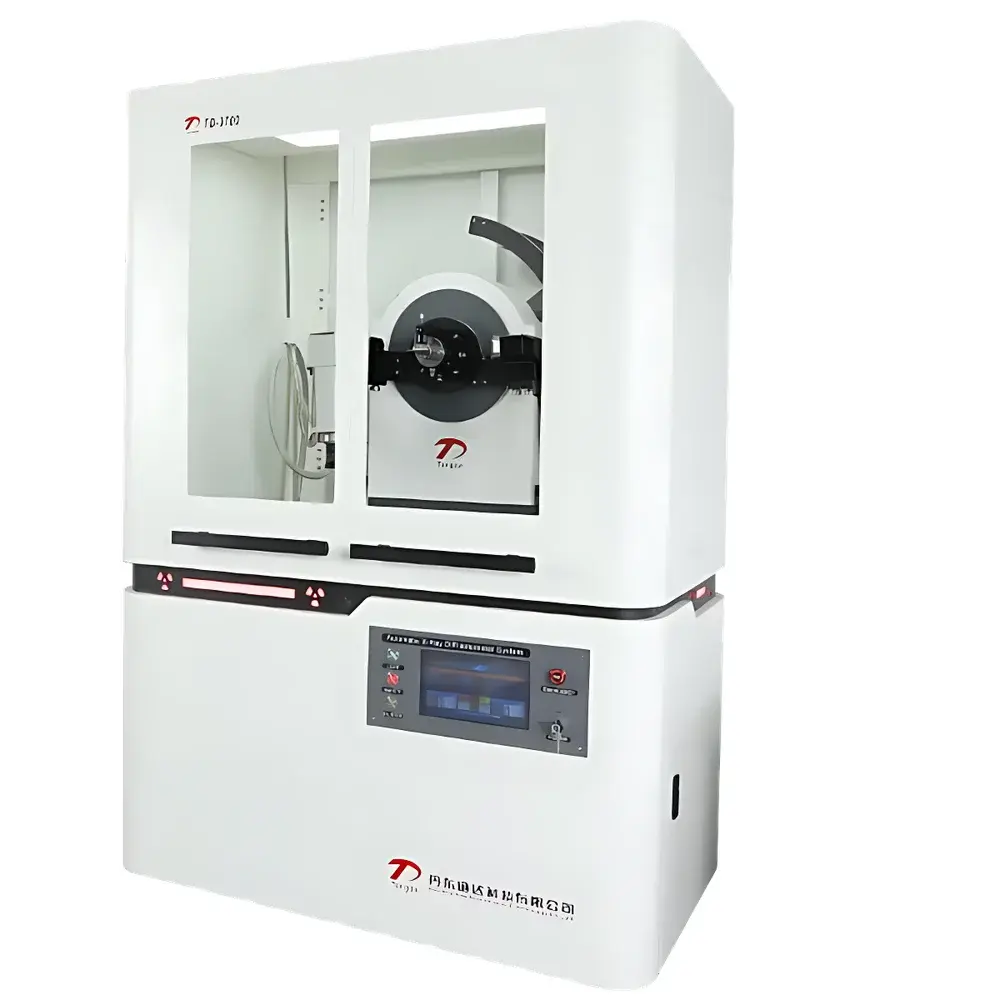
Tongda TD-2D X-ray Diffractometer
| Brand | Tongda |
|---|---|
| Origin | Liaoning, China |
| Manufacturer Type | Authorized Distributor |
| Product Category | Domestic |
| Model | TD-2D |
| Price Range | USD 45,000 – 87,000 |
| Instrument Type | Powder X-ray Diffractometer |
| Configuration | Portable |
| X-ray Source Power | 3 kW |
| Angular Accuracy | ±0.0001° (2θ) |
| Angular Resolution | 0.01° (2θ) |
| Detector | Pilatus Hybrid Pixel Array Detector (HPAD), 2D area detector with real-time frame readout |
Overview
The Tongda TD-2D X-ray Diffractometer is a portable, laboratory-grade powder X-ray diffractometer engineered for high-fidelity two-dimensional diffraction data acquisition. It operates on the principle of Bragg diffraction using monochromatic Cu Kα radiation (λ = 1.5418 Å), enabling precise determination of crystalline phase composition, lattice parameters, crystallite size (via Scherrer analysis), microstrain (via Williamson–Hall or Warren–Averbach methods), and preferred orientation (texture). Unlike conventional 1D scanning systems, the TD-2D integrates a Pilatus hybrid pixel array detector (HPAD) capable of simultaneous capture of full Debye–Scherrer cones across a wide 2θ range—eliminating sequential angular scanning and significantly reducing measurement time while preserving spatial intensity distribution. Its compact, vibration-damped mechanical architecture supports deployment in shared labs, quality control environments, and field-based materials characterization workflows where mobility and rapid turnaround are critical.
Key Features
- Portable design with integrated X-ray generator (3 kW sealed-tube source), collimation optics, and goniometric stage—fully self-contained without external cooling or high-voltage cabinets.
- High-precision θ–2θ goniometer with angular accuracy of ±0.0001° and resolution of 0.01°, calibrated traceably to NIST SRM standards.
- Pilatus HPAD detector (e.g., Pilatus3 R 2M or equivalent) offering single-photon counting, zero readout noise, high dynamic range (>20-bit equivalent), and sub-millisecond frame rates for time-resolved or in-situ experiments.
- Adjustable X-ray penetration depth via variable incidence angle (Grazing Incidence XRD mode) and beam energy selection—enabling depth-profiling of thin films, coatings, and multilayer structures.
- Real-time 2D pattern visualization and on-board geometric calibration tools (including ring centering, distortion correction, and polarization correction) compliant with ISO 21369:2020 (X-ray diffraction — Calibration of 2D detectors).
- Modular sample stage accommodating flat plates, powders in capillaries or holders, fibers, flexible substrates, and small-volume liquid cells.
Sample Compatibility & Compliance
The TD-2D accommodates diverse solid-state samples including polycrystalline powders, sintered ceramics, polymer films, metal foils, electrospun nanofibers, battery electrode coatings, and geological specimens. It supports standard ASTM E975 (Standard Practice for X-ray Diffraction Crystallographic Analysis of Coatings), ISO 21369 (2D detector calibration), and ISO 17873 (quantitative phase analysis by Rietveld refinement). Data acquisition and processing workflows adhere to GLP principles, with audit-trail-enabled software supporting 21 CFR Part 11-compliant electronic signatures when deployed with validated IT infrastructure. All safety interlocks conform to IEC 61010-1 and GB/T 18801 (Chinese national standard for X-ray equipment safety).
Software & Data Management
The system ships with Tongda XRD Studio—a cross-platform application built on Qt and Python (PyFAI, silx, GSAS-II integration). It provides real-time 2D-to-1D conversion (azimuthal integration), background subtraction, peak indexing (using ICDD PDF-4+ database), Rietveld full-pattern refinement (via GSAS-II backend), texture analysis (pole figure and inverse pole figure generation), and crystallinity mapping. Raw .cbf and .tif image files are stored with embedded metadata (sample ID, instrument parameters, timestamp, operator ID). Export formats include CIF, XYE, CSV, and HDF5—ensuring compatibility with third-party platforms such as TOPAS, FullProf, and MATLAB. Data integrity is enforced through SHA-256 checksums and optional network-attached storage (NAS) synchronization.
Applications
- Quantitative phase analysis of pharmaceutical intermediates and excipients under GMP-regulated QC protocols.
- In-situ thermal or mechanical stress studies of battery cathode materials during cycling (using custom heating/strain stages).
- Crystallographic texture evaluation of rolled aluminum alloys and additive-manufactured Ti-6Al-4V components.
- Crystallinity grading of polyethylene terephthalate (PET) films used in flexible electronics packaging.
- Residual stress mapping in laser-welded joints via sin²ψ method using azimuthally resolved peak shifts.
- Thin-film thickness and interfacial roughness estimation from specular and off-specular XRD scans.
FAQ
Is the TD-2D suitable for quantitative Rietveld analysis?
Yes—its high-intensity 3 kW source, low-background geometry, and Pilatus detector’s linear response enable robust full-pattern fitting with typical Rwp values below 10% for well-prepared samples.
Can it perform grazing-incidence XRD (GIXRD) on thin films?
Yes—the incident angle is continuously adjustable from 0.1° to 5°, supporting both surface-sensitive GIXRD and bulk-sensitive transmission modes.
What level of technical support and calibration services are provided?
Tongda offers factory-certified annual calibration (traceable to NIST reference materials), remote diagnostics, and on-site application training delivered by ISO/IEC 17025-accredited service engineers.
Does the system comply with FDA requirements for regulated laboratories?
When configured with validated software modules and documented change control procedures, the TD-2D meets the data integrity and audit trail requirements of 21 CFR Part 11 for use in pharmaceutical and medical device QA/QC.
Are third-party detector upgrades supported?
Yes—the detector interface follows the Dectris API standard; compatible replacements include EIGER2 R series and other PILATUS-compatible HPADs meeting the 200 mm × 200 mm active area and <100 µs frame time specifications.
Related Products






