
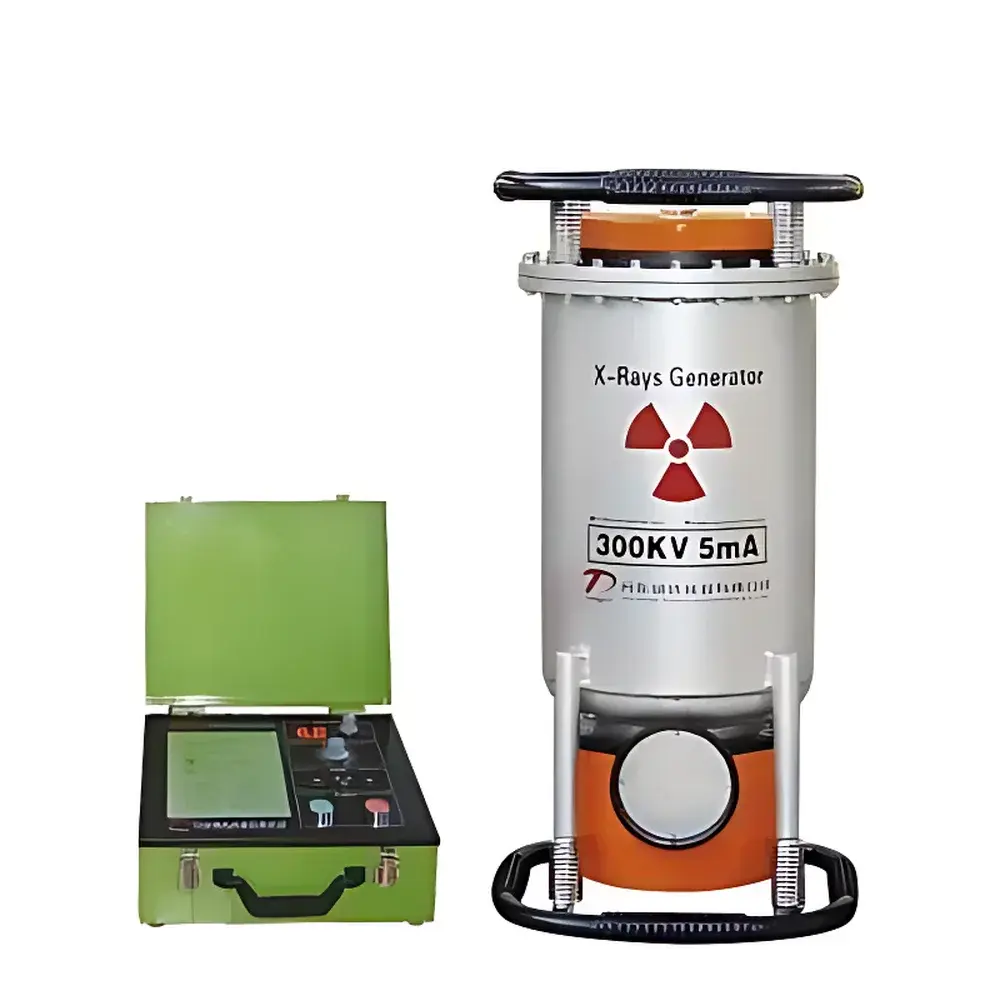
Tongda XXG-1605/2005/2505/3005/3505 Portable Ceramic-Structured X-ray Radiographic Inspection Systems
| Brand | Tongda |
|---|---|
| Origin | Liaoning, China |
| Manufacturer Type | Authorized Distributor |
| Country of Origin | China |
| Models | XXG-1605, XXG-2005, XXG-2505, XXG-3005, XXG-3505 |
| Price Range | USD 1,400 – 7,000 (FOB) |
| X-ray Tube Type | Corrugated Ceramic Insulated Tube |
| Max. Output Voltage | 80–350 kV |
| Input Power | 1.5–3.5 kW |
| Focal Spot Size | 1.2×1.2 to 2.5×2.5 mm |
| Radiation Beam Angle | 40° ±5° |
| Steel Penetration (A3) | 19–60 mm |
| Generator Weight | 14.5–38 kg |
| Generator Dimensions (L×W×H) | 225×225×550 to 345×345×670 mm |
Overview
The Tongda XXG-series portable X-ray radiographic inspection systems are engineered for high-reliability field-based non-destructive testing (NDT) of metallic welds, castings, pipelines, pressure vessels, and structural components. These systems utilize a corrugated ceramic-insulated X-ray tube — a design that integrates high-voltage insulation, compact geometry, and enhanced mechanical robustness into a single monolithic structure. Unlike conventional glass-envelope or metal-ceramic hybrid tubes, the corrugated ceramic architecture delivers superior thermal dissipation, reduced micro-arc risk under vibration, and extended operational lifetime (>5,000 h typical at rated load). The generator employs constant-potential high-frequency inverter technology to ensure stable kV/mA output with ≤1% ripple, enabling consistent image contrast and quantitative density resolution across varying ambient conditions. Designed for compliance with ISO 5579:2019 (Radiographic testing — General principles for radiographic examination of metallic materials) and ASTM E94/E1742 (Standard Guide for Radiographic Examination), these units support both film-based and digital detector array (DDA) workflows.
Key Features
- Corrugated ceramic X-ray tube: Enables higher voltage stability (up to 350 kV), lower focal spot drift, and improved shock/vibration resistance — critical for mobile and offshore NDT applications.
- Modular lightweight generator design: Weighing from 14.5 kg (XXG-1605) to 38 kg (XXG-3505), each model features an integrated high-frequency inverter, oil-free cooling, and IP54-rated enclosure for dust/moisture resistance.
- Precision focal spot control: Five standard models offer calibrated focal sizes (1.2×1.2 mm to 2.5×2.5 mm) optimized for spatial resolution vs. penetration trade-offs per ASTM E2737.
- Fixed 40° ±5° conical beam geometry: Ensures repeatable geometric unsharpness (Ug) and uniform exposure field coverage without collimator reconfiguration.
- Real-time kV/mA monitoring with analog + digital interface: Supports external dose logging and integration with radiographic quality management software compliant with ISO 9001 and ASNT SNT-TC-1A documentation requirements.
Sample Compatibility & Compliance
These systems are validated for radiographic inspection of ferrous and non-ferrous alloys up to 60 mm A3 steel equivalent thickness. Compatible with industrial film (ASTM E1815 Class I–III), computed radiography (CR) phosphor plates (ISO 17636-2:2022), and flat-panel detectors (IEC 62495). All models meet electromagnetic compatibility (EMC) requirements per IEC 61000-6-3/6-4 and carry CE marking under the EU Machinery Directive 2006/42/EC. Radiation safety conforms to IEC 61331-1 (Protective devices against diagnostic medical X-radiation) and national regulatory limits for portable X-ray emitters (e.g., China’s GBZ 130-2020, US NRC 10 CFR Part 20). Optional lead-lined carrying cases and remote trigger cables facilitate ALARA-compliant operation.
Software & Data Management
While the base hardware operates as a standalone radiographic source, Tongda provides optional PC-based acquisition software (Tongda RIS v3.2) supporting DICOM SR export, exposure parameter logging, and audit trail generation aligned with FDA 21 CFR Part 11 and ISO/IEC 17025 traceability requirements. The system records timestamped kV, mA, exposure time, tube temperature, and cumulative tube-on hours — all exportable via USB or RS-232 to laboratory information management systems (LIMS). Firmware updates maintain compatibility with evolving DDA manufacturers’ SDKs (e.g., Varex, Teledyne DALSA, Canon).
Applications
- In-service pipeline girth weld inspection in oil & gas transmission corridors.
- Field verification of aerospace component castings and turbine blade root attachments.
- Quality assurance of railway axle and bogie frame welds during maintenance depots.
- Pre-commissioning radiography of offshore platform structural nodes under ISO 19901-6.
- Educational use in NDT training centers requiring portable, low-infrastructure X-ray sources compliant with EN 473/ISO 9712 Level II syllabi.
FAQ
What radiation safety certifications do these units hold?
All XXG-series generators comply with IEC 61331-1 for primary barrier performance and are type-tested per national regulations including GBZ 130-2020 (China), ARPANSA RPS C-1 (Australia), and carry EU CE marking for portable X-ray equipment.
Can the XXG-3505 be used with digital radiography detectors?
Yes — its stable 350 kV output and low ripple (<0.8%) meet the dynamic range and linearity requirements of IEC 62495-certified flat-panel detectors; recommended minimum SID is 600 mm for optimal DQE.
Is tube replacement possible in the field?
The corrugated ceramic tube is sealed and non-serviceable; however, full generator exchange is supported under Tongda’s 12-month limited warranty and extended service contracts include certified recalibration and source strength verification.
How does the corrugated ceramic design improve reliability over standard metal-ceramic tubes?
The continuous corrugated profile eliminates discrete brazed joints, reducing thermal stress concentration points and mitigating microcrack propagation under cyclic thermal loading and mechanical shock — validated per MIL-STD-810G Method 514.6 vibration profiles.
Are custom beam filtration options available?
Yes — optional 0.5–2.0 mm Cu or 1.0–3.0 mm Al filters can be installed upstream of the port to tailor HVL and reduce scatter for high-contrast weld evaluation per ISO 17636-1 Annex B.



