
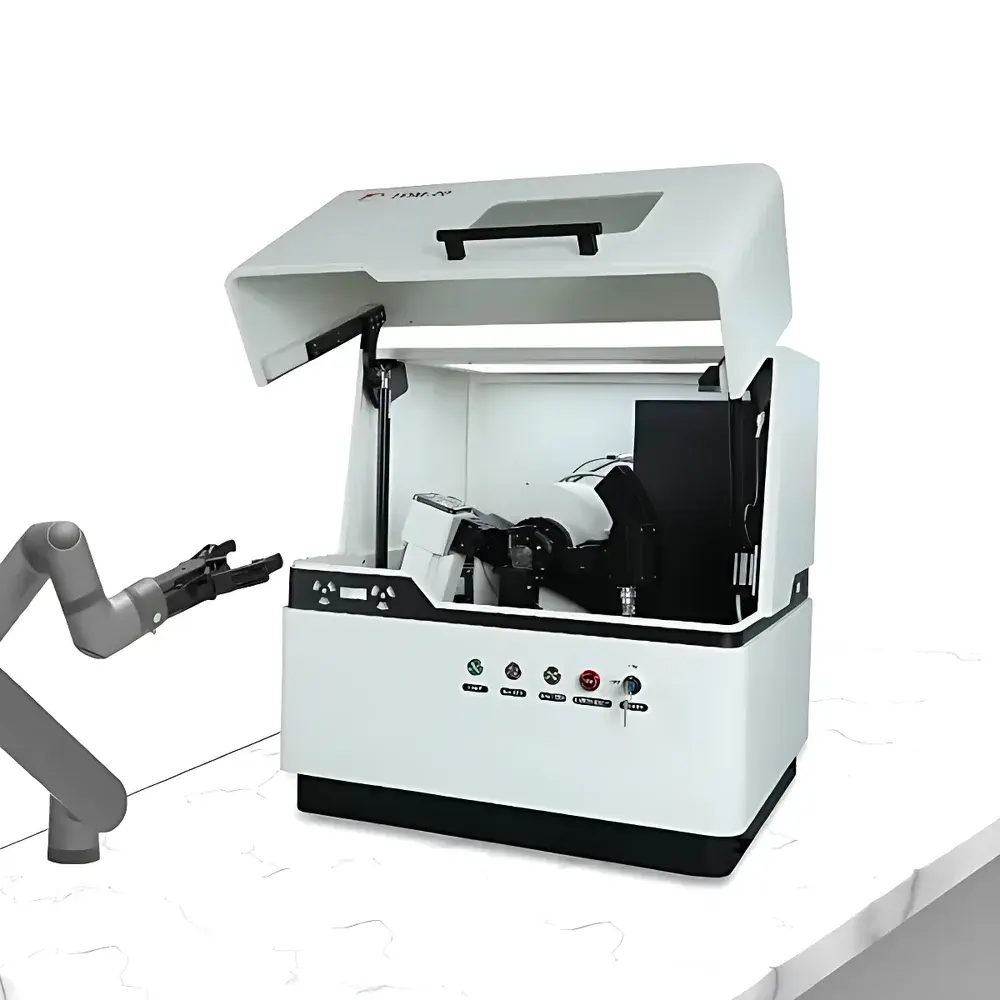
Tongda AI-Powered Fully Automated X-ray Diffractometer
| Brand | Tongda |
|---|---|
| Origin | Liaoning, China |
| Manufacturer Type | Authorized Distributor |
| Product Category | Domestic |
| Model | AI Fully Automated X-ray Diffractometer |
| Price Range | USD 45,000 – 87,000 (FOB) |
| Instrument Type | Powder X-ray Diffractometer (PXRD) |
| Configuration | Benchtop Portable System |
| Maximum Anode Power | 3 kW |
| Angular Accuracy | ±0.0001° (2θ) |
| Angular Resolution | 0.01° (2θ) |
| Automation Level | Integrated Robotic Sample Handler with AI-Driven Acquisition & Analysis Workflow |
Overview
The Tongda AI-Powered Fully Automated X-ray Diffractometer is a benchtop powder X-ray diffractometer (PXRD) engineered for high-throughput, reproducible phase identification, quantitative analysis, and crystallinity assessment in research laboratories, quality control environments, and materials development centers. It operates on Bragg’s law-based X-ray diffraction principles, utilizing Cu Kα radiation (λ = 1.5418 Å) generated by a sealed-tube X-ray source. The system integrates a precision goniometer with θ–θ geometry, enabling accurate 2θ scanning across the standard range of 5°–90° (extendable to 120° upon configuration). Its core innovation lies in the seamless fusion of robotic sample handling—featuring a multi-position auto-loader with positional repeatability < ±5 µm—and embedded artificial intelligence algorithms that optimize scan parameters (step size, counting time, scan speed) in real time based on preliminary intensity feedback and prior spectral knowledge. This architecture significantly reduces operator dependency while maintaining strict adherence to ISO 17873:2022 (XRD data acquisition protocols) and ASTM E975 (standard practice for X-ray diffraction measurements).
Key Features
- AI-optimized acquisition workflow: Automatically selects optimal scan parameters—including step width, dwell time per step, and dynamic range adjustment—based on real-time signal-to-noise evaluation and historical database matching.
- Fully integrated robotic sample handler: Supports up to 36 standard 25 mm or 13 mm diameter sample holders; accommodates custom trays for irregular or encapsulated samples (e.g., capillary, transmission, or thin-film mounts).
- Benchtop portable design: Compact footprint (< 0.8 m²), modular chassis with tool-less access panels, and integrated vibration-damping feet enable deployment in shared lab spaces or mobile analytical units without dedicated shielding rooms.
- Remote operation capability: Native support for iOS/Android mobile applications and web-based dashboard (HTTPS-secured); enables instrument status monitoring, job queue management, and emergency shutdown via authenticated cloud interface.
- Interlocked safety architecture: Motorized shutter, door position sensors, and real-time X-ray emission verification comply with IEC 61010-1 and GB/T 18801-2015 standards; all interlocks log timestamps and event codes for GLP/GMP audit trails.
- Modular detector options: Compatible with scintillation counters (for routine phase ID) and optional silicon strip detectors (SSD) delivering up to 10× faster data collection at equivalent resolution.
Sample Compatibility & Compliance
The system accepts powdered, pressed pellet, and thin-film specimens conforming to ISO 13126-2 (powder preparation) and ASTM E1361 (sample mounting guidelines). It supports ambient, heated (up to 1000°C with optional furnace stage), and humidity-controlled stages (5–95% RH, ±2% accuracy). All firmware and software modules are validated per FDA 21 CFR Part 11 requirements, including electronic signature enforcement, audit trail generation (user actions, parameter changes, data exports), and role-based access control (RBAC). Certificate of Conformance (CoC) and Factory Acceptance Test (FAT) reports are provided with each unit shipment.
Software & Data Management
Powered by Tongda XRD Suite v4.2, the platform delivers full-stack data processing—from raw intensity vs. 2θ conversion to Rietveld refinement (via integrated TOPAS engine), PDF-4+ database searching (ICDD licensed), and crystallite size/strain analysis (Williamson-Hall & Scherrer methods). Data export formats include CIF, XYE, CSV, and Bruker RAW-compatible binary. All processing workflows are scriptable using Python API (PyTongdaSDK), supporting integration into LIMS (e.g., LabVantage, Thermo Fisher SampleManager) and automated reporting pipelines. Raw and processed datasets are stored in AES-256 encrypted SQLite repositories with automatic daily backups to network-attached storage (NAS) or S3-compatible cloud endpoints.
Applications
- Pharmaceutical solid-state characterization: Polymorph screening, hydrate/solvate identification, and stability-indicating assays per ICH Q5A and USP .
- Advanced battery material R&D: Cathode/anode phase evolution tracking during cycling simulations and thermal abuse testing.
- Geological and metallurgical QC: Rapid mineralogical quantification in ores, slags, and corrosion products using reference intensity ratio (RIR) methods.
- Nanomaterials analysis: Crystallite size distribution modeling and lattice strain mapping in catalysts and quantum dot precursors.
- Academic teaching labs: Preconfigured method templates for undergraduate XRD labs aligned with ACS and RSC curriculum standards.
FAQ
Does the system meet international regulatory requirements for GMP-compliant environments?
Yes—the instrument includes 21 CFR Part 11–compliant software, full audit trail logging, electronic signatures, and IQ/OQ documentation packages available upon request.
Can the robotic sample handler accommodate non-standard sample geometries?
Yes—custom trays and fixture adapters (e.g., for capillaries, wire samples, or microfluidic chips) are supported under Tongda’s Engineering Services Program.
What maintenance intervals are recommended for the X-ray tube and goniometer?
The sealed-tube anode requires no scheduled replacement within its 2,000-hour rated lifetime; goniometer calibration is verified automatically during startup and recommended annually via certified service technician.
Is third-party software integration supported?
Yes—API access, OPC UA connectivity, and SCADA-ready Modbus TCP support enable integration with MES, ERP, and industrial automation platforms.
How is thermal management handled during extended high-power operation?
A dual-stage forced-air + thermoelectric cooling system maintains anode temperature stability within ±0.5°C over continuous 3 kW operation, ensuring long-term angular accuracy and detector linearity.
Related Products






