
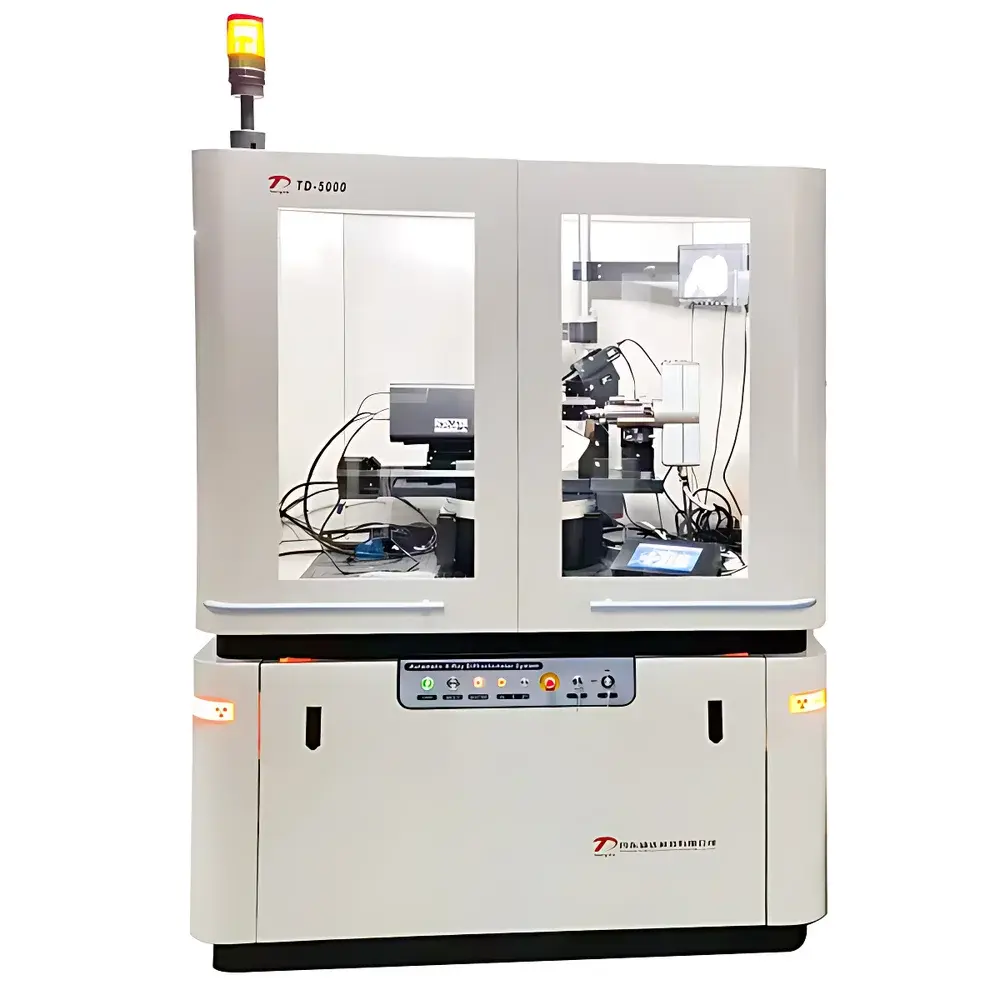
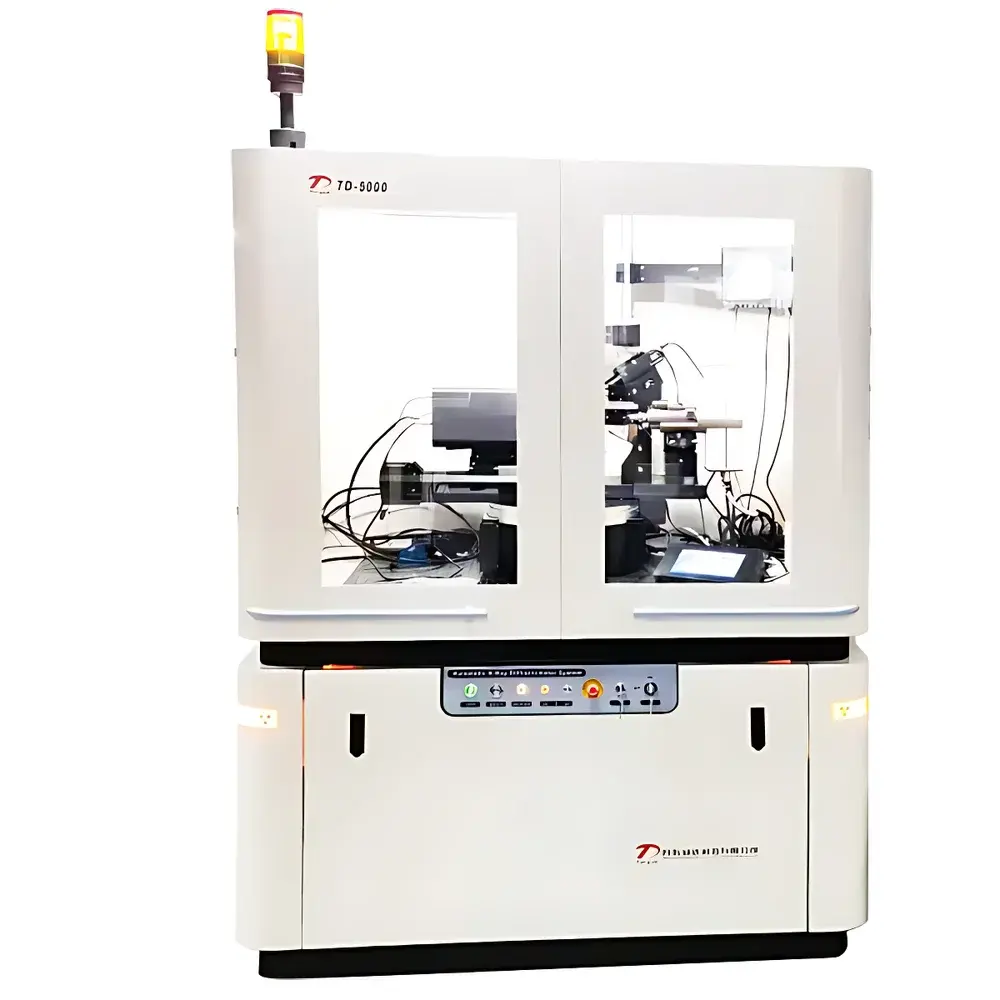
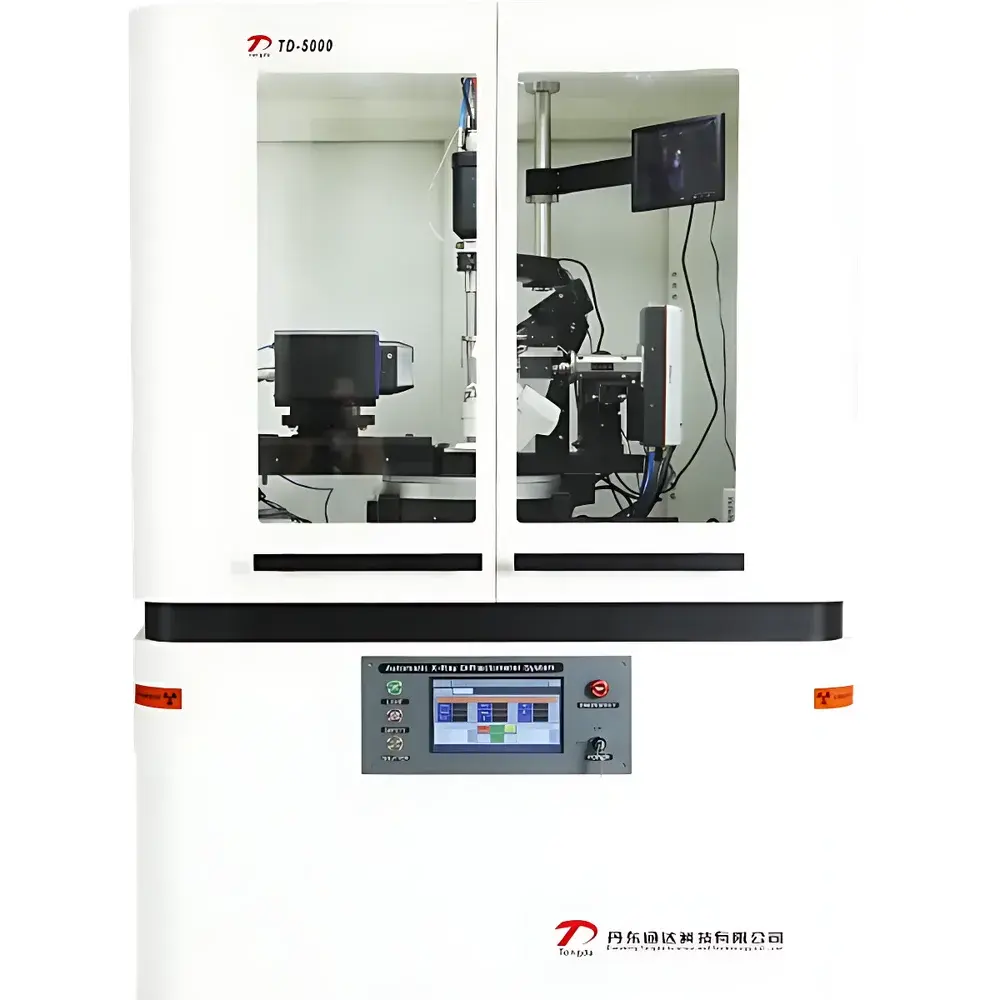
TD-5000 X-ray Single-Crystal Diffractometer by Tongda
| Brand | Tongda |
|---|---|
| Origin | Liaoning, China |
| Model | TD-5000 |
| Instrument Type | Single-Crystal X-ray Diffractometer |
| Configuration | Floor-Standing |
| X-ray Source Power | 3 kW |
| 2θ Angular Repeatability | 0.0001° |
| Minimum Step Angle | 0.0001° |
| Temperature Control Range | 100 K – 300 K |
| Temperature Stability | ±0.3 K |
| Detector | PILATUS Hybrid Pixel Detector |
| Goniometer Architecture | Four-Circle Concentric Design |
| Data Acquisition Interface | Touchscreen-Controlled PLC System |
Overview
The TD-5000 X-ray Single-Crystal Diffractometer is a floor-standing, laboratory-scale crystallographic instrument engineered for high-precision determination of three-dimensional atomic and electronic structures in crystalline solids. Based on Bragg’s law and single-crystal diffraction geometry, the system employs monochromatic X-ray radiation—generated from Mo or Cu anode sources—to probe periodic electron density distributions within unit cells. Its core measurement principle relies on precise angular positioning of the crystal relative to incident and diffracted beams, enabling full data collection over reciprocal space via ω, 2θ, φ, and χ rotations. Designed to meet international standards for structural characterization in academic and industrial research settings, the TD-5000 supports quantitative analysis of bond lengths, bond angles, torsion angles, absolute configuration, thermal displacement parameters (ADPs), and intermolecular interactions—including hydrogen bonding and weak noncovalent contacts. As a domestically developed platform supported by China’s National Major Scientific Instrument Development Program, it addresses long-standing supply-chain constraints in advanced crystallography infrastructure.
Key Features
- Four-circle concentric goniometer architecture ensuring invariant diffractometer center during all rotational motions—critical for data completeness, intensity reproducibility, and accurate absorption correction.
- High-stability 3 kW sealed-tube X-ray generator with selectable Mo/Cu anodes and optional multilayer focusing optics (divergence: 0.5–1 mrad; focal spot size: 0.5–2 mm).
- PILATUS hybrid pixel detector integrating single-photon counting and noise-free readout—eliminating readout noise and dark current artifacts while delivering high dynamic range and point-spread function fidelity.
- Integrated cryogenic stage with active temperature control from 100 K to 300 K (stability ±0.3 K); liquid nitrogen consumption: 1.1–2 L/h.
- PLC-based automation with touchscreen HMI for real-time monitoring of vacuum status, tube power, detector health, goniometer position, and safety interlocks.
- Electromechanical lead-shutter interlock system providing dual-layer radiation safety compliance per IEC 61010-1 and GB/T 18871-2002.
Sample Compatibility & Compliance
The TD-5000 accommodates standard capillary- or loop-mounted single crystals ranging from 0.05 mm to 0.5 mm in linear dimension. It supports routine data collection for small-molecule organic/inorganic compounds, metal–organic frameworks (MOFs), coordination polymers, pharmaceutical co-crystals, and quasi-crystalline or incommensurately modulated phases. All mechanical and electrical subsystems conform to ISO 9001 quality management requirements. Radiation shielding design satisfies national regulatory limits for occupational exposure (≤1 µSv/h at 5 cm from housing). Software workflows support audit-trail generation and user-access logging, facilitating alignment with GLP and preclinical regulatory documentation frameworks such as ICH M4 and FDA 21 CFR Part 11 when paired with validated electronic lab notebook (ELN) integration.
Software & Data Management
Acquisition and processing are managed through a modular software suite supporting automated crystal centering, strategy calculation (using BEST algorithm principles), frame integration (with profile-fitting and Lorentz-polarization corrections), scaling, and structure solution (direct methods/SHELXT) and refinement (SHELXL). Raw data are stored in vendor-neutral CBFLIB-compliant binary format (.cbf), with metadata embedded per NeXus/HDF5 conventions. Export options include CIF, SHELX RES/INS, PDB, and mmCIF for deposition to the Cambridge Structural Database (CSD) or Protein Data Bank (PDB). Batch processing pipelines allow parallel refinement of multiple datasets under consistent restraint libraries and weighting schemes—essential for comparative structural studies across homologous series.
Applications
- Structural elucidation of novel synthetic compounds in medicinal chemistry and asymmetric catalysis.
- Determination of absolute stereochemistry in chiral drug candidates without derivatization.
- Quantitative analysis of lattice strain, twinning fractions, and domain orientation in functional materials.
- Thermal ellipsoid modeling and electron-density mapping (via multipole refinement) for charge-density studies.
- Validation of computational chemistry predictions (DFT, QM/MM) against experimental structural benchmarks.
- Supporting patent applications with crystallographically unambiguous structural evidence compliant with WIPO ST.26 and USPTO guidelines.
FAQ
What X-ray source configurations are supported?
The TD-5000 accepts both Mo-Kα (λ = 0.71073 Å) and Cu-Kα (λ = 1.54187 Å) sealed-tube sources, with optional multilayer focusing optics to enhance flux density on microcrystals.
Is remote operation and data monitoring possible?
Yes—the system supports secure SSH-based CLI access and HTTP(S)-enabled status dashboards for real-time diagnostics, provided local network policies permit inbound connections to designated ports.
Does the instrument comply with international crystallographic data deposition standards?
All output files adhere to IUCr-compliant CIF syntax (version 1.1), including mandatory _publ_section_title, _chemical_name_systematic, and _exptl_crystal_density_diffrn fields required for CSD/PDB submission.
Can the TD-5000 perform low-temperature time-resolved experiments?
While not designed for millisecond time resolution, the cryostat enables stable sub-150 K data collection over multi-hour runs, suitable for trapping metastable intermediates and studying phase transitions via sequential cooling ramps.
What maintenance intervals are recommended for the X-ray tube and detector?
X-ray tubes require annual performance verification (output stability, focal spot integrity); PILATUS detectors are maintenance-free but require annual calibration checks using certified reference crystals (e.g., Si SRM 640e).




