
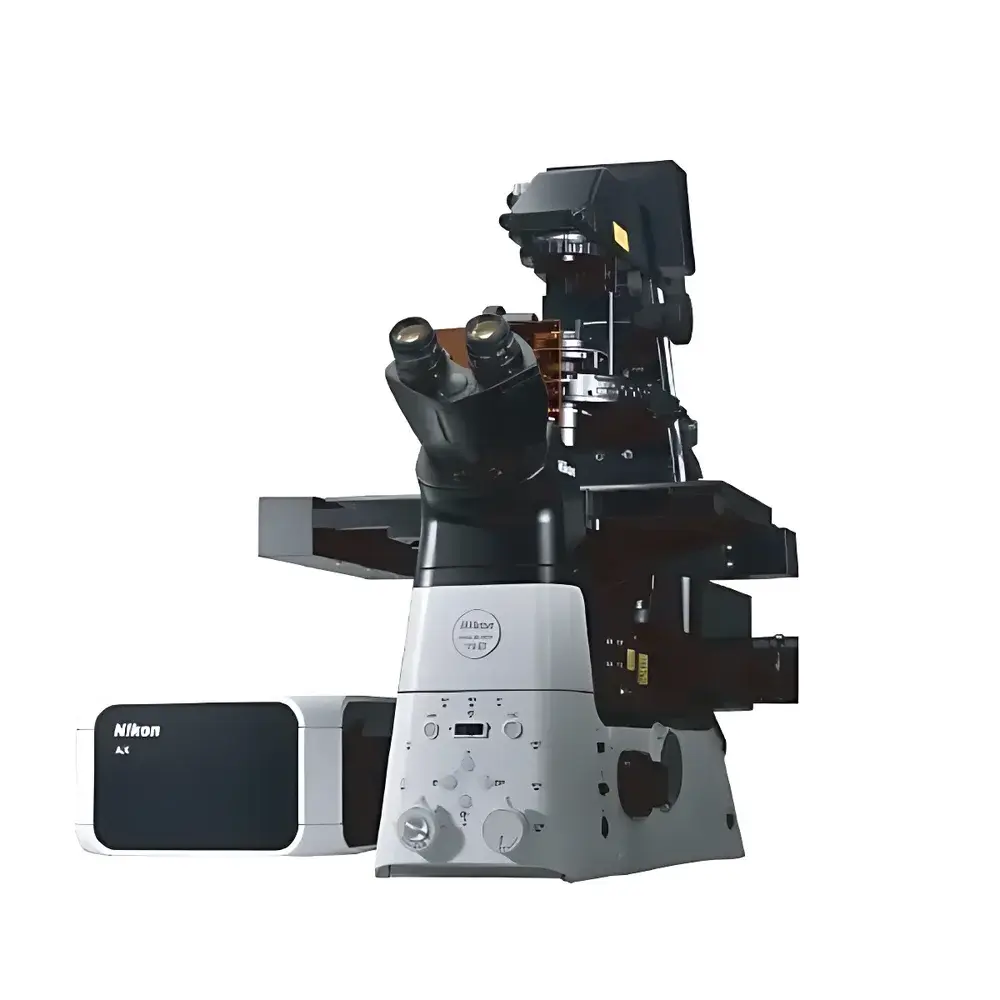
Nikon AX and AXR Laser Scanning Confocal Microscopes
| Brand | Nikon |
|---|---|
| Origin | Japan |
| Model | AX / AXR |
| Type | Upright Laser Scanning Confocal Microscope System |
| Optical Architecture | Dual-galvo scanning with resonant scanner option |
| Detection | GaAsP hybrid detectors (HyD) with spectral unmixing capability |
| Objective Compatibility | Nikon CFI Plan Apo λ series, 10×–100×, oil/water/glycerol immersion |
| Laser Lines | 405 nm, 488 nm, 561 nm, 640 nm (standard), optional UV and IR lines |
| Maximum Imaging Speed | Up to 30 fps at 512 × 512 resolution (resonant mode) |
| Z-resolution | < 0.1 µm (with piezo stage and deconvolution) |
| Software Platform | NIS-Elements AR/CV with AI-powered denoising and 3D/4D reconstruction modules |
Overview
The Nikon AX and AXR are high-performance upright laser scanning confocal microscopes engineered for quantitative, multi-dimensional biological imaging in demanding research environments. Built upon Nikon’s proprietary dual-galvanometer scanning architecture—with optional resonant scanner integration—the AX/AXR systems deliver exceptional spatial resolution, signal-to-noise ratio, and temporal fidelity across live-cell, fixed-tissue, and cleared-sample applications. These platforms operate on the fundamental principle of point illumination and pinhole-confined detection: a focused laser beam scans the specimen point-by-point, while an optically conjugated pinhole rejects out-of-focus fluorescence, enabling optical sectioning with submicron axial resolution. The AXR variant extends this capability with enhanced spectral detection flexibility, supporting simultaneous multi-channel acquisition and linear unmixing of fluorophores with overlapping emission spectra—critical for multiplexed immunofluorescence and FRET-based assays.
Key Features
- Dual-scanning architecture: Independent galvo-based XY scanning paired with high-precision piezoelectric Z-stage for stable, drift-compensated volumetric imaging.
- Hybrid detector technology: GaAsP-based Hybrid Detectors (HyD) provide quantum efficiency >45% across 400–900 nm, with ultra-low noise and extended dynamic range—optimized for low-light conditions such as single-molecule tracking or sparse-labeling experiments.
- Modular laser engine: Standard 4-laser configuration (405/488/561/640 nm) with TTL and analog modulation; field-upgradeable to include 355 nm UV or 785 nm NIR lines for deep-tissue or optogenetic compatibility.
- Intelligent optics control: Motorized filter turrets, dichroic mirrors, and emission filters synchronized with acquisition parameters via NIS-Elements software—enabling fully automated multichannel time-lapse protocols.
- Vibration-damped optical bench: Integrated active air suspension and thermally stabilized housing ensure long-term alignment stability, essential for overnight timelapse or correlative light-electron microscopy (CLEM) workflows.
Sample Compatibility & Compliance
The AX/AXR supports standard glass-bottom dishes (MatTek, WillCo), multi-well plates (96-/384-well), histological slides, and thick-sectioned specimens up to 1 mm in thickness when combined with clearing agents (e.g., CUBIC, iDISCO). Immersion objectives—including water-dipping, silicone-oil, and glycerol-immersion variants—are optimized for refractive index matching across diverse sample preparations. The system complies with IEC 61000-6-3 (EMC emissions) and IEC 60825-1 (laser safety Class 1 when interlocked), and its software architecture supports audit trail logging, electronic signatures, and 21 CFR Part 11 compliance when deployed under validated GLP/GMP conditions—making it suitable for preclinical imaging studies submitted to regulatory agencies.
Software & Data Management
NIS-Elements AR (Advanced Research) serves as the unified acquisition and analysis platform, offering real-time deconvolution, AI-assisted background subtraction (using trained CNN models), and GPU-accelerated 3D rendering. Time-series data is stored in open-format ND2 files with embedded metadata (acquisition time, laser power, PMT gain, objective ID, temperature logs). Batch processing pipelines support automated cell segmentation (via trainable pixel classifiers), colocalization quantification (Pearson’s/Manders’ coefficients), and intensity normalization across sessions. Export options include TIFF stacks, OME-TIFF, and HCS-compatible .ome.zarr for integration with cloud-based image analysis platforms (e.g., QuPath, ilastik, or custom Python workflows using AICSImageIO).
Applications
- Subcellular organelle dynamics: Mitochondrial fission/fusion, lysosomal trafficking, and nuclear envelope remodeling in primary neurons and iPSC-derived cardiomyocytes.
- 3D tissue architecture: High-resolution mapping of vascular networks, immune cell infiltration, and extracellular matrix organization in tumor spheroids and organotypic brain slices.
- Developmental biology: Live imaging of gastrulation, neural tube closure, and somitogenesis in zebrafish and mouse embryo explants.
- Neuroscience: Dendritic spine turnover, synaptic vesicle recycling (pHluorin-based), and calcium wave propagation in acute brain slices.
- Drug discovery: Phenotypic screening of compound libraries using morphometric endpoints (nuclear shape, cytoskeletal integrity, mitochondrial membrane potential).
FAQ
What is the difference between the AX and AXR models?
The AXR includes an additional spectral detection unit with tunable bandpass filtering and linear unmixing algorithms, enabling robust separation of spectrally overlapping fluorophores without sequential scanning—whereas the AX relies on conventional filter-based multichannel detection.
Can the system be integrated with electrophysiology rigs?
Yes—Nikon provides TTL synchronization I/O ports and third-party driver support (e.g., for PatchMaster, pCLAMP) to coordinate imaging acquisition with patch-clamp recordings or optogenetic stimulation pulses.
Is remote operation supported?
NIS-Elements supports secure remote desktop access via RDP or VNC, and scheduled acquisitions can be initiated through REST API endpoints for integration into centralized lab management systems.
Does the system support super-resolution modalities?
While not a dedicated super-resolution platform, the AX/AXR achieves effective lateral resolution down to ~140 nm (with 60×/1.4 NA oil objective and 488 nm excitation) and supports structured illumination microscopy (SIM) via optional hardware add-on kits compatible with Nikon’s Eclipse Ti2-E base.
What service and calibration options are available?
Nikon offers annual preventive maintenance contracts including laser power calibration, detector sensitivity verification, pinhole alignment validation, and optical path throughput measurement—all documented per ISO/IEC 17025 traceable procedures.



