
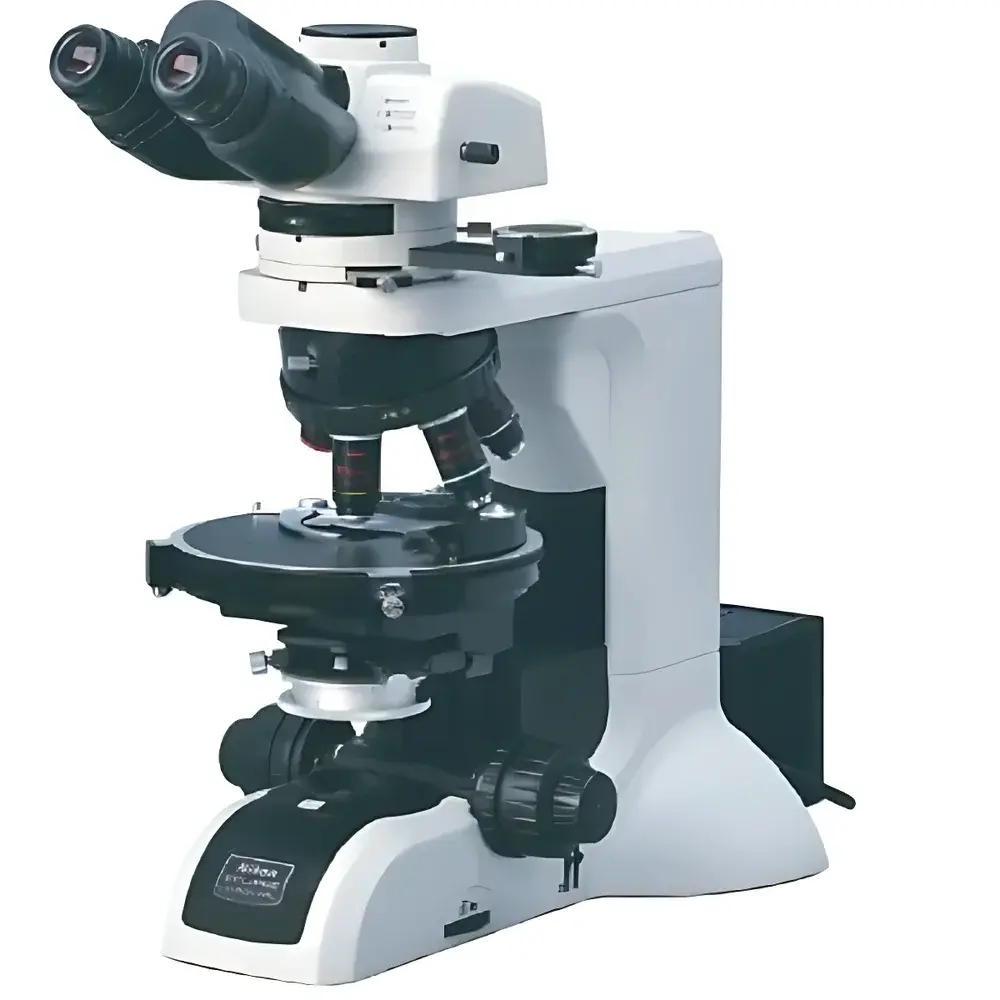
Nikon ECLIPSE LV100N Ci-POL Research-Grade Polarizing Microscope
| Brand | Nikon |
|---|---|
| Origin | Japan |
| Model | ECLIPSE LV100N Ci-POL |
| Optical System | CFI60 Infinity-Corrected |
| Illumination | 6 V / 30 W Halogen Lamp with Built-in Transformer |
| Focus Travel | 30 mm (Coarse: 9.33 mm/rev |
| Fine | 0.1 mm/rev |
| Precision | 1 µm increments) |
| Eyepieces | Widefield 10× (22 mm FOV) |
| Trinocular Tube | P-TT3 for Polarization |
| Binocular Tube | P-TB2 |
| Bertrand Lens | Focusing, Removable, Switchable for Conoscopic Observation |
| Analyzer | 360° Rotatable Polarizer, 0.1° Graduation |
| Objective Turret | 5-Position, Centerable, DIN-Standard |
| Stage | Ball-Bearing Rotating Stage (360°, 1° Increment, Lockable) |
| Mechanical XY Translation (35 × 25 mm, Vernier Scale | 0.1 mm) |
| Condenser | Stress-Free Swing-Out Achromat, NA 0.9 |
| Polarizer | Uncalibrated Linear Polarizer |
| Objectives | CFI Achromat P 4×, 10×, LWD 20×, 40×, 100× Oil |
| Accessories | Insertable λ/4 Plate, Full-Wave Plate, Quartz Wedge, Senarmont Compensator |
| Power Consumption | 38 W |
| Weight | ~14 kg (Standard Binocular Configuration) |
Overview
The Nikon ECLIPSE LV100N Ci-POL is a high-precision research-grade polarizing microscope engineered for quantitative birefringence analysis and anisotropic material characterization in geoscience, materials science, polymer engineering, and pharmaceutical crystallinity studies. Built upon Nikon’s CFI60 infinity-corrected optical platform, it delivers exceptional image fidelity, chromatic correction, and polarization integrity across transmitted and reflected light modes. Its optomechanical architecture is specifically designed to minimize intrinsic stress in optical components—critical for accurate retardation measurement and extinction angle determination. The system supports both orthoscopic (plane-polarized) and conoscopic (interference figure) observation via a dedicated focusing Bertrand lens housed in the intermediate tube, enabling rigorous crystallographic identification and symmetry analysis per ASTM D1711 and ISO 10112 standards.
Key Features
- CFI60 infinity-corrected optical path with strain-free objectives and condenser, ensuring minimal polarization artifacts and high transmission efficiency.
- Dual-mode illumination: Integrated 6 V / 30 W halogen Köhler illuminator with ND4 and ND8 neutral density filters; optional LV-UEPI-N universal epi-illuminator for reflected-light polarization (requires external power supply).
- Precision mechanical stage featuring ball-bearing rotation (360°, 1° incremental locking) and motor-ready mechanical XY translation (35 × 25 mm, 0.1 mm vernier resolution), optimized for orientation-dependent measurements.
- Rotatable analyzer with 0.1° angular graduation and reproducible positioning—essential for quantitative extinction angle mapping and slow/fast axis determination.
- Interchangeable compensation optics: Dedicated slot accommodates standard λ/4 plates, full-wave (530 nm) plates, quartz wedges, and Senarmont compensators for precise retardation quantification up to several wavelengths.
- Modular trinocular or binocular configurations (P-TT3 or P-TB2 tubes) with removable Bertrand lens for seamless switching between orthoscopic and conoscopic imaging without realignment.
Sample Compatibility & Compliance
The LV100N Ci-POL accommodates standard 24 × 50 mm and 40 × 60 mm petrographic slides, thick-sectioned geological specimens (up to 30 mm), and metallurgical samples under epi-illumination. Its stress-free optical train meets ISO 9001 manufacturing tolerances and complies with key regulatory frameworks for analytical instrumentation: ASTM E112 (grain size analysis), ASTM D412 (rubber birefringence), USP (particulate matter in injectables), and ICH Q5E (structural characterization of biopharmaceuticals). All polarization components are certified free of residual birefringence per Nikon’s internal QC protocol (NIS-QC-POL-03), ensuring traceability in GLP-compliant laboratories.
Software & Data Management
While the LV100N Ci-POL operates as a standalone optical instrument, it is fully compatible with Nikon NIS-Elements BR and AR software platforms via digital camera integration (e.g., DS-Fi3, DS-Ri2). Software-supported capabilities include automated extinction angle logging, interference figure capture with calibrated rotation metadata, multi-channel birefringence intensity profiling, and export of annotated TIFF/CSV datasets for statistical analysis. Audit trails, user access control, and electronic signature support align with FDA 21 CFR Part 11 requirements when deployed in regulated environments.
Applications
- Geological thin-section analysis: Identification of mineral species, optic sign determination, and twinning behavior using interference figures and Michel-Lévy color charts.
- Polymer morphology assessment: Quantification of crystallinity, spherulite size distribution, and molecular orientation in extruded films and injection-molded parts.
- Pharmaceutical solid-state characterization: Detection of polymorphic transitions, hydrate formation, and chiral domain segregation during lyophilization or hot-melt extrusion.
- Advanced materials R&D: Evaluation of liquid crystal alignment, ferroelectric domain structure, and stress-induced birefringence in optical coatings and semiconductor wafers.
- Forensic fiber analysis: Discrimination of synthetic fibers by retardation magnitude, dispersion staining, and dispersion staining cross-polarization response.
FAQ
Does the LV100N Ci-POL support motorized stage or focus automation?
Yes—mechanical interfaces comply with Nikon’s Motor Drive Interface (MDI) specification; third-party or Nikon-branded motorized Z-drive (e.g., MS-Z100) and XY stages (e.g., MS-200) can be retrofitted with firmware v3.2+.
Is the Bertrand lens parfocal with all objective magnifications?
Yes—the focusing Bertrand lens is mechanically coupled to the objective turret and maintains parfocality across the full CFI Achromat P and LU Plan Fluor EPI P objective series.
Can the system be validated for ISO/IEC 17025 accreditation?
Yes—Nikon provides factory calibration certificates for analyzer rotation accuracy (±0.05°), stage rotational repeatability (±0.2°), and objective centering tolerance (≤25 µm), supporting method validation documentation.
What is the maximum specimen height clearance under epi-illumination?
With the LV-UEPI-N illuminator and 5× EPI objective, vertical working distance exceeds 28 mm—sufficient for bulk metallographic mounts and encapsulated battery cross-sections.
Are strain-free condenser adjustments documented per ISO 10110-7?
Yes—the swing-out achromat condenser undergoes individual wavefront error testing (λ/10 PV @ 633 nm) and includes serialized certification per ISO 10110-7 Annex B compliance reporting.




