
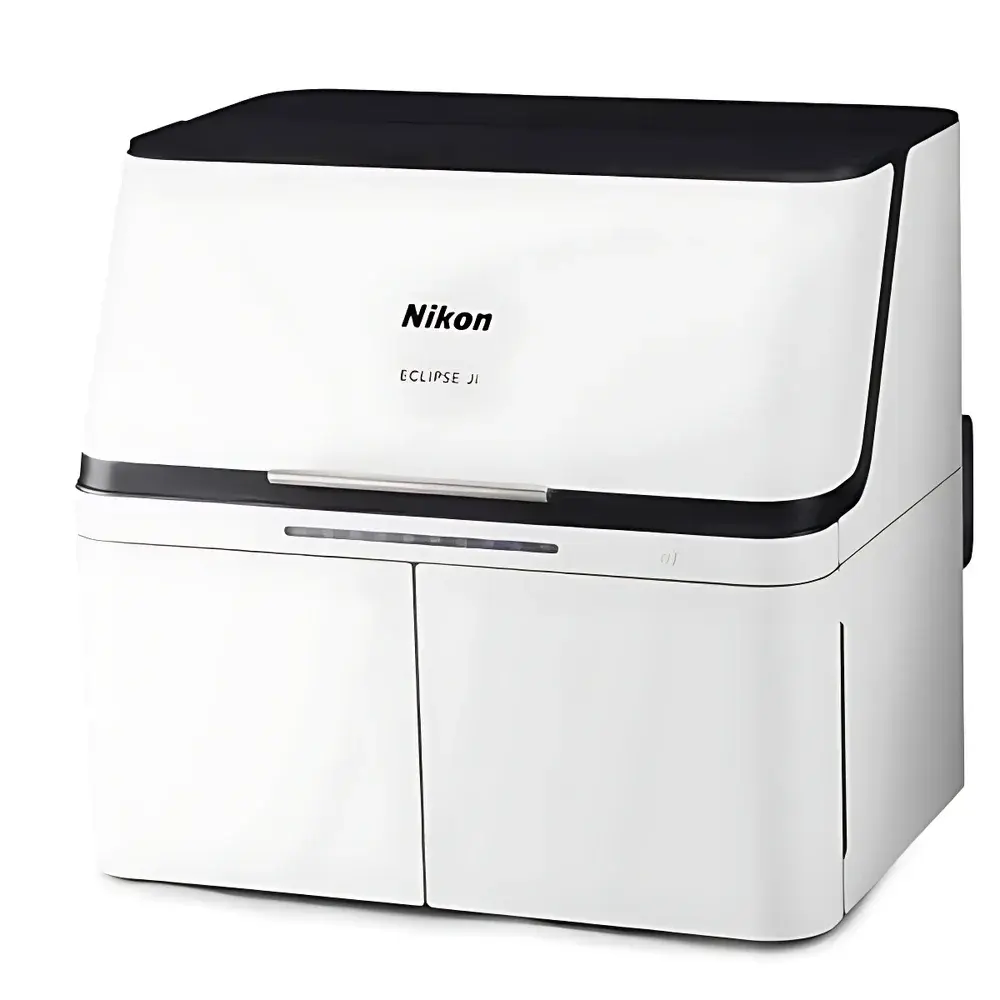
Nikon ECLIPSE Ji Intelligent Imaging System
| Brand | Nikon |
|---|---|
| Origin | Japan |
| Model | ECLIPSE Ji |
| Optical System | CFI Infinity Optics |
| Microscope Type | Inverted Fluorescence Microscope |
| Observation Modes | Brightfield & Epi-Fluorescence |
| Field Number | 25 |
| Camera | 7.8 MP Monochrome CMOS Sensor |
| Bit Depth | 12-bit / 8-bit |
| Max Frame Rate | 18 fps |
| Output Resolution | 2800 × 2800 pixels |
| Focus Drive | Motorized PFS (Perfect Focus System) |
| Focus Travel | ~10 mm |
| Max Focus Speed | 2.5 mm/sec |
| PFS Method | Infrared Projection-Based Focus Maintenance |
| Stage Travel (X/Y) | ±59 mm / ±39.5 mm |
| Max Stage Speed | ~25 mm/sec |
| Objective Turret | 6-position, Motorized |
| Filter Cube Capacity | 6 positions (wide-field compatible) |
| Filter Turret Drive | Motorized |
| Light Source | D-LEDI2 LED Fluorescence Illuminator |
| Illumination | Köhler LED Transmitted Light |
| Interface | USB 3.0 (SuperSpeed), USB-B connector |
| Input Voltage | 100–240 VAC ±10%, 50/60 Hz |
| Power Consumption | 320 W |
| Compliance | UL, CE, RoHS |
Overview
The Nikon ECLIPSE Ji Intelligent Imaging System is an inverted fluorescence microscope engineered for high-fidelity, quantitative live-cell and tissue imaging in academic research, pharmaceutical development, and preclinical assay environments. Built upon Nikon’s CFI (Chromatic Aberration-Free Infinity) optical architecture, the system delivers diffraction-limited resolution across wide-field brightfield and epi-fluorescence modalities. Its core design integrates hardware-level automation with deterministic optical path control—enabling reproducible image acquisition without manual intervention. The system employs a dedicated infrared-based Perfect Focus System (PFS) that continuously monitors and corrects axial drift in real time, eliminating focus drift during time-lapse experiments lasting hours or days. Unlike software-based autofocus solutions, PFS operates independently of sample fluorescence or contrast, ensuring robustness across low-signal or phototoxicity-sensitive applications such as long-term stem cell differentiation or neuronal activity monitoring.
Key Features
- Motorized inverted platform with 6-position objective turret and 6-slot motorized filter cube holder—fully programmable via hardware-triggered sequences.
- Integrated 7.8-megapixel monochrome CMOS camera with dual-gain readout (12-bit linear dynamic range, 8-bit streaming mode) optimized for low-noise fluorescence quantification.
- D-LEDI2 LED illumination system delivering stable, intensity-calibrated excitation across UV–visible spectrum (365–660 nm), with TTL and analog modulation support for synchronized multi-channel acquisition.
- Köhler-illuminated transmitted-light path using high-CRI white LED, enabling precise phase contrast, DIC, and brightfield co-localization without lamp alignment or heat-induced stage drift.
- Precision XYZ motorized stage with ±59 mm (X) and ±39.5 mm (Y) travel range, capable of sub-micron positioning repeatability and programmable multi-site time-lapse routines.
- USB 3.0 SuperSpeed interface ensures lossless, high-throughput image transfer at full frame rate (up to 18 fps at 2800 × 2800 pixels), minimizing acquisition bottlenecks in high-content screening workflows.
Sample Compatibility & Compliance
The ECLIPSE Ji accommodates standard 35 mm, 60 mm, and 100 mm Petri dishes; multi-well plates (6–384-well); chambered coverslips; and custom microfluidic devices up to 30 mm height. Its open-stage design permits integration with environmental control enclosures (temperature, CO₂, humidity) and electrophysiology rigs. The system complies with IEC 61000-6-3 (EMC emission), IEC 61000-6-2 (immunity), and meets essential requirements of the EU Medical Device Regulation (MDR) Annex I for non-invasive laboratory equipment. All electrical components carry UL/cULus and CE markings; power supplies conform to EN 60601-1 safety standards for lab instrumentation. The LED light sources are RoHS-compliant and certified for Class 1 laser safety per IEC 60825-1:2014.
Software & Data Management
The ECLIPSE Ji operates natively with Nikon NIS-Elements AR (Advanced Research) software, supporting GLP/GMP-aligned audit trails, user-defined permission hierarchies, and FDA 21 CFR Part 11-compliant electronic signatures. Acquisition protocols—including Z-stack generation, multi-position time-lapse, spectral unmixing, and FRAP/FLIM trigger sequencing—are saved as executable modules with embedded metadata (objective ID, exposure time, PFS status, LED intensity). Raw data is stored in TIFF or NIS-Elements proprietary ND2 format with embedded calibration tags (pixel size, gain, exposure). Export options include OME-TIFF for FAIR data compliance and direct pipeline integration with ImageJ/Fiji, Python (via ND2 reader libraries), and commercial analysis platforms such as Imaris or Huygens.
Applications
- Long-term live-cell imaging of mitotic progression, organelle dynamics, and protein trafficking under physiological conditions.
- High-content phenotypic screening in 96- and 384-well formats for oncology, neurodegeneration, and infectious disease models.
- Co-culture and organoid imaging requiring multi-channel fluorescence registration with transmitted-light structural context.
- Quantitative immunofluorescence validation in primary human tissue sections mounted on glass slides or membrane inserts.
- Developmental biology studies involving zebrafish, C. elegans, and mouse embryo explants under controlled thermal and gaseous environments.
FAQ
Does the ECLIPSE Ji support objective lenses from other Nikon microscope series?
Yes—CFI60-series objectives (including CFI Plan Apo λ, CFI S Fluor, and CFI Achromat) are fully compatible, provided mechanical and optical back focal length specifications align with the inverted tube lens configuration.
Can the PFS maintain focus during rapid Z-stack acquisition?
Yes—the infrared PFS operates at 100 Hz sampling frequency and adjusts focus between frames without interrupting camera readout or stage motion, enabling drift-free volumetric imaging at speeds up to 10 volumes/second.
Is NIS-Elements software included with the system purchase?
A perpetual license for NIS-Elements AR v5.11 or later is bundled with the ECLIPSE Ji; optional modules (e.g., Deconvolution, Spot Detection, Machine Learning Segmentation) are available as annual subscriptions.
What environmental conditions are required for optimal performance?
Ambient temperature stability within ±2°C/hour and relative humidity between 30–70% non-condensing are recommended; vibration isolation is advised for sub-200 nm resolution work.
How is calibration traceability maintained for quantitative intensity measurements?
Nikon provides factory-calibrated LED intensity profiles and sensor quantum efficiency maps; users may perform routine verification using NIST-traceable neutral density filters and fluorescent microsphere standards (e.g., Chroma QF-100-1).




