
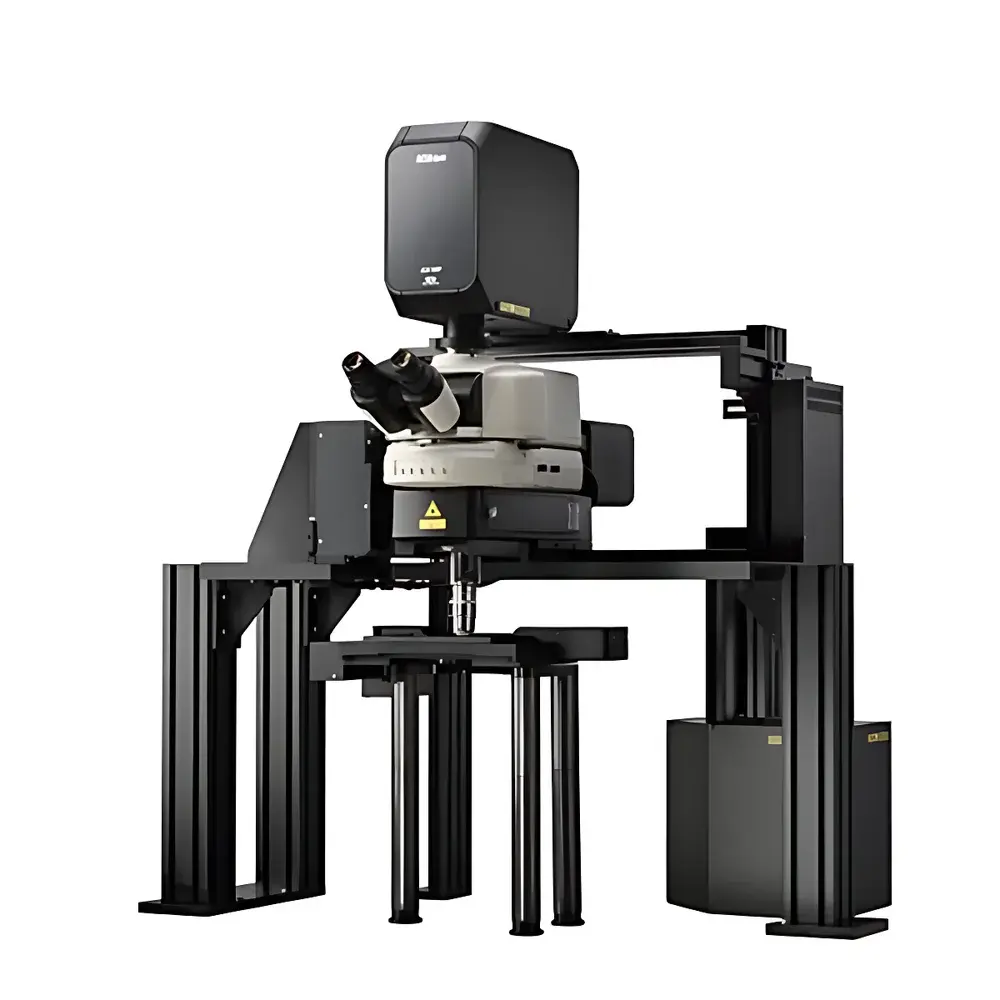
Nikon AX R MP Multiphoton Confocal Microscope
| Brand | Nikon |
|---|---|
| Origin | Japan |
| Model | AX R MP |
| Optical System | Infinity-Corrected |
| Frame Type | AX-FNSP (Upright) / AX-FNGP (Gantry) |
| Focus Unit | AX-FN Motorized Coaxial Coarse/Fine Focus |
| Focus Travel | +13 mm / –2 mm |
| Minimum Step Size | 0.02 µm |
| Focal Plane Height | 400 mm above Vibration-Isolation Table |
| Controller | AX-FNCTL Main Controller + AX-FNHC Hub Controller (manages objective focus, transmitted illumination, joystick, motorized epi-fluorescence filter turret, ergonomic motorized quad-port head, DSC zoom port) |
| Scanning | 2K Resolution Resonant Scanner |
| Imaging Mode | Multiphoton Excitation + Confocal Detection |
Overview
The Nikon AX R MP Multiphoton Confocal Microscope represents a paradigm shift in deep-tissue, high-fidelity live imaging. Engineered for precision intravital microscopy, it integrates multiphoton excitation with synchronized confocal detection to minimize out-of-focus phototoxicity while preserving signal-to-noise ratio at depths exceeding 1 mm in scattering biological specimens. Unlike conventional single-photon confocal systems, the AX R MP utilizes near-infrared pulsed lasers (typically 680–1300 nm) to achieve localized nonlinear excitation—confined to the focal volume—thereby enabling longitudinal observation of dynamic cellular and subcellular processes in intact organs, brain slices, tumor xenografts, and developing embryos. Its optical architecture is built upon Nikon’s CFI Apo LWD series objectives (e.g., 25×/1.10 W, 16×/0.80 W), optimized for dispersion compensation and transmission efficiency across multiphoton wavelengths. The system operates within a rigid, thermally stable mechanical platform designed to maintain optical alignment during extended time-lapse acquisitions.
Key Features
- 2K-resolution resonant scanning galvanometer: Delivers up to 30 fps at full-frame (2048 × 2048) with sub-millisecond pixel dwell time, enabling high-temporal-resolution capture of rapid physiological events such as calcium transients or vesicle trafficking.
- Dual-path detection architecture: Simultaneous collection of multiphoton-emitted photons (via non-descanned detectors) and confocal-reflected signals (via descanned PMTs), supporting spectral unmixing and multimodal contrast generation.
- Expandable sample chamber: Accommodates specimens up to 100 mm in height (AX-FNGP gantry configuration) or 75 mm (AX-FNSP upright), with standardized mounting interfaces for perfusion chambers, incubation enclosures, micromanipulators, and electrophysiology rigs.
- Motorized, vibration-damped focusing system: AX-FN unit provides 15 mm total travel (13 mm upward, 2 mm downward) with 0.02 µm minimum step resolution and programmable auto-retract/re-focus routines—critical for automated Z-stack acquisition and drift correction in multi-hour experiments.
- Integrated controller ecosystem: AX-FNCTL central controller coordinates laser modulation, scan mirror synchronization, detector gating, and hardware triggering; AX-FNHC hub enables plug-and-play expansion of peripheral modules including motorized filter turrets, DSC zoom ports, and ergonomic quad-port observation heads compliant with ISO 9241-5 ergonomics guidelines.
Sample Compatibility & Compliance
The AX R MP supports diverse specimen formats—from cultured primary neurons on glass-bottom dishes to whole-mount cleared tissues and anesthetized rodent preparations. Its open-stage design permits integration with commercial and custom-built environmental control units (37°C, 5% CO₂, humidity regulation) and physiological monitoring systems (ECG, respiration, temperature probes). All optical components comply with ISO 10110 surface quality standards; laser safety architecture conforms to IEC 60825-1:2014 Class 4 requirements with interlocked access doors and real-time power monitoring. For regulated research environments, the system supports audit-trail-enabled acquisition logs compatible with GLP-compliant workflows; metadata embedding (including laser power, dwell time, pinhole size, and objective ID) adheres to MIAME and OME-TIFF specifications.
Software & Data Management
NIS-Elements AR v5.01+ serves as the unified acquisition, analysis, and visualization platform. It features GPU-accelerated deconvolution (Richardson-Lucy algorithm), batch-processing pipelines for large-volume Z/t-series, and native support for HDF5-based data storage to ensure scalability beyond terabyte-scale datasets. Acquisition protocols are exportable as XML-defined SOPs, enabling cross-platform reproducibility. Data security protocols include role-based user permissions, encrypted project archives, and optional integration with laboratory information management systems (LIMS) via RESTful API. For regulatory submissions, NIS-Elements supports 21 CFR Part 11-compliant electronic signatures when deployed with validated server infrastructure.
Applications
- In vivo neuroimaging: High-resolution mapping of dendritic spine dynamics, microglial surveillance, and vascular permeability in mouse cortex using cranial windows.
- Developmental biology: Time-lapse tracking of cell migration, mitotic spindle orientation, and tissue morphogenesis in zebrafish and chick embryos.
- Oncology research: Intravital assessment of immune cell infiltration, tumor angiogenesis, and drug penetration kinetics in orthotopic PDAC or melanoma models.
- Cardiovascular physiology: Functional imaging of calcium handling and mitochondrial membrane potential in Langendorff-perfused hearts.
- 3D tissue engineering: Structural and functional validation of scaffold-integrated organoids via label-free second-harmonic generation (SHG) and fluorescence lifetime imaging (FLIM).
FAQ
What laser sources are compatible with the AX R MP?
The system is engineered for tunable Ti:Sapphire and optical parametric oscillator (OPO) lasers operating between 680 nm and 1300 nm, with optional integrated wavelength multiplexing for simultaneous dual-excitation imaging.
Can the AX R MP perform spectral unmixing without external hardware?
Yes—integrated spectral detectors with 32-channel linear array PMTs and real-time spectral fitting algorithms enable in-software unmixing of fluorophores with overlapping emission profiles, including GFP/mCherry, Cy5/Cy7, and intrinsic NAD(P)H/FAD signals.
Is remote operation supported for core facility deployment?
Full remote acquisition and instrument control are enabled via secure TLS-encrypted web interface (NIS-Web), allowing authorized users to initiate, monitor, and troubleshoot experiments from off-site locations without compromising data integrity or system calibration.
How does the AX R MP handle thermal drift during long-term imaging?
Active thermal stabilization of the optical path (±0.1°C) combined with closed-loop piezo-driven objective positioning ensures axial stability better than ±50 nm over 8-hour acquisitions, verified per ASTM E2915-21 standard test methods for microscope stage drift.
Does Nikon provide application-specific validation packages?
Yes—Nikon offers documented IQ/OQ/PQ protocols for common use cases (e.g., neuronal activity imaging, tumor immunology), including traceable calibration certificates for scanner linearity, detector quantum efficiency, and laser power stability, aligned with ISO/IEC 17025 requirements for accredited laboratories.





