
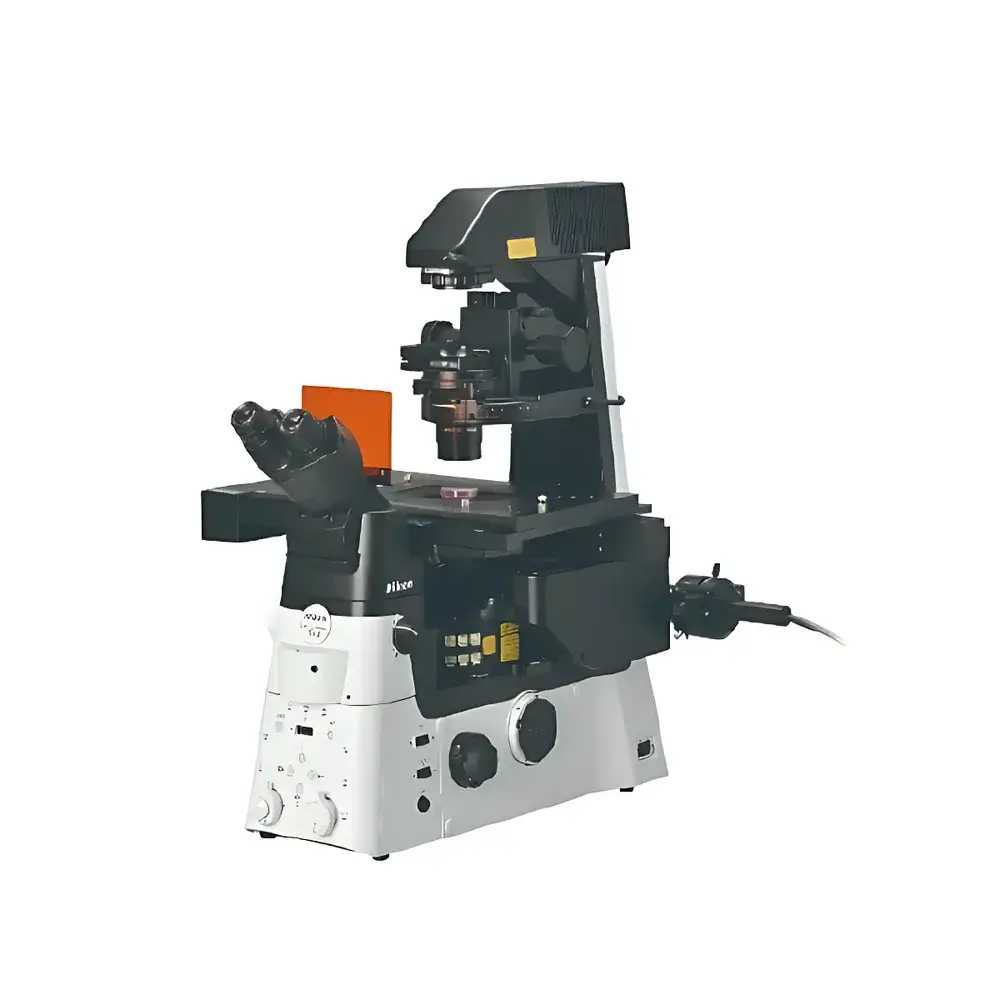
Nikon ECLIPSE Ts2R-FL Inverted Research-Grade Fluorescence Microscope
| Brand | Nikon |
|---|---|
| Origin | Japan |
| Model | ECLIPSE Ts2R-FL |
| Optical System | CFI60 Infinity-Corrected |
| Observation Modes | Brightfield, Phase Contrast (including TIRF-capable phase), DIC, NAMC (Nikon Advanced Modulation Contrast), Relief Contrast, Spindle Observation, Epifluorescence |
| Illumination | High-Intensity White LED Transmitted Light (with Köhler illumination and built-in fly-eye lens) |
| wavelengths | 385, 455, 470, 505, 525, 590, 625 nm) |
| Eyepiece Options | 10×/22, 12.5×/16, 15×/14.5 field number |
| Trinocular Port Split Ratios | 100:0 / 0:100, 100:0 / 20:80, 100:0 / 50:50 |
| Focus Mechanism | Objective nosepiece-driven Z-axis movement (8 mm upward, 3 mm downward travel) |
| coarse focus | 5.0 mm/rev, fine focus: 0.1 mm/rev |
| Nosepiece | 6-position revolver with DIC prism slots |
| Condenser | Multi-position condenser turret (7-slot), compatible with ELWD, LWD, and NAMC condensers |
| Stage | Flat stage (260 × 300 mm) |
| Fluorescence Accessories | Motorized filter cube turret (with noise-reduction mechanism) |
| Dimensions (W×D×H) | 286 × 466 × 542 mm |
| Weight | ~17–18 kg |
| Power Supply | 100–240 V AC, <0.65 A, 30 W max |
Overview
The Nikon ECLIPSE Ts2R-FL is a high-performance inverted research-grade microscope engineered for demanding live-cell imaging, fluorescence observation, and multimodal contrast analysis in academic, pharmaceutical, and biotechnology laboratories. Built upon Nikon’s CFI60 infinity-corrected optical platform, the system delivers exceptional resolution, flatness, and chromatic fidelity across visible and near-UV excitation bands. Its inverted configuration enables stable long-term observation of adherent and suspension cultures in standard labware—including multiwell plates, Petri dishes, and Terasaki plates—without compromising ergonomic access or environmental control. The Ts2R-FL integrates dual LED illumination pathways: a high-stability white LED transmitted-light source with Köhler illumination and integrated fly-eye homogenization optics, and a modular epifluorescence illuminator supporting up to four independently addressable narrowband LEDs (385–625 nm). This architecture eliminates mercury lamp hazards and thermal drift while ensuring precise spectral selection, rapid switching, and quantitative repeatability—critical for time-lapse studies, FRET, and co-localization assays.
Key Features
- CFI60 optical design ensures uniform resolution and minimal aberration across wide-field and high-magnification objectives (up to 100× oil immersion).
- Multi-contrast capability: simultaneous support for brightfield, phase contrast (including high-contrast TIRF-compatible phase), differential interference contrast (DIC), Nikon Advanced Modulation Contrast (NAMC), and relief contrast—each optimized via dedicated sliders and condenser configurations.
- Ergonomic Siedentopf binocular head with 15–45° adjustable inclination and 50–75 mm interpupillary adjustment minimizes operator fatigue during extended sessions.
- Precision Z-drive system features dual-range focusing (coarse: 5.0 mm/rev; fine: 0.1 mm/rev), adjustable coarse-torque control, and a mechanical re-focus mechanism for reproducible return-to-focus after objective changes.
- 6-position objective revolver includes dedicated slots for DIC prisms and accommodates standard CFI Plan Apo, CFI LU, and CFI S Fluor objectives.
- Motorized fluorescence filter cube turret incorporates mechanical noise-dampening to prevent vibration-induced image blur during filter switching—a key requirement for low-signal applications such as single-molecule tracking.
Sample Compatibility & Compliance
The Ts2R-FL is designed for routine use with standard biological sample carriers under controlled environmental conditions. Its large-format flat stage (260 × 300 mm) and modular stage inserts—including C-S-HP35 (35 mm dish), C-S-HLP100 (100 mm dish), C-S-HT (Terasaki plate), and C-S-HU (universal holder)—support seamless transitions between culture formats without realignment. The system complies with IEC 61000-6-3 (EMC emissions) and IEC 61000-6-2 (immunity), and meets CE marking requirements for laboratory equipment. While not certified for ISO 13485 or FDA 21 CFR Part 11 out-of-the-box, its hardware architecture—including deterministic LED timing, stable power delivery, and mechanical filter positioning—provides a foundation for integration into GLP/GMP workflows when paired with validated third-party acquisition software featuring audit trail, electronic signature, and data integrity controls per ALCOA+ principles.
Software & Data Management
The Ts2R-FL operates natively with Nikon NIS-Elements software (v5.0+), which provides full hardware control, multichannel time-lapse acquisition, Z-stack reconstruction, and quantitative intensity profiling. NIS-Elements supports metadata embedding compliant with MIAME and OME-TIFF standards, enabling interoperability with downstream analysis platforms such as ImageJ/Fiji, MATLAB, and Python-based tools (e.g., scikit-image, napari). Optional modules include deconvolution (Wiener and constrained iterative), spectral unmixing, and object-based segmentation with machine learning inference (via NIS-Elements AI plugin framework). All acquired images and logs are stored in vendor-neutral formats with embedded timestamps, exposure parameters, and objective/condenser configuration data—facilitating traceability in regulatory submissions.
Applications
- Long-term live-cell imaging of mammalian, insect, and stem cell cultures under physiological conditions.
- Fluorescent protein expression monitoring (e.g., GFP, mCherry, tdTomato) and calcium dynamics using ratiometric dyes (e.g., Fura-2, Fluo-4).
- Mitotic spindle visualization in dividing cells using tubulin-specific antibodies or tagged constructs.
- High-content screening (HCS) in 96- and 384-well plates with automated stage navigation and multi-position acquisition.
- Phase and DIC imaging of unstained primary neurons, organoids, and spheroids where label-free contrast is essential.
- Developmental biology studies requiring simultaneous brightfield and fluorescence observation of zebrafish embryos or C. elegans larvae.
FAQ
Does the Ts2R-FL support motorized Z-focus or stage automation?
The base configuration includes manual Z-focus and mechanical XY stage. Motorized Z-drive (PFS-compatible) and motorized XY stage (M-MS200) are available as optional upgrades and require NIS-Elements Advanced Edition licensing.
Can the system be integrated with environmental chambers for CO₂ and temperature control?
Yes—the open-stage design and standardized mounting dimensions allow integration with commercially available incubation chambers (e.g., Tokai Hit INU series, OkoLab) via adapter plates. Power and gas line routing paths are预留 in the chassis rear panel.
What fluorescence filter sets are compatible with the LED illuminator?
Nikon offers C-FL filters optimized for each LED wavelength (e.g., C-FL DAPI, C-FL FITC, C-FL TRITC, C-FL Cy5), all featuring hard-coated dichroics and emission filters with OD6 blocking and <2% autofluorescence.
Is the CFI60 objective line compatible with older Nikon inverted microscopes?
CFI60 objectives are mechanically and optically backward-compatible with ECLIPSE Ti-series and TE-series microscopes but not with pre-CFI systems (e.g., Diaphot). Tube lens focal length (200 mm) and parfocal distance (60 mm) are maintained across the CFI60 platform.
How is calibration traceability maintained for quantitative fluorescence measurements?
Nikon provides NIST-traceable neutral density filters and fluorescence reference standards (e.g., TetraSpeck microspheres) for intensity calibration. Users are advised to perform daily gain/offset checks and log calibration events within NIS-Elements’ experiment metadata framework.
Related Products



