
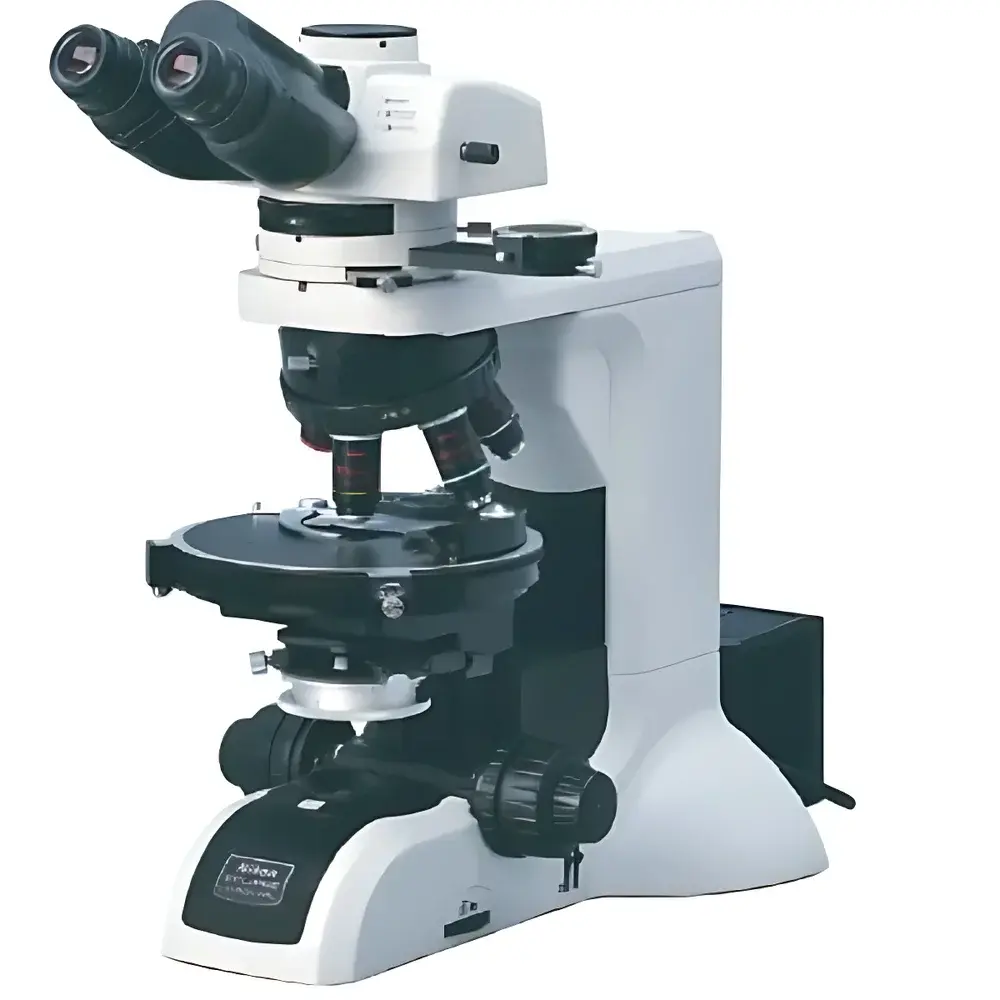
Nikon ECLIPSE LV100N POL Polarizing Microscope
| Brand | Nikon |
|---|---|
| Origin | Japan |
| Model | ECLIPSE LV100N POL |
| Optical System | CFI60 Infinity-Corrected |
| Illumination | 12 V / 50 W Halogen (Transmitted), Optional 12 V / 100 W Halogen (Reflected) |
| Focus Travel | 30 mm |
| Coarse Focus | 14 mm/rev |
| Fine Focus | 0.1 mm/rev, Minimum Graduation: 1 µm |
| Eyepieces | Widefield 10× (FOV 22 mm), Crosshair & Micrometer Scale |
| Observation Tubes | P-TT3 Trinocular, P-TB2 Binocular with Built-in Bertrand Lens (Removable, Centerable) |
| Analyzer | 360° Rotatable, Graduation: 0.1° |
| Polarizer | Fixed in Condenser Base with Scale |
| Condenser | Stress-Free Swing-Out Type, NA 0.9 Achromat |
| Objective Turret | Centerable Five-Position |
| Stage | Precision Circular Rotatable Stage (0–360°, 1° Increment, Click Stops at 45°), Mechanical XY Stage (35 × 25 mm, Vernier 0.1 mm) |
| Compensator Slots | Intermediate Tube for λ/4 Plate, Full-Wave Plate, Quartz Wedge, Senarmont Compensator |
| Reflected Light | LV-UEPI-N Universal Epi-Illuminator |
| Power Consumption | 75 W (1.2 A) |
| Weight | ~17 kg (Standard Trinocular Configuration) |
Overview
The Nikon ECLIPSE LV100N POL is a high-precision, research-grade polarizing microscope engineered for quantitative birefringence analysis and anisotropic material characterization in geological, metallurgical, pharmaceutical, and polymer laboratories. Built upon Nikon’s CFI60 infinity-corrected optical architecture, it delivers exceptional image fidelity, chromatic correction, and polarization purity across the full visible spectrum. The system operates on the fundamental principles of transmitted and reflected polarized light microscopy—utilizing orthogonal linear polarization states (polarizer and analyzer), controlled retardation via compensators, and interference contrast generation to quantify optical path differences in crystalline, fibrous, or stressed amorphous specimens. Its dual-illumination capability supports both conventional transmitted-light petrographic analysis and epi-illuminated observation of opaque or coated samples—making it suitable for ISO 9276-3 particle morphology assessment, ASTM D4124 coal petrography, USP particulate evaluation in injectables, and IEC 60424-2 ferroelectric domain imaging.
Key Features
- CFI60 infinity-corrected optics with strain-free glass components and anti-reflection coatings optimized for polarized light transmission and minimal depolarization.
- Dual-illumination design: Integrated 12 V / 50 W halogen transmitted-light source with selectable NCB11 and ND8 filters; optional 12 V / 100 W reflected-light module (LV-UEPI-N) for epi-fluorescence and brightfield contrast on conductive or polished surfaces.
- Precision mechanical stage: High-stability circular rotatable platform (0–360°, 1° incremental scale, detents every 45°) combined with a 35 × 25 mm mechanical XY stage (0.1 mm vernier resolution) for reproducible angular orientation and positional registration.
- Optimized polarizing optics: Fixed polarizer mounted at condenser base with calibrated angular scale; fully rotatable analyzer (360°, 0.1° graduation) housed in the observation tube; built-in Bertrand lens (P-TB2/P-TT3) for real-time conoscopic observation and interference figure acquisition.
- Modular compensator integration: Dedicated intermediate tube slot accommodates standard λ/4 plates, full-wave (sensitive-tint) plates, quartz wedge, and Senarmont compensators—enabling quantitative retardation measurement from sub-nanometer to micrometer optical path differences.
- Ergonomic focusing system: Coaxial coarse/fine focus with 30 mm total travel, 14 mm/rev coarse motion, and 0.1 mm/rev fine motion calibrated to 1 µm minimum graduation—designed for repeatable focus positioning under GLP-compliant documentation workflows.
Sample Compatibility & Compliance
The LV100N POL accommodates standard 24 × 50 mm and 46 × 27 mm thin sections, metallurgical mounts up to 30 mm in diameter, and polished wafers or coated substrates for stress-induced birefringence mapping. Its stress-free optical train meets ISO 10110-6 requirements for polarization extinction ratio (>10⁴:1), while the CFI Achromat P and LU Plan Fluor EPI P objective series comply with DIN 6123 and JIS B 7152 for numerical aperture accuracy and field flatness. The instrument supports audit-ready operation under GMP environments through manual logbook traceability; optional digital camera integration enables time-stamped image capture compatible with FDA 21 CFR Part 11–compliant LIMS platforms when paired with validated third-party acquisition software.
Software & Data Management
While the LV100N POL is primarily a hardware-optimized analog platform, its modular trinocular port (P-TT3) and standardized C-mount interface support seamless integration with Nikon NIS-Elements or third-party machine vision software (e.g., Olympus cellSens, Media Cybernetics Image-Pro). Digital imaging configurations enable automated rotation-stage synchronization, multi-angle image stacks for birefringence vector mapping, and pixel-level retardation calibration using reference standards traceable to NIST SRM 2085. All hardware controls—including analyzer angle, stage position, and illumination intensity—are manually indexed and documented per ISO/IEC 17025 clause 7.7, ensuring full procedural transparency during method validation.
Applications
- Geological petrography: Identification and orientation analysis of mineral assemblages (e.g., quartz, feldspar, mica) using interference color charts and extinction angle measurements per ASTM D5777.
- Pharmaceutical solid-state characterization: Polymorph differentiation, crystal habit analysis, and residual stress evaluation in lyophilized formulations and tablet coatings.
- Materials science: Quantitative assessment of thermal/mechanical stress distribution in polymers, composites, and semiconductor packaging under load or temperature cycling.
- Forensic fiber analysis: Refractive index matching, birefringence magnitude comparison, and molecular orientation mapping in synthetic textiles per SWGMAT guidelines.
- Metallurgy: Inclusion identification, phase boundary delineation, and grain orientation mapping in etched steel or aluminum alloys using differential interference contrast (DIC) with polarized illumination.
FAQ
Is the LV100N POL compliant with international standards for polarized light microscopy?
Yes—the optical train conforms to ISO 10110-6 for polarization extinction performance, and objective specifications align with DIN 6123 for magnification tolerance and field curvature. Its mechanical repeatability supports adherence to ASTM E112 for grain size analysis.
Can the microscope be used for both transmitted and reflected polarized light observation?
Yes—its dual-illumination architecture supports simultaneous configuration for transmitted-light petrography and epi-illuminated analysis of opaque samples via the LV-UEPI-N universal reflector.
What compensators are supported, and how are they calibrated?
The intermediate tube accepts standard λ/4, full-wave, quartz wedge, and Senarmont compensators. Calibration is performed using certified reference slides (e.g., NIST SRM 2085) and verified via interference fringe counting in conoscopic mode.
Does Nikon provide documentation for IQ/OQ/PQ validation?
Nikon supplies optical alignment certificates and mechanical specification sheets. Full qualification protocols must be developed internally or by qualified third parties in accordance with ISO/IEC 17025 or ASTM E2500.
Is motorized stage or analyzer rotation available as a factory option?
No—motorization is not offered for the LV100N POL platform. It is designed as a manually operated, high-reproducibility instrument optimized for method robustness over automation speed.




