
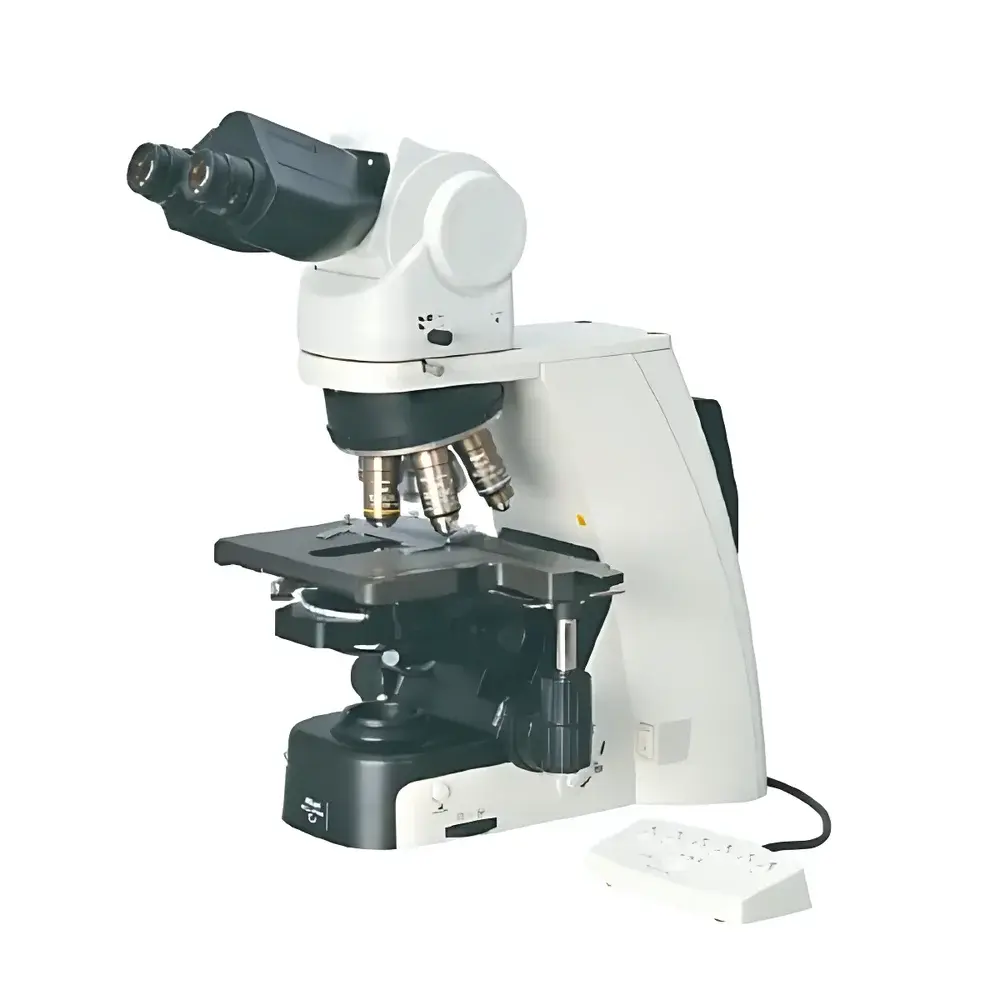
Nikon ECLIPSE Ci-L Upright Clinical and Laboratory Microscope
| Brand | Nikon |
|---|---|
| Origin | Japan |
| Model | ECLIPSE Ci-L |
| Optical System | CFI60 Infinity-Corrected |
| Illumination | High-Brightness White LED (Eco-Friendly) |
| Focus Mechanism | Coaxial Coarse/Fine Adjustment (30 mm Travel, 9.33 mm/rev Coarse, 0.1 mm/rev Fine) |
| Eyepieces | CFI 10× (22 mm FOV), CFI 12.5× (16 mm FOV), CFI 15× (14.5 mm FOV), CFI UW 10× (25 mm FOV) |
| Nosepiece | Motorized 6-Position with Polarizer Slot |
| Stage | 78 × 54 mm X-Y Travel, Ergonomic Adjustable Handle |
| Condenser Options | CI-CE Motorized (NA 0.9 / 0.22), C-AB Abbe (NA 0.9), C-PH Phase Contrast, C-DO Oil Darkfield (NA 1.2–1.43), C-DD Dry Darkfield (NA 0.8–0.95), C-AA Achromat-Apochromat (NA 1.4) |
| Observation Modes | Brightfield, Epi-Fluorescence, Darkfield, Phase Contrast, Simple Polarization, Sensitive Color Polarization |
| Fluorescence Accessories | CI-FL (4-filter cube capacity), D-FL (6-filter cube capacity), ND4/ND8/ND16, Excitation Noise Suppression |
| Epi-Illuminators | C-LEDFI LED, C-HGFI/C-HGFIE Fiber-Coupled Mercury (130 W) |
| Power Consumption | 6–38 W (Config-Dependent) |
| Weight | ~13.4–15.4 kg (Configuration-Dependent) |
Overview
The Nikon ECLIPSE Ci-L is a high-performance upright microscope engineered for routine clinical diagnostics, academic teaching laboratories, and mid-throughput life science research environments. Built upon Nikon’s proven CFI60 infinity-corrected optical platform, the Ci-L delivers consistent image fidelity, chromatic and spherical aberration correction, and scalable modularity without compromising ergonomic usability or system stability. Its core design philosophy centers on operational efficiency in shared-lab settings: the integrated white LED illumination provides flicker-free, color-stable, low-heat illumination with no warm-up time and >20,000-hour lifetime—eliminating mercury lamp replacement cycles and reducing total cost of ownership. The system supports quantitative imaging workflows through standardized port configurations (C-TB, C-TE2, C-TF, C-TT), enabling seamless integration with digital cameras compliant with USB3.0, HDMI, or GigE standards. All mechanical and optical components are manufactured to ISO 9001-certified processes in Nikon’s Japanese facilities, ensuring dimensional repeatability and long-term alignment integrity across instrument lifecycles.
Key Features
- CFI60 infinity-corrected optical architecture optimized for high numerical aperture (NA) objectives and uniform flat-field imaging across FOV22 and FOV25 configurations
- Motorized 6-position nosepiece with built-in polarizer slot and inter-objective switching logic—enabling rapid, repeatable mode transitions during multi-modal imaging sessions
- Ergonomic dual-focus coaxial mechanism with adjustable coarse-torque control and mechanical re-focus memory for consistent Z-axis reproducibility
- Modular condenser system supporting NA-matched illumination for brightfield, phase contrast, darkfield (oil/dry), and polarization—each calibrated to ISO 10934-1 alignment tolerances
- Dual-path epi-fluorescence capability via CI-FL (4-filter) or D-FL (6-filter) turret options, paired with excitation noise suppression optics and precision ND filter actuation (ND4/ND8/ND16)
- Ceramic-coated mechanical stage with 78 × 54 mm travel range, vernier-scaled positioning, and height/torque-adjustable handle—compatible with C-HIC dual-slide carriers and C-CSR series specimen holders
Sample Compatibility & Compliance
The ECLIPSE Ci-L accommodates standard glass slides (26 × 76 mm), Petri dishes (up to 100 mm diameter), multi-well plates (6–96-well), and custom-mounted tissue sections. Its stage clearance (≥35 mm) and objective parfocal distance (45 mm) support inverted-compatible accessories such as heated stage inserts and environmental chambers (optional). All optical paths conform to ISO 8578:2017 (microscope mechanical tube length and parfocality) and JIS B 7151-1:2016 (objective labeling and NA marking). For regulated environments, the system supports audit-trail-capable digital acquisition when paired with Nikon NIS-Elements software configured under FDA 21 CFR Part 11 compliance mode—including electronic signatures, user-level permissions, and immutable metadata logging per image frame.
Software & Data Management
While the Ci-L operates independently as a standalone optical instrument, its standardized C-mount and F-mount ports enable plug-and-play compatibility with third-party imaging platforms including Hamamatsu ORCA-Fusion BT, Photometrics Prime BSI, and Basler ace USB3 cameras. When deployed with Nikon NIS-Elements (v5.0+), users gain access to automated acquisition scripting, multi-channel fluorescence registration, Z-stack reconstruction, and measurement tools validated per ASTM E2858-22 (digital microscopy image analysis). Raw data export supports TIFF (uncompressed), ND2 (Nikon native), and OME-TIFF formats—ensuring FAIR (Findable, Accessible, Interoperable, Reusable) data principles for institutional repositories and ELN integrations.
Applications
The Ci-L serves as a primary workhorse in hematology labs for peripheral blood smear analysis, in pathology departments for frozen-section screening, and in university biology programs for live-cell observation using phase contrast or differential interference contrast (DIC) add-ons. Its stable LED illumination and motorized components reduce operator fatigue during prolonged educational demonstrations or QC inspections. In industrial microbiology, the system supports ISO 8578-compliant colony morphology assessment and filamentous fungal identification using C-DO oil darkfield condensers. The optional C-TE2 ergonomic binocular head—with 10–30° inclination and 40 mm vertical extension—meets EN 61000-3-2 harmonic emission standards and reduces musculoskeletal strain during extended use.
FAQ
Is the ECLIPSE Ci-L compatible with DIC or Hoffman modulation contrast accessories?
Yes—DIC prisms and sliders (e.g., C-DIC series) and Hoffman modulators (C-HMC) can be installed in the intermediate optical path when using compatible CFI60 objectives (e.g., CFI Plan Apo λ series).
Can the motorized nosepiece be controlled remotely via serial command or TTL trigger?
Yes—the Ci-L supports RS-232C and USB virtual COM port protocols for external automation; full command syntax is documented in the Nikon Hardware Integration Guide v3.2.
What is the maximum working distance supported for long-working-distance objectives?
With the C-LAR LWD condenser (NA 0.65) and CFI LUWD 20×/0.40 objective, the system achieves ≥5.2 mm working distance—sufficient for thick tissue sections or microfluidic device imaging.
Does the LED illumination support intensity calibration traceable to NIST standards?
Nikon provides factory-calibrated photometric reports (per ISO/IEC 17025-accredited lab) upon request; end-user intensity validation is supported via integrated camera-based luminance profiling in NIS-Elements.
Are service manuals and spare parts available for field-level maintenance?
Yes—Nikon offers authorized service training, downloadable technical bulletins, and genuine OEM replacement modules (e.g., LED driver boards, focus encoder assemblies) through Nikon Metrology Service Centers in North America, EMEA, and APAC regions.



