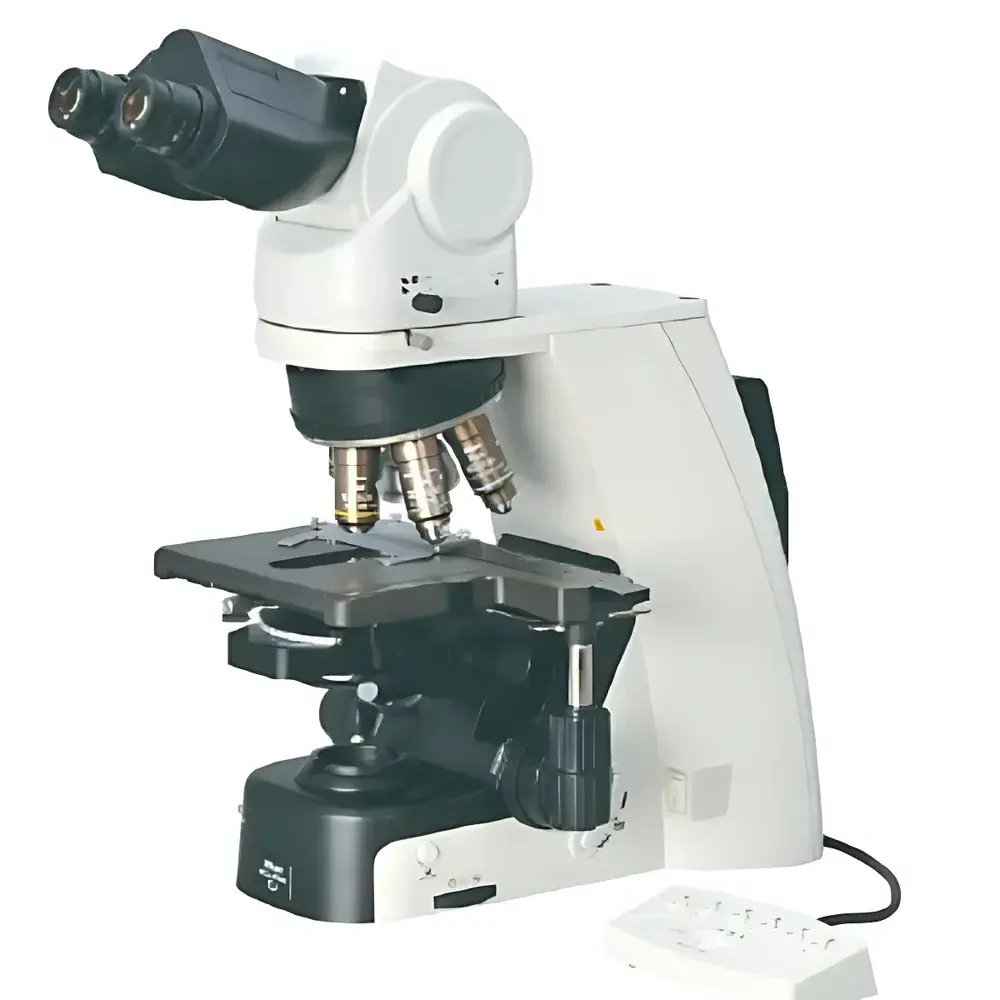
Nikon Eclipse Ci-L PLUS Biological Microscope
| Brand | Nikon |
|---|---|
| Origin | Japan |
| Model | Eclipse Ci-L PLUS |
| Optical System | CFI60 Infinity-Corrected |
| Illumination | High-Efficiency LED (5.0 W) |
| Eyepiece Field of View | 22 mm (binocular), 25 mm (trinocular) |
| Eyepiece Tube Diameter | Φ30 mm |
| Focusing | Coaxial coarse/fine focus with 30 mm travel, 1 µm fine focus increment |
| Stage Travel | 78 × 54 mm (X–Y) |
| Stage Height Adjustment | Adjustable handle + optional shims |
| Ergonomic Tilting Head | 10°–30° inclination, 40 mm extension |
| Weight | 13.3 kg (binocular configuration) |
| Compliance | CE, ISO 13485 (design & manufacturing processes), RoHS-compliant components |
Overview
The Nikon Eclipse Ci-L PLUS is a high-performance upright biological microscope engineered for clinical diagnostics, academic teaching, and routine life science research. Built upon Nikon’s proven CFI60 infinity-corrected optical platform, it delivers consistent image fidelity, chromatic correction, and long working distance across all standard objective magnifications (4× to 100×). Its core architecture integrates ergonomic optimization with operational robustness—designed not only for visual clarity but also for sustained user comfort during extended daily use in pathology labs, hematology departments, and university teaching facilities. Unlike modular research-grade systems requiring complex alignment or calibration, the Ci-L PLUS prioritizes out-of-the-box readiness while maintaining compatibility with standardized accessories defined under ISO 8578 and JIS B 7152 for microscope mechanical interfaces.
Key Features
- Ergonomic Viewing Geometry: The tilting binocular head offers adjustable inclination (10°–30°) and vertical extension (up to 40 mm), enabling natural neck and shoulder posture across diverse user statures. The stage handwheel height and torque are independently tunable; optional stage-lowering shims further improve accessibility for specimen loading.
- CFI60 Optical Architecture: All objectives are optimized for Nikon’s 200 mm tube length and 60 mm parfocal distance, ensuring seamless transitions between magnifications without refocusing or recentering. Standard plan achromat and plan fluor objectives provide flat-field imaging with minimal curvature and astigmatism—critical for digital documentation and quantitative morphological assessment.
- LED Illumination System: A 5.0 W high-color-rendering LED provides stable, flicker-free illumination with CCT ≈ 5,600 K. Integrated Light Intensity Management (LIM) automatically recalls preset brightness levels per objective, eliminating manual recalibration when switching magnifications.
- Precision Mechanical Stage: Featuring 78 × 54 mm X–Y travel with vernier scales, the ceramic-coated mechanical stage resists abrasion from glass slide handling and repeated cleaning. Fine-positioning accuracy supports repeatable region-of-interest navigation during serial section review or classroom demonstrations.
- Modular Imaging Integration: Trinocular configurations support C-mount or F-mount adapters for direct coupling to scientific CMOS or sCMOS cameras. Optional fluorescence modules—including the D-LEDI epi-illumination system—comply with ISO 10940 for fluorescence intensity stability and spectral consistency.
Sample Compatibility & Compliance
The Ci-L PLUS accommodates standard 1″ × 3″ (25 × 75 mm) glass slides and 24 × 60 mm coverslips, with optional phase contrast sliders (e.g., Ph1–Ph3) and darkfield condensers supporting unstained live-cell observation. Its mechanical design conforms to IEC 61000-6-2/6-4 for electromagnetic compatibility and meets ISO 13485 requirements for medical device-related instrumentation. While not classified as an in vitro diagnostic (IVD) device under EU IVDR or FDA 21 CFR Part 809, its optical performance and repeatability align with ASTM E2864 guidelines for microscope validation in clinical cytology workflows. Documentation includes traceable calibration certificates for focusing scale linearity and stage positioning accuracy.
Software & Data Management
Nikon NIS-Elements Basic software is available for image acquisition, annotation, and measurement (length, area, angle, particle count), supporting TIFF, JPEG, and proprietary ND2 formats. The microscope’s hardware-level LIM settings are retained independently of software state—ensuring reproducible illumination conditions even when switching between users or imaging sessions. For laboratories operating under GLP or GMP frameworks, optional NIS-Elements AR (Advanced Research) enables audit trail logging, electronic signatures, and 21 CFR Part 11–compliant data integrity controls. Exported metadata includes objective ID, magnification, illumination mode, and timestamp—facilitating integration into LIMS environments via DICOM-SR or CSV pipelines.
Applications
- Clinical hematology: Routine peripheral blood smear evaluation, reticulocyte counting, and malaria parasite detection.
- Pathology education: Histological section analysis using H&E, Masson’s trichrome, and PAS-stained tissues.
- Microbiology labs: Gram staining interpretation, yeast/bacterial morphology assessment, and motility testing.
- Quality control in biomanufacturing: Visual inspection of cell culture monolayers, contamination screening, and passage documentation.
- Undergraduate biology instruction: Comparative plant/animal histology, mitosis staging, and basic fluorescence demonstration (with optional D-LEDI).
FAQ
Is the Ci-L PLUS suitable for fluorescence imaging in regulated environments?
Yes—when equipped with the D-LEDI epi-illumination module and certified fluorescence filters (e.g., FITC, TRITC, DAPI sets), it supports semi-quantitative fluorescence observation compliant with ISO/TR 20004 for fluorescence microscopy validation.
Can the microscope be integrated into a networked digital pathology workflow?
It supports third-party DICOM gateways via NIS-Elements export functions; however, native DICOM-SOP class support requires NIS-Elements AR licensing and a dedicated acquisition workstation.
What maintenance intervals are recommended for the LED illumination system?
No scheduled lamp replacement is required—the LED source is rated for >25,000 hours at nominal output, with luminance decay <10% over 15,000 hours under continuous operation.
Does Nikon provide service documentation for ISO 17025-accredited calibration labs?
Yes—technical manuals, mechanical tolerance specifications, and optical test reports (including MTF curves and axial chromatic aberration data) are supplied under NDA for qualified service partners engaged in accredited calibration activities.
Related Products