
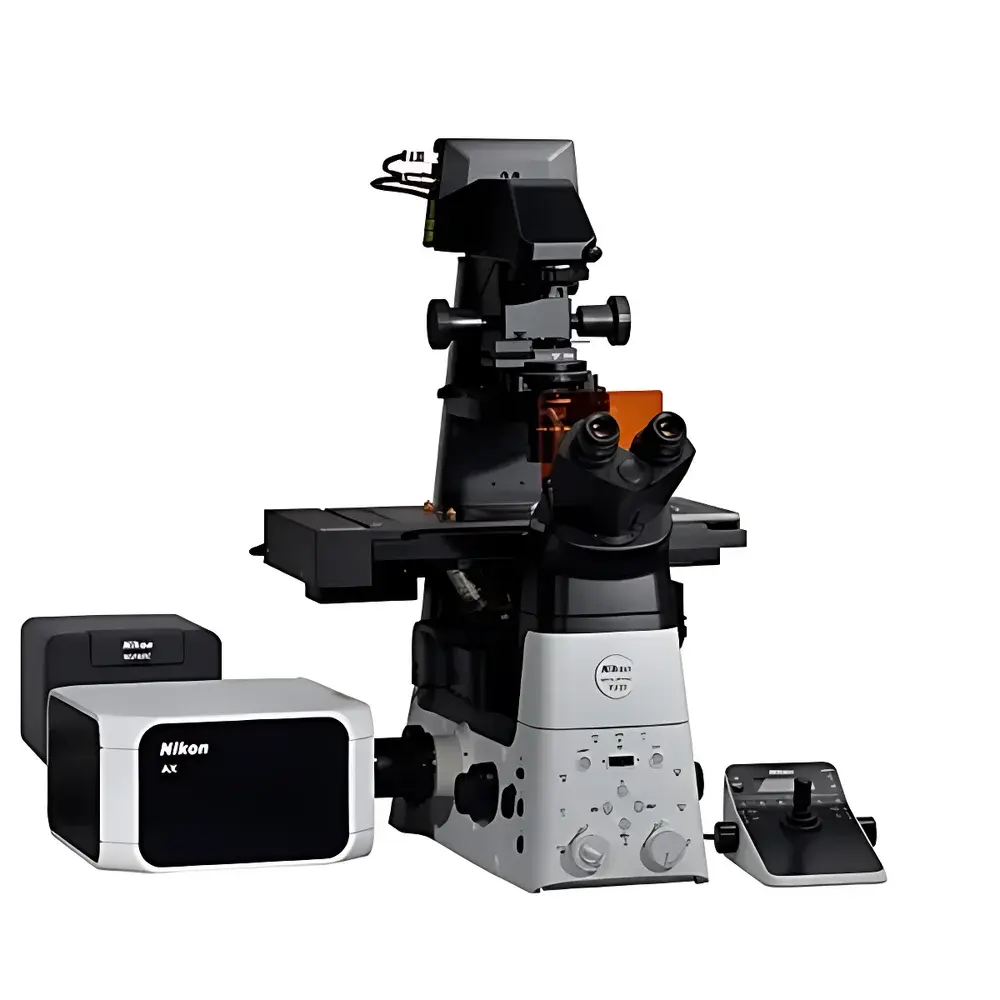
Nikon AX with NSPARC Super-Resolution 3D Laser Scanning Confocal Microscope
| Brand | Nikon |
|---|---|
| Origin | Japan |
| Model | AX with NSPARC |
| Detector Type | NSPARC (Nikon Spatially Resolved Array Photon Counter) |
| Lateral Resolution | 100 nm |
| Axial Resolution | 300 nm |
| Scan Head Options | AX-SHS (Galvo-only), AX-SHR (Galvo + Resonant) |
| Field of View | 25 mm |
| Max Image Resolution | 8192 × 8192 pixels |
| Resonant Scan Speed | up to 720 fps @ 2048 × 16 px |
| Galvo Scan Speed | 10 fps @ 512 × 512 px |
| Pixel Dwell Time Range | 0.2 ms – 10 µs |
| Scan Modes | Unidirectional, Bidirectional, Line Scan, Rolling Average, Line Average |
| Real-time AI Denoising | Denoise.ai integrated |
| Emission Filter Capacity | Up to 7 positions (405/445/488/514/561/594/640 nm) |
| Excitation Compatibility | Multi-laser (405–640 nm) |
| Detector Architecture | SPPC (Single-Pixel Photon Counting) Array |
| Rotation Capability | ±180° image rotation |
| Software Platform | NIS-Elements AR/C |
Overview
The Nikon AX with NSPARC is a high-performance, research-grade super-resolution 3D laser scanning confocal microscope engineered for quantitative subcellular imaging in live and fixed biological specimens. Built upon Nikon’s CFI Apo LWD objective platform and integrated with the proprietary NSPARC (Nikon Spatially Resolved Array Photon Counter) detector, this system leverages spatially resolved photon counting to achieve true single-photon sensitivity with ultra-low read noise—enabling robust detection of weak fluorescence signals while preserving native spatial fidelity. Unlike conventional PMT-based or hybrid detectors, NSPARC employs a custom SPPC (Single-Pixel Photon Counting) array architecture that delivers simultaneous spatial and temporal photon localization at pixel-level resolution, thereby extending the effective dynamic range and improving signal-to-noise ratio (SNR) without compromising acquisition speed. The system supports both galvanometric (AX-SHS) and hybrid galvo-resonant (AX-SHR) scanning modalities, offering flexible trade-offs between field uniformity, resolution, and temporal resolution across volumetric, time-lapse, and high-speed functional imaging workflows.
Key Features
- NSPARC detector with 100 nm lateral and 300 nm axial resolution—validated under ISO 19012-2 optical sectioning standards
- Dual-scan architecture: AX-SHS (pure galvo) for high-fidelity static imaging; AX-SHR (galvo + resonant) for high-frame-rate volumetric capture up to 720 fps at line-scan configurations
- 25 mm field-of-view compatible with large-format sensors and multi-well plate imaging—optimized for automated screening and correlative workflows
- Real-time Denoise.ai processing embedded within NIS-Elements AR/C—leveraging convolutional neural networks trained on biologically relevant ground-truth datasets to suppress Poisson noise while retaining structural edge integrity
- Seven-position motorized emission filter turret supporting full-spectrum multicolor acquisition (405–640 nm), fully synchronized with laser switching and scan timing
- Sub-millisecond dwell time control (0.2 ms minimum) with programmable bidirectional scanning, line averaging, and rolling average modes for enhanced SNR in low-light conditions
- Full ±180° software-controlled image rotation—preserving metadata integrity and enabling precise alignment in multi-angle reconstruction pipelines
Sample Compatibility & Compliance
The Nikon AX with NSPARC is validated for use with standard glass-bottom dishes, chambered coverslips, and thick tissue sections (up to 200 µm cleared samples). Its extended working distance objectives (e.g., CFI Plan Apo λ 20×/0.75 WD 1.0 mm) support live-cell imaging under physiological conditions, including CO2-controlled incubation and temperature regulation. All hardware and firmware comply with IEC 61000-6-3 (EMC emissions) and IEC 61000-6-2 (immunity) standards. Data acquisition and storage workflows adhere to GLP-compliant metadata tagging per NIH ImageJ/Fiji-compatible OME-TIFF specifications. Optional FDA 21 CFR Part 11 compliance packages include electronic signature modules, audit trail logging, and role-based access control for regulated environments.
Software & Data Management
Controlled exclusively via Nikon NIS-Elements AR/C v5.5+, the system provides end-to-end workflow integration—from acquisition parameter scripting (via Python API) to GPU-accelerated deconvolution (Wiener, constrained iterative) and 4D rendering (x,y,z,t). Raw NSPARC data is stored in hierarchical HDF5 format with embedded calibration profiles (gain, offset, pixel response nonuniformity). Time-series datasets support automatic drift correction using cross-correlation-based registration and fiducial-free stabilization. Export options include standardized formats (OME-Zarr, ND2, TIFF stack) compatible with downstream analysis in Imaris, Bitplane, and open-source platforms such as Napari and QuPath. Audit logs record all user actions, parameter changes, and hardware state transitions with UTC timestamps and operator ID—fully traceable for GMP/GLP documentation.
Applications
- Live-cell organelle dynamics tracking (mitochondria, lysosomes, ER) with sub-diffraction spatial discrimination
- 3D morphometric analysis of neuronal dendritic spines and synaptic puncta in brain slice preparations
- Quantitative co-localization studies using spectral unmixing across ≥5 fluorophores with <1% crosstalk
- High-content phenotypic screening in 384-well plates with autofocus-driven z-stack acquisition and tile stitching
- Correlative light-electron microscopy (CLEM) sample navigation using fiducial marker-guided coordinate mapping
- Photoactivation/photoconversion kinetics in optogenetic constructs (e.g., PA-GFP, Dendra2) with millisecond temporal resolution
FAQ
What is the fundamental principle behind NSPARC detection?
NSPARC utilizes spatially resolved single-photon counting across a custom CMOS-based SPPC array, where each pixel independently records arrival time and position of individual photons—enabling photon-limited imaging without analog amplification noise.
Does the system support spectral unmixing and linear unmixing?
Yes—NIS-Elements AR/C includes built-in spectral library generation and constrained linear unmixing algorithms compatible with multi-laser excitation and multi-band emission filtering.
Can NSPARC data be exported for third-party analysis in MATLAB or Python?
Yes—raw photon event lists and calibrated intensity volumes are exportable in HDF5 and OME-TIFF formats, with documented metadata schemas and Python SDK support via niscore.
Is the AX-SHR scan head compatible with resonant frequency tuning for custom frame rates?
No—the resonant scanner operates at a fixed 8 kHz fundamental frequency; however, sub-harmonic sampling and ROI-based partial-frame readout allow user-defined effective frame rates.
How is phototoxicity minimized during long-term live imaging?
Through adaptive illumination control (AIC), which dynamically modulates laser power based on real-time SNR feedback and detector saturation thresholds—reducing total photon dose by up to 40% versus fixed-power protocols.




