
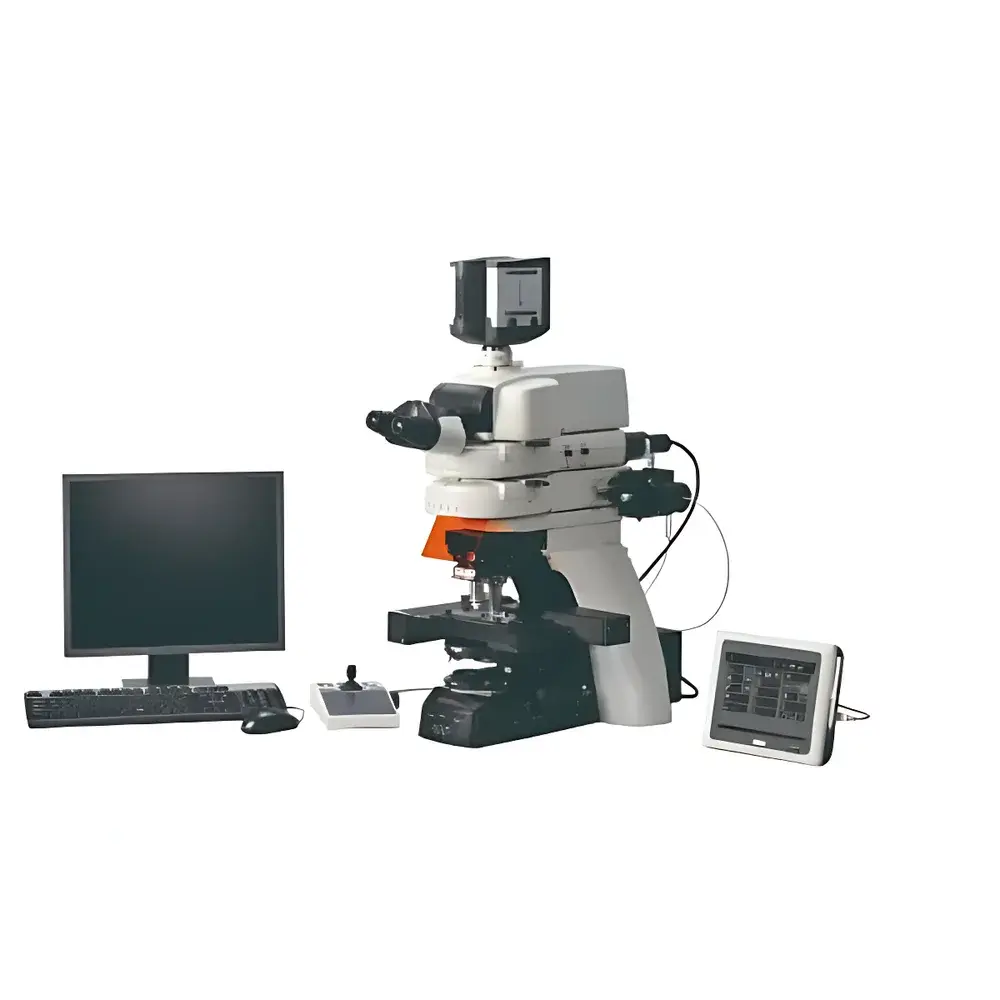
Nikon ECLIPSE Ni-E Motorized Upright Research Microscope (Objective-Focusing Configuration)
| Brand | Nikon |
|---|---|
| Origin | Japan |
| Model | Nikon ECLIPSE Ni-E (Objective-Focusing Type) |
| Optical System | CFI60 and CFI75 Infinity-Corrected Optics |
| Focusing Mechanism | Motorized Objective Nosepiece Translation (±13 mm vertical travel) |
| Linear Encoder Resolution | 0.025 µm |
| Illumination | High-CRI LED (50,000 hr lifetime) or 12V/100W Halogen |
| Eyepiece FOV | 22 mm or 25 mm |
| Motorized Components | NI-N7-E 7-Position Objective Turret, NI-S-E XY Stage (0.1 µm resolution), NI-TT2-E Motorized Quad-Port Tilting Trinocular Tube |
| Compliance | Designed for GLP/GMP-compliant imaging workflows with audit-trail-ready control architecture |
Overview
The Nikon ECLIPSE Ni-E Motorized Upright Research Microscope (Objective-Focusing Configuration) is a high-precision, modular platform engineered for demanding life science applications requiring exceptional optical fidelity, repeatable positioning, and seamless integration with automated imaging workflows. Unlike conventional stage-focusing microscopes, the Ni-E’s objective-focusing architecture decouples specimen stability from focus actuation—enabling ultra-stable sample observation during time-lapse experiments, multi-position acquisitions, and high-resolution Z-stack reconstruction. Its dual CFI60/CFI75 optical pathway supports both legacy CFI60 objectives and next-generation CFI75 optics optimized for deeper tissue penetration and reduced spherical aberration in thick-sample imaging. The system employs Nikon’s proprietary Perfect Focus System (PFS) architecture, which maintains focal plane integrity in real time by continuously monitoring and compensating for thermal drift and mechanical displacement—critical for long-duration live-cell imaging under environmental chambers.
Key Features
- Motorized objective nosepiece focusing (NI-N7-E or NI-ND6-E turrets) with ±13 mm vertical travel range and 0.025 µm linear encoder resolution ensures sub-micron repeatability across thousands of focus cycles.
- Integrated high-color-rendering LED illumination (50,000-hour rated lifetime) delivers stable, flicker-free intensity without thermal load on specimens—compatible with quantitative fluorescence and brightfield contrast techniques including DIC, phase contrast, and darkfield.
- Modular port architecture supports simultaneous multi-channel acquisition: dual DSC ports (C-TEP2/C-TEP3), rear port (NI-BPU), and motorized zoom port (NI-RPZ-E, 0.6×–2.0×) enable concurrent camera, photomultiplier, and laser coupling without optical compromise.
- Ergonomic flexibility via C-TE2 tilting binocular tube (10°–30° inclination, 40 mm extension) and NI-TT2-E motorized quad-port trinocular tube (15°–35° tilt, three independent light paths) accommodates diverse user anthropometry and multi-instrument integration requirements.
- Intelligent hardware coordination through NI-CTLB control box enables synchronized operation of motorized turret, XY stage (NI-S-E, 0.1 µm step resolution), and PFS—fully scriptable via NIS-Elements software for reproducible experimental protocols.
Sample Compatibility & Compliance
The Ni-E accommodates standard glass slides, multi-well plates (including 96- and 384-well formats), Petri dishes (with optional NI-SH-D dish holder), and specialized FN1-compatible specimens such as electrophysiology chambers and perfusion systems. Its large working distance (up to 13 mm with CFI75 LWD objectives) and flexible condenser options—including NI-CUD-E motorized universal dry condenser (NA 0.88), C-AA apochromatic condenser (NA 1.40), and D-CUO DIC oil condenser (NA 1.40)—support advanced contrast modalities across varied specimen thicknesses and refractive indices. The system meets essential regulatory expectations for research-grade instrumentation: all motorized functions log timestamped execution data, supporting audit trails required under GLP and GMP frameworks; firmware and control software comply with ISO/IEC 17025 traceability principles for measurement uncertainty documentation.
Software & Data Management
Control and acquisition are unified within Nikon’s NIS-Elements AR (Advanced Research) platform—a validated, modular software suite supporting full instrument orchestration, multi-dimensional image capture (X-Y-Z-T-λ), and quantitative analysis. The software implements role-based access control, electronic lab notebook (ELN) export (via CSV, OME-TIFF, and ND2 formats), and FDA 21 CFR Part 11–compliant user authentication, electronic signatures, and immutable audit logs. Automated calibration routines verify objective magnification, stage coordinates, and PFS offset at startup and scheduled intervals—ensuring metrological consistency across instruments in core facilities. Integration with third-party analysis pipelines (e.g., Fiji/ImageJ, MATLAB, Python via NIS-Elements SDK) preserves raw data integrity while enabling custom algorithm deployment.
Applications
The Ni-E excels in longitudinal cellular dynamics studies—including mitosis tracking, organelle trafficking, and calcium signaling—where thermal stability and autofocus robustness are non-negotiable. Its objective-focusing design eliminates stage-induced vibration during high-magnification DIC or differential interference contrast imaging of unstained tissues. In neuroscience, the platform supports acute brain slice imaging with infrared-DIC and patch-clamp compatibility via FN1-standard stage interfaces. Developmental biologists utilize its motorized multi-position scanning and Z-stack reconstruction for embryo phenotyping across 3D volumes. Additionally, the system serves as a foundational platform for correlative light-electron microscopy (CLEM) workflows, where precise coordinate mapping between optical and EM datasets relies on sub-micron stage and turret repeatability.
FAQ
What distinguishes objective-focusing from stage-focusing microscopes?
Objective-focusing isolates focus adjustment to the objective turret, preserving absolute specimen position and minimizing mechanical perturbation—essential for time-lapse imaging, microinjection, and electrophysiology.
Can the Ni-E support both CFI60 and CFI75 objectives simultaneously?
No—the optical path is configured at installation for either CFI60 or CFI75; switching requires mechanical reconfiguration of tube lens and intermediate optics per Nikon service protocols.
Is PFS compatible with oil-immersion objectives?
Yes—PFS operates independently of immersion medium and maintains focus stability during prolonged oil-based acquisitions, provided proper objective alignment and cover-slip thickness matching are verified.
How is calibration traceability maintained for motorized components?
Each linear encoder and stepper motor undergoes factory calibration against NIST-traceable standards; calibration certificates and verification reports are accessible via NIS-Elements diagnostic modules.
Does the system support remote operation in BSL-2 or controlled environments?
Yes—NI-CTLB control box enables Ethernet-based command routing, allowing full microscope control from outside containment zones while maintaining signal integrity and electromagnetic compatibility (EMC) per IEC 61326-1 standards.




