
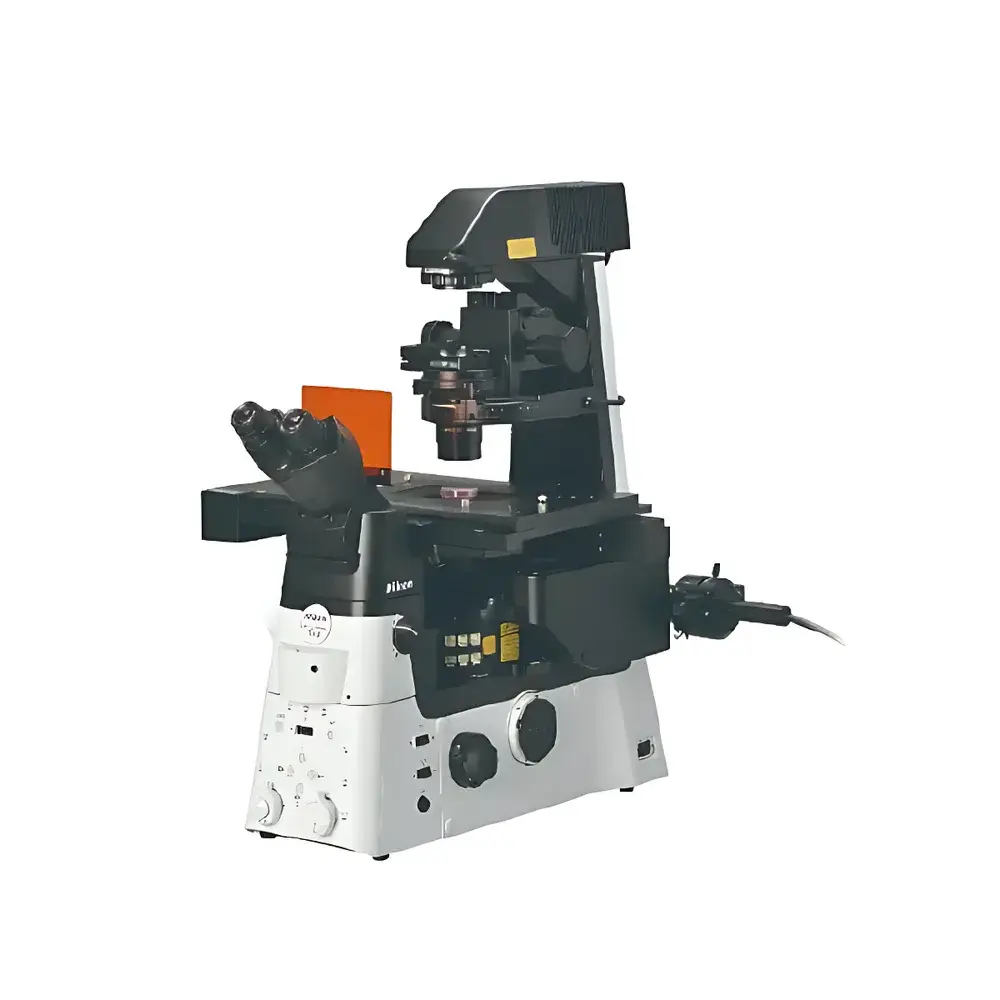
Nikon ECLIPSE Ts2R Inverted Research-Grade Microscope
| Brand | Nikon |
|---|---|
| Origin | Japan |
| Model | ECLIPSE Ts2R |
| Optical System | CFI60 Infinity-Corrected |
| Observation Modes | Brightfield, Phase Contrast (including TMC), DIC, NAMC (Nikon Advanced Modulation Contrast), Relief Contrast, Fluorescence Epi-Illumination, Spindle Observation |
| Illumination | High-Brightness White LED Transmitted Light (with Homogenizing Lens), LED Epi-Illumination (up to 4 interchangeable units |
| wavelengths | 385, 455, 470, 505, 525, 590, 625 nm) |
| Eyepiece Options | 10× (22 mm FOV), 12.5× (16 mm), 15× (14.5 mm) |
| Binocular Tube | Siedentopf-type, interpupillary distance 50–75 mm, tilt angle 35° (standard) or 15–45° (ergonomic) |
| Camera Port Split Ratios | 100:0 / 0:100, 100:0 / 20:80, 100:0 / 50:50 |
| Focus Mechanism | Objective nosepiece-driven Z-movement |
| coarse focus | 5.0 mm/rev, fine focus: 0.1 mm/rev |
| Objective Turret | 6-position, with DIC prism slots |
| Condenser | Rotating condenser turret (7-slot), compatible with ELWD, LWD, and NAMC condensers |
| Stage | Flat stage (260 × 300 mm) |
| Stage Adapters | C-S-HP35 (35 mm dish), C-S-HLP100 (100 mm dish), C-S-HT (Terasaki plates & Ø65 mm dishes), C-S-HS (slide, Ø54 mm dish, hemocytometer), C-S-HU (universal for Terasaki, slides, Ø35–65 mm dishes, hemocytometer), C-S-HG (circular glass slide), C-S-HLS (circular slide kit), TC-S-HA (acrylic stage plate) |
| Fluorescence Accessories | Motorized filter cube turret (body-integrated, noise-reduction design) |
| Dimensions (W×D×H) | 286 × 466 × 542 mm |
| Weight | ~17–18 kg |
| Power Supply | 100–240 V AC, <0.65 A |
| Power Consumption | 30 W |
Overview
The Nikon ECLIPSE Ts2R is an inverted research-grade microscope engineered for rigorous live-cell imaging, developmental biology, and routine fluorescence applications in academic, pharmaceutical, and biotechnology laboratories. Built upon Nikon’s CFI60 infinity-corrected optical architecture, the Ts2R delivers high-fidelity image formation across multiple contrast modalities—including brightfield, phase contrast (standard and TMC variants), differential interference contrast (DIC), Nikon Advanced Modulation Contrast (NAMC), and relief contrast—enabling reliable visualization of unstained, low-contrast specimens such as adherent and suspension cultures, zebrafish embryos, organoids, and mitotic spindles. Its modular epi-fluorescence configuration supports multi-channel acquisition with precisely calibrated LED excitation sources (385–625 nm), minimizing phototoxicity while maintaining signal-to-noise integrity. Designed for long-term stability and ergonomic operation, the Ts2R integrates a rigid mechanical platform, thermally stable LED illumination, and precision Z-axis mechanics—making it suitable for time-lapse microscopy, routine QC assays, and GLP-aligned cell morphology assessments.
Key Features
- CFI60 infinity-corrected optical system ensures consistent resolution, flatness of field, and chromatic correction across all magnifications and contrast modes.
- Multi-modal contrast capability: simultaneous support for brightfield, phase contrast (including TMC for enhanced edge definition), DIC (with dedicated prism slots), NAMC (a non-polarized alternative to DIC), and relief contrast—each optimized for specific specimen types and culture conditions.
- Dual LED illumination architecture: high-output white LED transmitted-light source with built-in homogenizing lens ensures uniform Köhler illumination; independent epi-LED module accommodates up to four user-selectable excitation wavelengths (385, 455, 470, 505, 525, 590, 625 nm), each with stable output and minimal thermal drift.
- Ergonomic Siedentopf binocular tube with adjustable tilt (15–45°) and wide interpupillary range (50–75 mm) reduces operator fatigue during extended sessions.
- Objective nosepiece-driven focusing mechanism provides ±11 mm total Z-travel (↑8 mm / ↓3 mm), fine focus resolution of 0.1 µm/rev, and torque-adjustable coarse drive—critical for reproducible focusing across diverse vessel heights (e.g., Petri dishes, multi-well plates, glass-bottom chambers).
- 6-position objective turret includes integrated DIC prism slots, enabling rapid switching between contrast techniques without realignment.
- Rotating 7-slot condenser turret allows seamless interchange of phase annuli, DIC prisms, NAMC modules, IMSI optics, and ND filters—eliminating manual condenser replacement during workflow transitions.
Sample Compatibility & Compliance
The Ts2R accommodates a broad spectrum of life science sample formats—from standard glass slides and hemocytometers to 35 mm, 65 mm, and 100 mm Petri dishes, Terasaki plates, and multi-well plates (6–96-well). Optional stage adapters (C-S-HP35, C-S-HLP100, C-S-HT, etc.) ensure precise positioning and thermal stability for temperature-sensitive live-cell experiments. The system complies with ISO 10934-1 (microscope nomenclature), ISO 8578 (mechanical stability), and IEC 61000-6-3 (EMC emissions). While not FDA 21 CFR Part 11–certified out-of-the-box, its hardware architecture supports integration with validated third-party imaging software platforms that provide audit trails, electronic signatures, and secure data export—meeting GLP and GMP documentation requirements when deployed in regulated environments.
Software & Data Management
The Ts2R operates as a hardware platform compatible with Nikon’s NIS-Elements software suite (v5.0+), which enables full control of illumination intensity, filter cube selection, Z-stack acquisition, time-lapse scheduling, and multi-channel fluorescence registration. NIS-Elements supports TIFF, ND2, and OME-TIFF export formats, metadata embedding (including objective ID, exposure, gain, and timestamp), and batch processing via macro scripting. When configured with optional motorized components (e.g., automated filter turret, motorized stage), the system supports semi-automated workflows compliant with ISO/IEC 17025 traceability standards. Raw image data remain unprocessed at acquisition—preserving quantitative fidelity for downstream analysis in ImageJ/Fiji, MATLAB, or Python-based pipelines.
Applications
- Live-cell time-lapse imaging: Stable thermal management and low-phototoxicity LED illumination enable hour-scale monitoring of cell migration, division, and organelle dynamics.
- Embryology & developmental biology: TMC and relief contrast modes enhance visualization of blastomeres, yolk sac structures, and spindle apparatuses in zebrafish, mouse, and Xenopus embryos.
- Stem cell & organoid characterization: ELWD and LWD condensers accommodate thick specimens (>1 mm), while NAMC improves contrast in heterogeneous 3D cultures without staining.
- Fluorescence co-localization studies: Precisely aligned LED excitation bands minimize spectral crosstalk; motorized filter turret ensures repeatable channel switching for ratiometric or FRET-based assays.
- Quality control in biomanufacturing: Routine inspection of CHO or HEK293 cell confluency, morphology, and contamination status under standardized brightfield and phase protocols.
FAQ
Is the Ts2R compatible with third-party cameras and software?
Yes—the Ts2R features standardized C-mount and Nikon proprietary camera ports (TS2R-P-CF/CH/CHL) and supports DCAM-compliant drivers for integration with major scientific CMOS/CCD cameras and open-source or commercial image acquisition platforms.
Can the system be upgraded to include motorized Z-focus or stage control?
While the base Ts2R is manually operated, Nikon offers factory-installed motorization kits for Z-focus and XY stage movement—enabling compatibility with NIS-Elements’ automated acquisition modules.
What safety certifications does the Ts2R meet?
It conforms to IEC 61010-1 (safety requirements for electrical equipment), IEC 60825-1 (laser product classification—applicable to LED-based systems), and RoHS 2011/65/EU for hazardous substance restrictions.
Does the Ts2R support Köhler illumination alignment for all contrast modes?
Yes—both transmitted and epi-illumination paths are designed for rapid, repeatable Köhler setup; condenser turret indexing and pre-centered phase sliders significantly reduce alignment time per objective.
How is thermal management handled during extended fluorescence imaging sessions?
The LED light sources generate minimal heat (4-hour acquisitions.
Related Products



