
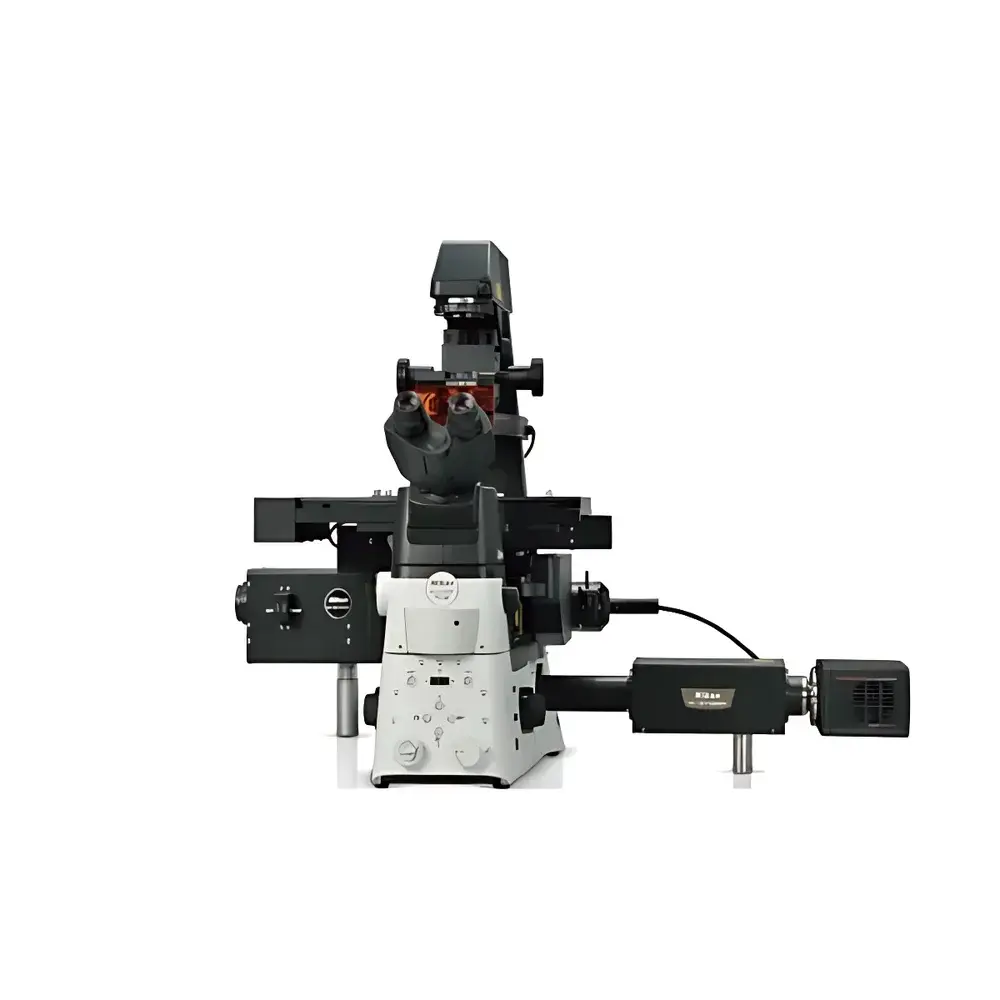
Nikon N-STORM Super-Resolution Microscope
| Brand | Nikon |
|---|---|
| Origin | Japan |
| Model | N-STORM |
| XY Resolution | ~20 nm |
| Z Resolution | ~50 nm |
| Imaging Modes | 2D-STORM (n-STORM, c-STORM), 3D-STORM (n-STORM, c-STORM), 3D-Stack |
| Maximum Field of View | 80 µm × 80 µm |
| Frame Rate | up to 500 Hz |
| Multicolor Capability | up to 3 channels |
| Compatible Lasers | LU-NV Series (405/488/561/647 nm), LUD-H Series (405/488/561/640 nm) |
| Compatible Platform | Nikon ECLIPSE Ti2-E motorized inverted microscope |
| Autofocus System | Perfect Focus System (PFS) with encoder-based motorized XY stage and Piezo Z-stage |
| Objective Lenses | CFI SR HP Plan Apochromat Lambda S 100XC Sil (NA 1.35), CFI SR HP Apochromat TIRF 100XC oil (NA 1.49), CFI SR HP Apochromat TIRF 100XAC oil (NA 1.49), CFI HP Plan Apochromat VC 100X oil (NA 1.40) |
| Camera Options | ORCA-Fusion BT sCMOS (Hamamatsu), iXON Ultra DU-897U EMCCD (Andor) |
| Software | NIS-Elements AR / NIS-Elements C (optional), NIS-A 6D and N-STORM Analysis Module (required) |
| Operating Temperature | 20–25 °C (±0.5 °C) |
Overview
The Nikon N-STORM Super-Resolution Microscope is a single-molecule localization microscopy (SMLM) platform engineered for quantitative nanoscale imaging in fixed and live-cell biological specimens. Based on stochastic optical reconstruction microscopy (STORM) principles, the system achieves sub-diffraction resolution by temporally separating the fluorescence emission of photoswitchable dyes—enabling precise centroid determination of individual emitters across thousands of frames. With typical lateral (XY) resolution of ~20 nm and axial (Z) resolution of ~50 nm, the N-STORM delivers consistent, reproducible structural detail beyond the Abbe diffraction limit (~250 nm for visible light). It operates as an integrated module on the Nikon ECLIPSE Ti2-E motorized inverted microscope platform, leveraging high-NA objective optics, precision piezoelectric Z-scanning, and hardware-synchronized laser excitation to ensure spatiotemporal fidelity in multicolor 2D and 3D acquisitions.
Key Features
- Stochastic single-molecule localization architecture optimized for n-STORM and c-STORM modalities, supporting both 2D and 3D reconstruction workflows
- High-fidelity optical train incorporating CFI SR HP apochromat objectives with numerical apertures up to NA 1.49, specifically corrected for super-resolution applications
- Encoder-equipped motorized XY stage and closed-loop piezoelectric Z-stage enabling nanometer-level positional repeatability and drift compensation
- Dual-laser illumination compatibility via LU-NV and LUD-H series units (405/488/561/640/647 nm), supporting sequential or simultaneous multi-wavelength activation and readout
- High-speed acquisition capability up to 500 Hz frame rate, facilitating dynamic process capture in live-cell STORM when combined with appropriate labeling and buffer conditions
- Maximum field-of-view of 80 µm × 80 µm at 1× magnification—scalable via binning and region-of-interest selection to balance speed, signal-to-noise, and localization density
Sample Compatibility & Compliance
The N-STORM platform supports standard immunofluorescence-labeled preparations using commercially available STORM-compatible dyes (e.g., Alexa Fluor 647, Cy5, CF647) and custom photoswitchable probes. Sample mounting employs oxygen-scavenging and thioredoxin-based buffers to promote controlled blinking. The system meets essential laboratory infrastructure requirements per ISO/IEC 17025:2017 for measurement traceability in analytical microscopy, and its software architecture supports audit-trail-enabled operation compliant with GLP and GMP documentation practices. While not FDA-cleared as a diagnostic device, the N-STORM adheres to IEC 61000-6-3 (EMC) and IEC 61000-6-2 (immunity) standards for laboratory instrumentation. All optical components conform to Nikon’s CFI60 mechanical and optical design standards, ensuring interchangeability and long-term calibration stability.
Software & Data Management
Data acquisition and analysis are managed through Nikon’s NIS-Elements AR software environment, extended by the dedicated N-STORM Analysis Module and NIS-A 6D extension for volumetric rendering and colocalization quantification. The software implements maximum-likelihood estimation (MLE) and Gaussian fitting algorithms for emitter localization, supports drift correction via cross-correlation or fiducial tracking, and exports results in standardized formats (TIFF, CSV, HDF5) compatible with third-party tools including ThunderSTORM, rapidSTORM, and Picasso. All processing steps—including channel alignment, background subtraction, and cluster analysis—are fully scriptable using Python and Java APIs. Audit trails record user actions, parameter changes, and timestamped metadata in accordance with 21 CFR Part 11 guidelines when configured with electronic signature modules.
Applications
- Nanoscale mapping of synaptic protein organization in neuronal tissue sections
- Quantitative assessment of nuclear pore complex architecture and heterogeneity
- 3D reconstruction of cytoskeletal filament networks (actin, microtubules, intermediate filaments)
- Multicolor co-localization studies of receptor clustering in plasma membrane domains
- Time-resolved structural dynamics during mitotic spindle assembly and chromosome segregation
- Correlative light-electron microscopy (CLEM) workflows using fiducial-guided registration
FAQ
What sample preparation protocols are recommended for optimal N-STORM performance?
Standard protocols involve primary/secondary antibody labeling with STORM-optimized fluorophores, followed by mounting in oxygen-scavenging buffer (e.g., glucose oxidase/catalase system) supplemented with thioredoxin or MEA. Coverslip cleaning and plasma treatment are strongly advised to minimize background and improve adhesion.
Is live-cell STORM supported on the N-STORM system?
Yes—when paired with low-phototoxicity dyes (e.g., Janelia Fluor dyes), fast-switching buffers, and appropriate environmental control (stage-top incubator, CO2 regulation), time-lapse STORM at ~1–5 s/frame is feasible for selected cellular processes.
Can the N-STORM be integrated with other Nikon imaging modalities such as confocal or TIRF?
Absolutely—the Ti2-E platform allows seamless switching between STORM, widefield, confocal (AX/AX R), and TIRF modes using shared optical paths and synchronized hardware control via NIS-Elements.
What computing resources are required for STORM data reconstruction?
A minimum of 64 GB RAM, dual Xeon or Ryzen Threadripper CPU, and NVIDIA GPU (RTX A4000 or higher) is recommended for real-time localization fitting and 3D rendering of datasets exceeding 100,000 frames.





