
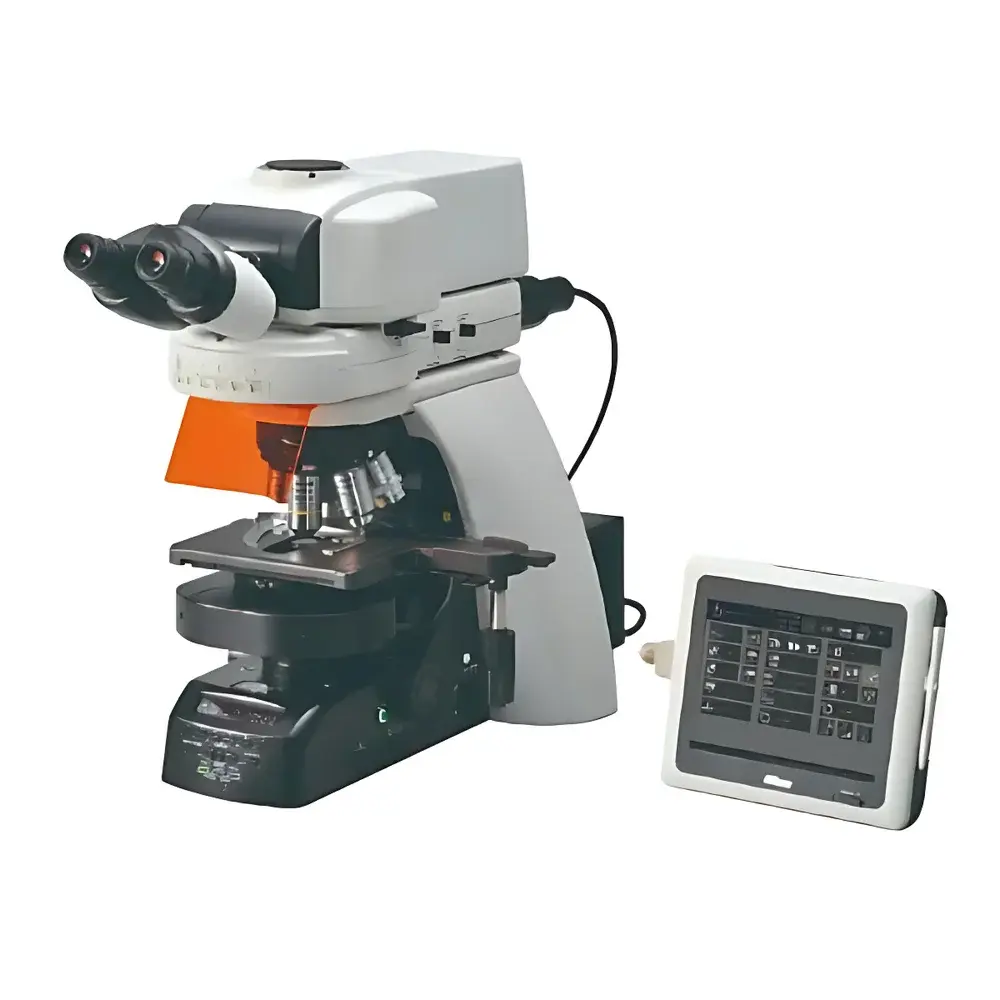
Nikon ECLIPSE Ni-E Motorized Upright Research Microscope with Stage-Based Focusing
| Brand | Nikon |
|---|---|
| Origin | Japan |
| Model | ECLIPSE Ni-E |
| Optical System | CFI60 and CFI75 Infinity-Corrected |
| Focusing Mechanism | Motorized Stage (±13 mm total travel, 0.025 µm encoder resolution) |
| Illumination | 12V/100W Halogen or High-CRI LED (50,000 hr lifetime) |
| Objective Turret Options | NI-N7-E (7-port motorized), NI-ND6-E (6-port DIC motorized), NI-N7-I (7-port smart) |
| Stage Options | NIE-CSRR2 (manual ceramic-coated, 78 × 54 mm), NI-S-E (motorized XY, 0.1 µm resolution) |
| Condenser Options | NI-CUD-E (motorized dry, NA 0.88), C-AB (Abbe, NA 0.90), C-PH (phase contrast turret), D-CUO (DIC oil, NA 1.40) |
| Eyepieces | CFI 10X (22 mm FOV), CFI 12.5X (16 mm), CFI 15X (14.5 mm), CFI UW10X (25 mm) |
| Tube Options | C-TE2 (ergonomic binocular), NI-TT2-E (motorized quad-port, 15–35° tilt) |
| Power Consumption | ≤211 W (halogen + full motorization), ≤96 W (LED + full motorization) |
| Weight | 18–32 kg (configuration-dependent) |
Overview
The Nikon ECLIPSE Ni-E is a high-precision, motorized upright research microscope engineered for demanding life science applications—including live-cell imaging, electrophysiology, tissue section analysis, and multi-modal fluorescence microscopy. Designed around Nikon’s dual-generation CFI60 and CFI75 infinity-corrected optical platforms, the Ni-E delivers exceptional chromatic and spherical aberration correction across wide spectral ranges (340–1000 nm), enabling quantitative imaging with high signal fidelity and minimal phototoxicity. Its defining architecture employs stage-based focusing—where the specimen stage moves vertically (±13 mm total range) under precise motorized control—eliminating objective lens motion during Z-stacking and preserving optical alignment integrity during long-term time-lapse experiments. Integrated linear encoders provide closed-loop positional feedback with 0.025 µm resolution, ensuring sub-micron repeatability essential for automated serial sectioning, focus mapping, and confocal correlation workflows.
Key Features
- Stage-Centric Motorized Focusing: Dual-mode vertical actuation—via motorized stage (±2 mm up / ±13 mm down) or motorized nosepiece (±13 mm up / ±2 mm down)—enables application-optimized Z-control strategies while maintaining parfocality across magnifications.
- Modular Optical Architecture: Supports both CFI60 (60 mm tube lens focal length) and CFI75 (75 mm) objectives, accommodating legacy CFI60 lenses and next-generation CFI75 optics optimized for wider fields-of-view, improved transmission, and enhanced resolution in UV-VIS-NIR bands.
- High-Stability Illumination System: Interchangeable 12 V/100 W halogen lamp (CIE illuminant A spectrum) or high-color-rendering LED (≥95 CRI, 50,000 hr rated lifetime) with integrated neutral density filters (ND8, ND32, removable NCB11), scattering plate, and optional NI-ND-E motorized ND wheel for dynamic intensity calibration.
- Multi-Port Imaging Flexibility: Quad-port configuration (NI-TT2-E) offers simultaneous access to eyepieces, upper camera port, and rear camera port—each independently configurable with C-mount or F-mount adapters and variable magnification (0.55X–2.5X) to match sensor pixel size and field coverage requirements.
- Intelligent Hardware Integration: Smart objective turrets (NI-N7-I) auto-detect installed objectives and relay magnification, correction collar, and immersion medium data to acquisition software—enabling automatic exposure, Z-step, and channel registration compensation per objective.
- Ergonomic & Automated Workflow Support: Optional NI-ERG ergonomic controller and NI-SRCP remote keypad enable one-handed operation of focus, filter cube, shutter, and stage positioning—critical for extended electrophysiology or patch-clamp sessions requiring minimal user movement.
Sample Compatibility & Compliance
The Ni-E accommodates diverse sample formats—from standard glass slides and coverslips to thick tissue sections (up to 2 mm), organotypic slices, microfluidic chambers, and live-animal preparations using FN1-compatible stages. Its modular condenser system supports Köhler illumination for brightfield, phase contrast (C-PH turret), differential interference contrast (D-CUO oil condenser, NA 1.40), darkfield (C-DO, C-DD), and oblique illumination (FN-C LWD condenser). All optical components comply with ISO 10934-1 (microscope terminology) and JIS B 7151 (optical performance testing). When configured with NI-CTLB control box and NI-ERG controller, the system meets GLP/GMP documentation requirements via audit-trail-enabled firmware logging (timestamped motor commands, illumination settings, and objective changes), aligning with FDA 21 CFR Part 11 electronic record integrity standards for regulated preclinical research environments.
Software & Data Management
The Ni-E integrates natively with Nikon NIS-Elements AR (Advanced Research) software, supporting synchronized multi-channel acquisition, hardware-triggered Z-series capture, and real-time deconvolution. Motorized components—including stage, turret, filter cube, shutter, and DSC zoom port—are fully scriptable via Python or MATLAB APIs. Acquisition metadata (objective ID, magnification, NA, illumination intensity, Z-position, encoder count) is embedded directly into TIFF/OME-TIFF headers, ensuring FAIR (Findable, Accessible, Interoperable, Reusable) data compliance. Optional NIS-Elements C module enables automated colony counting, neurite tracing, and mitotic staging with AI-assisted segmentation trained on public histopathology benchmarks (e.g., Pannuke, MoNuSeg). All configuration files and acquisition protocols are exportable as XML for cross-platform reproducibility and lab-wide instrument standardization.
Applications
- Live-Cell Time-Lapse Imaging: Stage-based focusing minimizes mechanical drift and thermal perturbation—critical for 24+ hour tracking of cell migration, division, or organelle dynamics under physiological CO₂ and temperature control.
- Electrophysiology & Patch-Clamp: Motorized XY stage (NI-S-E) with 0.1 µm resolution enables precise electrode targeting across multiple neurons; quad-port design allows simultaneous IR-DIC visualization, fluorescence calcium imaging, and electrophysiological recording.
- Neuropathology & Histomorphometry: Seamless integration with CFI75 high-NA objectives (e.g., Plan Apo λ 60X/1.40 Oil) and motorized C-PH condenser enables rapid, standardized scoring of amyloid plaques, neurofibrillary tangles, and glial activation in human brain sections.
- Developmental Biology: Wide-field fluorescence compatibility with CFI UW10X eyepieces (25 mm FOV) and NI-RPZ-E motorized zoom port facilitates whole-embryo imaging at low magnification, followed by targeted high-res confocal correlation without repositioning.
- Materials-Biology Interface Studies: CFI60/CFI75 hybrid compatibility supports simultaneous use of metallurgical objectives (for scaffold topography) and biological objectives (for cell adhesion assessment) on the same platform—reducing cross-contamination risk and calibration overhead.
FAQ
What distinguishes stage-based focusing from nosepiece-based focusing on the Ni-E?
Stage-based focusing maintains fixed optical path length and parfocality during Z-series acquisition, reducing spherical aberration drift and simplifying multi-objective co-registration—particularly advantageous for quantitative fluorescence intensity normalization across stacks.
Can the Ni-E support both transmitted-light and epi-fluorescence modalities simultaneously?
Yes—the NI-TT2-E quad-port tube provides dedicated optical paths for eyepieces, upper camera (transmitted light), and rear camera (epi-fluorescence), enabling concurrent brightfield morphology assessment and fluorescent reporter quantification without mechanical realignment.
Is the high-CRI LED illumination compatible with standard fluorescence filter sets?
Yes—the LED’s 450–650 nm emission profile matches conventional excitation bandpass filters (e.g., FITC, TRITC, DAPI), and its stable output eliminates warm-up drift, improving intensity reproducibility across multi-day experiments.
How does the Ni-E ensure long-term focus stability during extended acquisitions?
Closed-loop linear encoders on the motorized stage continuously monitor Z-position with 0.025 µm resolution, and active thermal compensation algorithms adjust for stage expansion/contraction based on internal ambient sensors—achieving < ±0.1 µm drift over 8 hours at 25°C.
What regulatory documentation is available for GLP-compliant installations?
Nikon provides IQ/OQ/PQ validation templates, firmware audit-log specifications, and 21 CFR Part 11 compliance statements for NIS-Elements AR v5.01+, including electronic signature implementation guidelines and secure user-role management protocols.



