
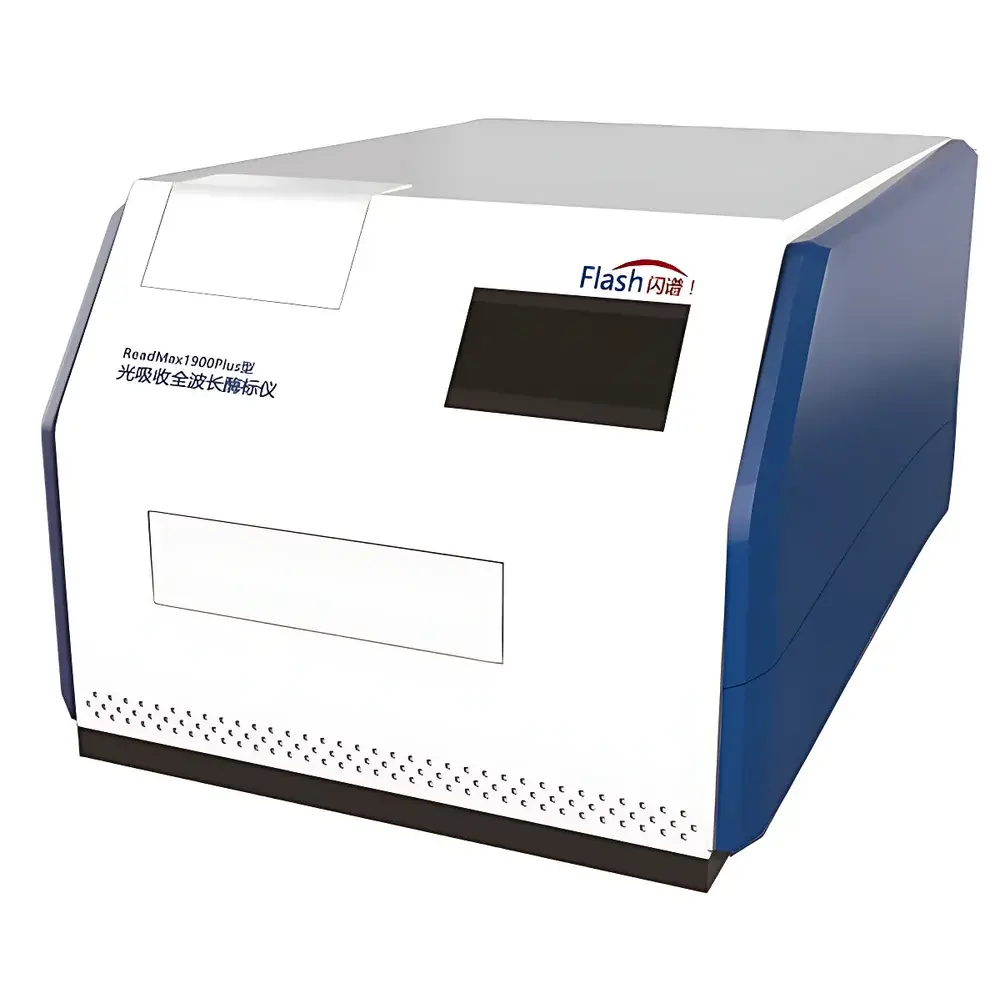
Flash Spectrum ReadMax 1900Plus UV-Vis Full-Range Absorbance Microplate Reader
| Brand | Flash Spectrum |
|---|---|
| Origin | Shanghai, China |
| Model | ReadMax 1900Plus |
| Function Type | Absorbance-Only |
| Automation Level | Fully Automated |
| Assay Modes | Endpoint, Kinetic, Spectral Scan |
| Curve Fitting | Linear Regression |
| Detector Configuration | Dual-Channel (Sample + Reference) |
| Wavelength Range | 190–1000 nm |
| Absorbance Range | 0–4.000 OD |
| Absorbance Linearity | 0–4.000 OD |
| Kinetic Measurement Speed | 6 sec per wavelength |
| Wavelength Accuracy | ±1.0 nm |
| Wavelength Repeatability | <0.2 nm |
| Temperature Control Range | Ambient +2°C to 65°C |
| Plate Compatibility | Standard 96-well and UV-transparent 96-well microplates |
| Light Source | Xenon Flash Lamp |
| Cuvette Port | Integrated UV-Vis spectrophotometer path |
| Software Compliance | FDA 21 CFR Part 11, IQ/OQ/PQ validated, GLP/GMP-ready audit trail |
Overview
The Flash Spectrum ReadMax 1900Plus is a fully automated, monochromator-based absorbance microplate reader engineered for precision quantification across the full ultraviolet–visible spectrum (190–1000 nm). It employs a high-stability xenon flash lamp coupled with a precision grating monochromator to deliver discrete, user-selectable wavelengths without reliance on interference filters—ensuring spectral flexibility, long-term photometric stability, and minimal lamp aging effects. Unlike filter-based systems, the ReadMax 1900Plus supports continuous spectral scanning, enabling full UV-Vis absorbance profiling of nucleic acids, proteins, enzyme reaction intermediates, and chromogenic substrates. Its dual-channel optical architecture—featuring independent sample and reference detectors—minimizes drift and enhances measurement reproducibility, particularly critical in kinetic assays and low-OD applications. Designed for regulated environments, the instrument integrates hardware-level temperature control (up to 65°C), on-board plate shaking, and a dedicated cuvette compartment that functions as a standalone UV-Vis spectrophotometer—extending utility beyond microplate formats to standard 1-cm quartz or plastic cuvettes.
Key Features
- Grating-based monochromator with 190–1000 nm spectral coverage and ±1.0 nm wavelength accuracy
- Dual-detector system (sample + reference) for real-time background correction and improved photometric fidelity
- Integrated Peltier-controlled incubation module (ambient +2°C to 65°C) with programmable ramping and hold profiles
- On-board orbital shaking (300–1200 rpm) with adjustable amplitude and duration, eliminating need for external shakers
- Dedicated cuvette port supporting 1-cm pathlength cells—enabling direct nucleic acid (A260/A280), protein (A280, A205), and small-molecule quantitation
- Kinetic mode capable of acquiring data at user-defined intervals (minimum 6 sec per wavelength), suitable for enzyme kinetics (e.g., NADH oxidation, phosphatase activity) and cell viability assays (MTT, XTT)
- Spectral scan mode generating full absorbance spectra (1 nm resolution) for compound identification, purity assessment, and method development
- Automated wavelength calibration using certified reference standards; optional traceable calibration kit available
- Robust mechanical design with vibration-damped optical bench and thermally stabilized detector housing
Sample Compatibility & Compliance
The ReadMax 1900Plus accommodates standard 96-well polystyrene, black/clear-bottom, and UV-transparent microplates—including those used in ELISA, cell-based assays, microbial growth monitoring (OD600), and endotoxin (LAL) testing. Its broad spectral range supports established quantification methods: nucleic acid analysis (260/280 nm ratio), Bradford/Lowry/BCA protein assays, enzymatic activity measurements (e.g., alkaline phosphatase, horseradish peroxidase), and metabolic assays (NAD(P)H, GST, kinase activity). The system complies with international quality frameworks: software enforces role-based access control, electronic signatures, and immutable audit trails meeting FDA 21 CFR Part 11 requirements. Instrument qualification documentation (IQ/OQ/PQ protocols) is provided, and operational parameters are fully traceable per GLP and GMP guidelines—making it suitable for QC laboratories in biopharmaceutical manufacturing and contract research organizations.
Software & Data Management
The S-Pro Microplate Analysis Workstation is a Windows-based application offering modular assay configuration, real-time data visualization, and ISO/IEC 17025-aligned reporting. It supports multi-parameter kinetic modeling (linear, exponential, sigmoidal), endpoint normalization (e.g., % inhibition, fold-change), and statistical validation (CV%, Z′-factor, signal-to-noise). All user actions—including plate layout definition, protocol execution, result export, and parameter modification—are logged with timestamp, operator ID, and reason-for-change fields. Raw absorbance values, processed curves, and audit logs are stored in encrypted SQLite databases with automatic backup scheduling. Export options include CSV, PDF (with embedded metadata), and XML for LIMS integration. The software undergoes annual re-validation and supports 21 CFR Part 11-compliant electronic signatures with biometric or token-based authentication.
Applications
- Nucleic acid quantification and purity assessment (DNA/RNA concentration, A260/A280, A260/A230)
- Protein concentration determination via direct UV (A280), Bradford, Lowry, or BCA assays
- Enzyme-linked immunosorbent assays (ELISA/EIA) with endpoint, dual-wavelength, and kinetic readout modes
- Cell viability and cytotoxicity screening (MTT, XTT, resazurin, LDH release)
- Microbial growth kinetics (OD600 monitoring over time)
- Endotoxin detection using chromogenic LAL assays
- Enzyme kinetics (Michaelis-Menten analysis, IC50/LD50 determination)
- UV-Vis spectral characterization of purified proteins, ligands, and nanomaterials
- Quality control of conjugated antibodies, labeled oligonucleotides, and diagnostic reagents
FAQ
Does the ReadMax 1900Plus support wavelength scanning below 200 nm?
Yes—the optical path is purged with nitrogen or argon (optional accessory) to enable reliable measurements down to 190 nm, essential for peptide bond and nucleic acid backbone absorbance.
Can the cuvette port accommodate non-standard pathlength cells?
The integrated spectrophotometer path accepts standard 10-mm square cuvettes (quartz or UV-grade plastic); custom adapters for 5-mm or 2-mm cells are available upon request.
Is remote instrument control supported?
Yes—via USB 2.0 interface and TCP/IP-enabled software modules compatible with LabVIEW, Python (PySerial), and MATLAB for automated workflow integration.
What validation documentation is included?
Factory-installed IQ/OQ protocols, wavelength and photometric accuracy verification reports, and a complete 21 CFR Part 11 compliance dossier—including electronic signature configuration guides and audit trail specifications.
How is thermal uniformity across the microplate ensured during incubation?
The heated lid and bottom-heating plate operate under independent PID control; thermal mapping data (per ASTM E2923) confirms ±0.5°C uniformity across all 96 wells at 37°C and 65°C.




