
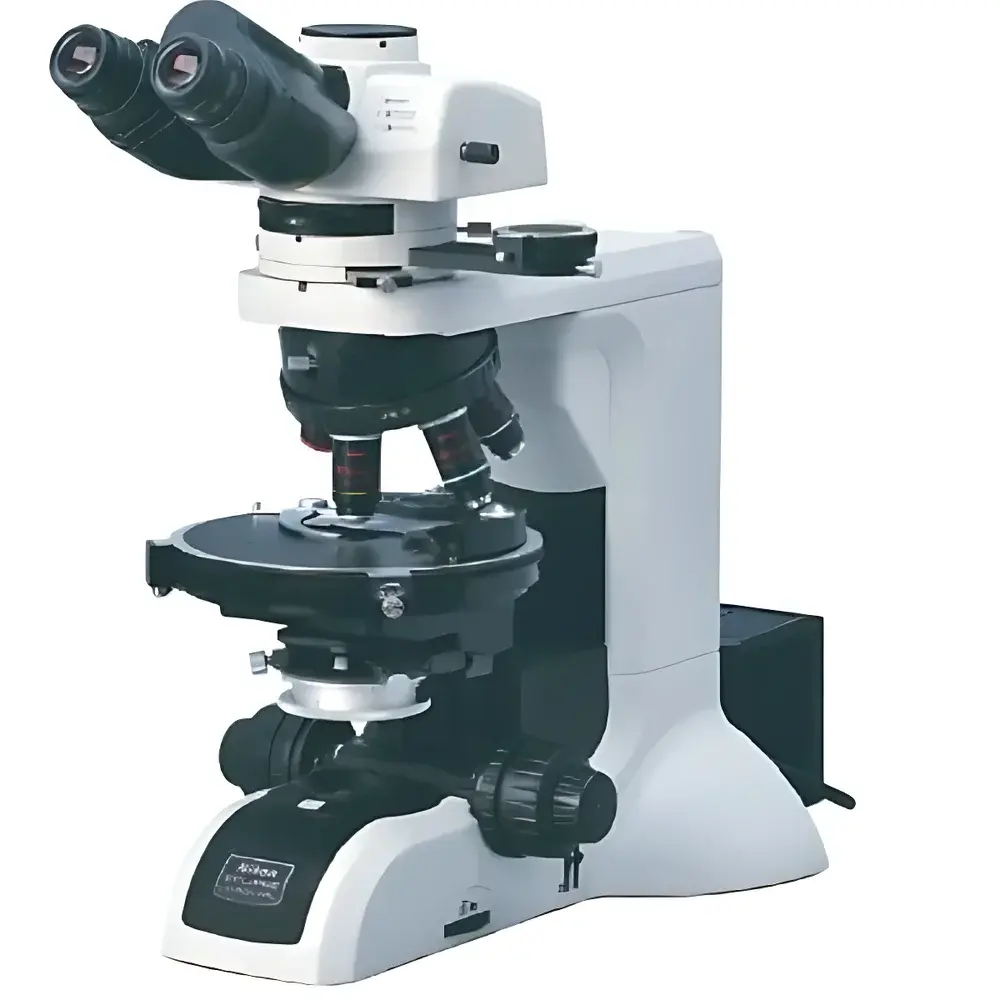
Nikon ECLIPSE LV100N and E200POL Research-Grade Polarizing Microscopes
| Brand | Nikon |
|---|---|
| Origin | Japan |
| Model | ECLIPSE LV100N / E200POL |
| Optical System | CFI60 Infinity-Corrected |
| Eyepieces | Standard 10× (FOV 22 mm), CM-type with 90° crosshair and micrometer scale |
| Basic set | 10× (FOV 20 mm) |
| Tube | Binocular P-TB2 / Trinocular P-TT3 (LV100N) |
| Intermediate Tube | Built-in focusable Bertrand lens (removable from optical path) |
| Analyzer | 360° rotatable dial, minimum angular resolution 0.1° |
| Objective Turret | Fixed 4-position |
| Focus Mechanism | Coarse/fine adjustment — fine drive: 0.2 mm/rev, coarse travel: 37.7 mm/rev |
| minimum step size | 2 µm (left-hand fine knob) |
| Stage | 160 mm circular graduated stage, 1° increments with vernier reading to 0.1° |
| Illumination | Pre-centered 6 V–30 W halogen lamp with continuously variable intensity control |
| Objectives | CFI Achromat P 4×, 10×, LWD P 20×, 40×, 100× Oil (all strain-free, polarized-light optimized) |
| Condenser | Strain-free swing-out condenser |
| Polarizer | Mounted at condenser base |
| Compensators | Standard λ/4 and tint plates |
Overview
The Nikon ECLIPSE LV100N and E200POL are dedicated research-grade polarizing microscopes engineered for high-fidelity birefringence analysis in geological, materials science, pharmaceutical, and polymer laboratories. Both systems employ Nikon’s CFI60 infinity-corrected optical architecture—designed to minimize internal stress and chromatic aberration—ensuring exceptional image fidelity under crossed-polarized illumination. The LV100N is configured for advanced quantitative polarimetry, featuring a built-in Bertrand lens for conoscopic observation, precise 0.1°-resolution analyzer rotation, and integrated compensation slots compatible with standardized retardation devices. The E200POL offers streamlined ergonomics and modular adaptability for routine polarized-light imaging while maintaining full compatibility with Nikon’s CFI polarized objectives and strain-free optical train. Neither instrument compromises on mechanical stability or thermal drift control—critical for long-duration extinction angle measurements and time-lapse birefringence mapping.
Key Features
- CFI60 strain-free infinity optics optimized for polarized light: All lenses, prisms, and tube lenses are manufactured to <0.5 nm residual stress specifications per ISO 10110-5, eliminating spurious birefringence artifacts.
- Dual-path observation capability: Orthoscopic (direct) and conoscopic (interference figure) modes selectable via mechanical lever; Bertrand lens focus-adjustable without realignment.
- Precision rotational mechanics: Analyzer dial calibrated to ±0.1° accuracy over full 360° range; vernier-equipped 160 mm circular stage enables reproducible crystal orientation registration (±0.1° repeatability).
- Modular compensation system: Dedicated intermediate tube slot accepts λ/4 plates, full-wave tint plates, quartz wedges (0–30λ range), and Senarmont compensators—each with defined fast-axis orientation markers per ASTM E1318.
- Strain-free illumination pathway: Pre-centered 6 V–30 W halogen source coupled with swing-out condenser ensures uniform Köhler illumination without induced polarization distortion.
- Objective suite compliance: CFI Achromat P series (4×, 10×, LWD 20×, 40×, 100× Oil) meet ISO 8578 requirements for numerical aperture tolerance (±0.01 NA), working distance consistency, and extinction ratio >10⁴:1 under crossed polars.
Sample Compatibility & Compliance
These microscopes accommodate standard 26 mm and 32 mm diameter thin sections, polished metallographic mounts, polymer films (1–500 µm thickness), pharmaceutical crystalline dispersions, and liquid crystal cells. All optical components—including slide holders, objective housings, and condenser mounts—are certified free of thermally induced birefringence per JIS B 7152. The systems support GLP-compliant documentation workflows when paired with Nikon NIS-Elements software: audit trails record analyzer angle, exposure time, objective ID, and stage coordinates with timestamped metadata. Mechanical stage encoders (optional) enable XY positional traceability aligned with ISO/IEC 17025 calibration requirements for metrological applications.
Software & Data Management
When integrated with Nikon NIS-Elements AR (Advanced Research) software, the LV100N/E200POL supports automated extinction angle measurement, interference figure capture, retardation quantification using Michel-Lévy charts or direct pixel-intensity calibration, and multi-channel birefringence mapping. Software modules comply with FDA 21 CFR Part 11 for electronic records and signatures—enabling secure user authentication, role-based access control, and immutable audit logs. Image metadata embeds EXIF-compliant polarization parameters (e.g., analyzer angle, compensator type, objective NA), ensuring traceability across collaborative research environments governed by ISO 9001 or ICH Q5E guidelines.
Applications
- Geosciences: Quantitative mineral identification via optic sign determination, optic axial angle measurement, and dispersion staining of silicates and carbonates.
- Materials Characterization: Stress distribution mapping in tempered glass, weld zone birefringence profiling, and phase transition kinetics in shape-memory alloys.
- Pharmaceutical Development: Polymorph screening of active pharmaceutical ingredients (APIs), crystallinity assessment of amorphous solid dispersions, and hydrate/solvate differentiation.
- Polymer Science: Spherulite morphology analysis, draw-ratio quantification in oriented fibers, and lamellar thickness estimation via selected-area retardation spectroscopy.
- Forensics & Quality Control: Fiber identification in trace evidence, counterfeit detection in optically anisotropic packaging films, and coating uniformity validation.
FAQ
What distinguishes the LV100N from the E200POL in terms of optical train design?
The LV100N includes a fully focusable Bertrand lens and dual-mode (conoscopic/orthoscopic) observation capability within a single intermediate tube assembly; the E200POL uses a fixed Bertrand lens optimized for rapid switching between transmission and reflected polarized modes.
Are CFI Achromat P objectives compatible with non-polarizing Nikon microscope frames?
Yes—CFI60 P-series objectives maintain mechanical and optical compatibility with all Nikon CFI60 platforms, though strain-free performance and extinction ratios are only guaranteed when used with designated polarizing tubes, analyzers, and condensers.
Can the system be calibrated for absolute retardation measurement?
Yes—using NIST-traceable quartz wedge standards and the built-in 0.1° analyzer encoder, users can perform two-point calibration per ASTM E2822 to achieve ±0.5 nm retardation uncertainty at 546 nm wavelength.
Is motorized stage or analyzer control available as a factory option?
Motorized XYZ stages and programmable analyzer rotation (0.01° resolution) are available as OEM-integrated options under Nikon’s Custom Configuration Program (CCP), with full API support in NIS-Elements SDK.
Does the system meet regulatory requirements for pharmaceutical microscopy documentation?
When deployed with NIS-Elements AR v5.01+ and validated hardware configuration, the platform satisfies data integrity requirements outlined in USP , EU Annex 11, and FDA Guidance for Industry on Computerized Systems Used in Clinical Trials.





