
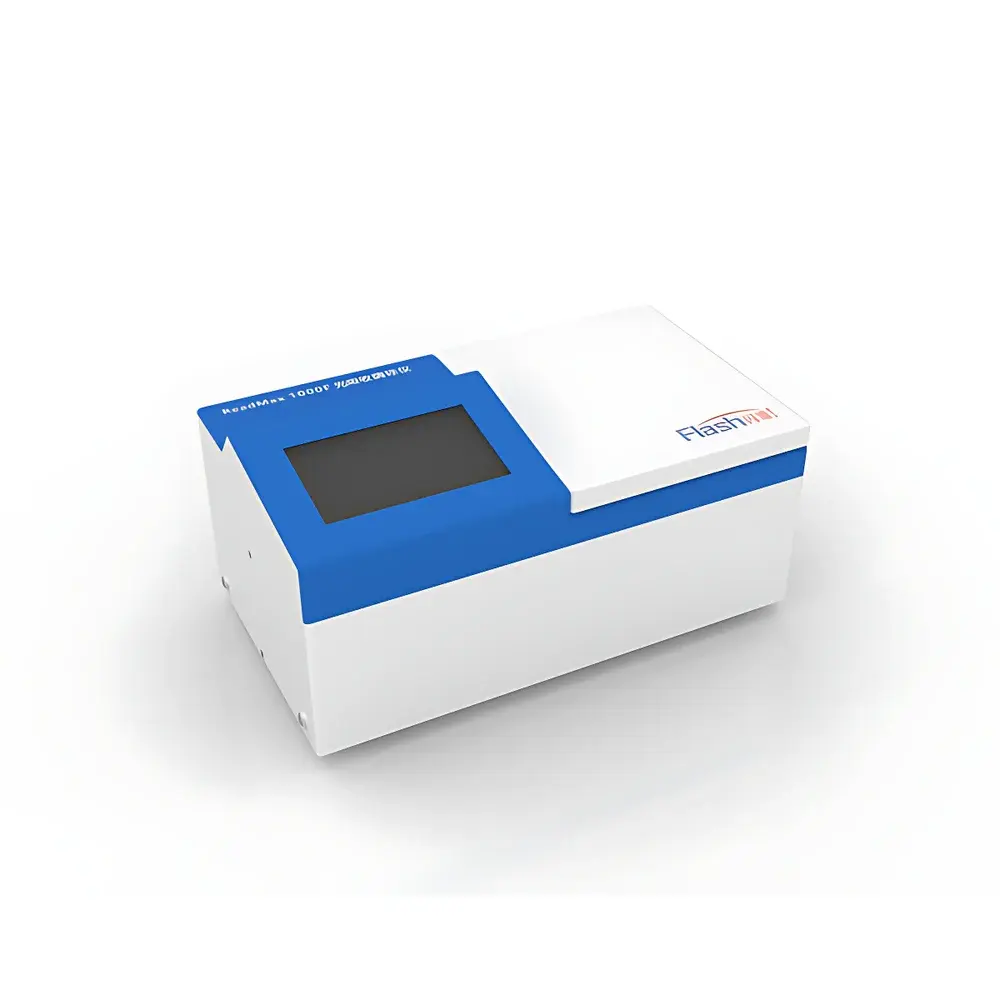
Flash Spectrum ReadMax 1000F Absorbance Microplate Reader
| Brand | Flash Spectrum |
|---|---|
| Origin | Shanghai, China |
| Model | ReadMax 1000F |
| Detection Principle | Absorbance (UV-Vis) |
| Wavelength Range | 190–1000 nm |
| Absorbance Range | 0–6 Abs |
| Linearity Range | 0–3 Abs (±2%) |
| Wavelength Measurement Speed | 6 s per 96-well plate (fast mode) |
| Precision | CV ≤ 0.2% (0–3 Abs) |
| Detector Type | Photodiode |
| Filter Capacity | Up to 16 positions (standard: 405, 450, 620 nm) |
| Plate Format | Standard 96-well microplates |
| Resolution | 0.001 Abs |
| Incubation Option | Optional heated incubator module (MF-10) |
| Control Interface | 7-inch capacitive touchscreen |
| Data Storage | 100 protocols + 100 × 96-well datasets |
| Connectivity | 3× USB (PC, USB drive, printer) |
Overview
The Flash Spectrum ReadMax 1000F is a high-performance, fully automated absorbance microplate reader engineered for precision endpoint and kinetic assays in life science laboratories. Based on dual-beam photometric architecture with a stabilized xenon flash lamp and temperature-compensated photodiode detection, it delivers robust optical performance across the ultraviolet-to-near-infrared spectrum (190–1000 nm). Its design prioritizes reproducibility, traceability, and compliance-ready operation—making it suitable for regulated environments where data integrity is essential. Unlike hybrid multimode readers, the ReadMax 1000F is purpose-built for absorbance-based quantification, eliminating cross-modal interference and optimizing signal-to-noise ratio for colorimetric assays including ELISA, protein quantification (Bradford, Lowry), cytotoxicity (MTT/XTT), enzyme kinetics (phosphatase, kinase), endotoxin (LAL), and microbial growth monitoring.
Key Features
- Stabilized xenon flash lamp with >10⁹ flashes lifetime—ensures consistent spectral output without warm-up drift or intensity decay between measurements.
- Dual-reference channel system: independent blank reference and background reference channels enable real-time correction for plate heterogeneity, meniscus variation, and optical path differences.
- High-capacity filter wheel (up to 16 positions) with factory-calibrated interference filters; standard configuration includes 405 nm, 450 nm, and 620 nm—optimized for common immunoassay and cell viability applications.
- True single-beam, dual-wavelength capability: simultaneous acquisition at two user-defined wavelengths supports ratiometric analysis (e.g., background subtraction in turbid samples) without mechanical repositioning delay.
- Integrated linear shaker with three programmable speed settings (low/medium/high) ensures homogeneous mixing prior to measurement—critical for endpoint assays requiring uniform reaction completion.
- Onboard 7-inch capacitive touchscreen interface with intuitive workflow navigation; no external PC required for routine operation, protocol execution, or result review.
- Comprehensive onboard data management: stores up to 100 assay protocols and 100 full 96-well datasets with timestamp, operator ID, and plate map metadata—supporting GLP-aligned record retention.
- USB host connectivity (3 ports): direct export to USB mass storage devices, seamless integration with laboratory printers, and optional PC tethering for advanced data export (CSV, XML) and remote instrument control.
Sample Compatibility & Compliance
The ReadMax 1000F is validated for use with ANSI/SBS-compliant 96-well microplates—including clear, flat-bottom, UV-transparent, and opaque formats. It accommodates standard assay volumes (100–300 µL per well) and supports both static and kinetic read modes with configurable interval timing (1 s to 24 h). The instrument meets key international performance benchmarks: absorbance linearity (0–3 Abs, ±2% deviation per ASTM E275-22), inter-plate precision (CV ≤ 0.2% at 405 nm, 0–3 Abs), and wavelength accuracy (±1 nm certified per NIST-traceable calibration standards). While not pre-certified for FDA 21 CFR Part 11, its audit trail functionality—including immutable timestamps, operator logins, and protocol versioning—enables straightforward validation for GxP environments when deployed with appropriate SOPs and electronic signature controls.
Software & Data Management
Firmware-based embedded software provides complete assay lifecycle control—from plate layout definition and wavelength selection to curve fitting (linear, 4PL, 5PL, log-log) and statistical analysis (mean, SD, CV, Z′-factor). Raw absorbance values are stored in vendor-neutral CSV format with column headers compliant with MIAME and MIAPE reporting guidelines. Optional PC software (FlashSpectrum Analyst Suite) extends capabilities with multi-plate batch processing, plate heatmaps, outlier detection, and automated report generation compatible with LIMS interfaces. All data files include embedded metadata: instrument serial number, firmware revision, calibration date, and user-defined experiment notes—facilitating traceability during internal audits or regulatory inspections.
Applications
- Quantitative Immunoassays: High-sensitivity ELISA/EIA using 450 nm detection with optional dual-wavelength correction (e.g., 450/620 nm) to mitigate edge effects and matrix interference.
- Protein Quantification: Bradford, Lowry, BCA, and biuret assays across 405–620 nm range; validated linearity supports accurate dilution-series interpolation.
- Cytotoxicity & Viability Screening: MTT, XTT, and resazurin reduction assays with kinetic monitoring up to 48 h—enabled by programmable incubation (with MF-10 module) and time-resolved absorbance tracking.
- Enzyme Kinetics: Initial rate determination for phosphatases, proteases, and kinases using continuous-mode absorbance acquisition at defined intervals (e.g., 15-s sampling over 30 min).
- Endotoxin Testing: Chromogenic LAL assays compliant with USP and EP 2.6.14, utilizing 405 nm endpoint detection with built-in curve-fitting algorithms for endotoxin concentration calculation.
- Microbial Growth Monitoring: Turbidimetric OD600 measurements for bacterial/fungal culture density assessment in antibiotic susceptibility or fermentation optimization studies.
FAQ
Is the ReadMax 1000F compliant with FDA 21 CFR Part 11?
The instrument supports core technical prerequisites (audit trail, electronic signatures via optional PC software, and data integrity safeguards), but formal Part 11 compliance requires site-specific validation documentation and procedural controls—not inherent to the hardware alone.
Can it perform kinetic assays?
Yes—supports time-resolved absorbance measurements with user-defined intervals (1 s to 24 h), ideal for enzyme kinetics, cell proliferation, and LAL activation monitoring.
What calibration standards are supported?
NIST-traceable neutral density filters and holmium oxide solution are recommended for wavelength and photometric verification; optional certified calibration plates (FlashCal-Abs) provide full-system performance validation.
Does it require external cooling or ventilation?
No—the xenon lamp and detector assembly operate within ambient lab conditions (15–30 °C, non-condensing humidity); no active cooling or dedicated exhaust is needed.
How is data security ensured during USB export?
All exported CSV files contain only measurement data and metadata; no proprietary firmware or configuration files are accessible via USB interface—preventing unauthorized modification or reverse engineering.





