
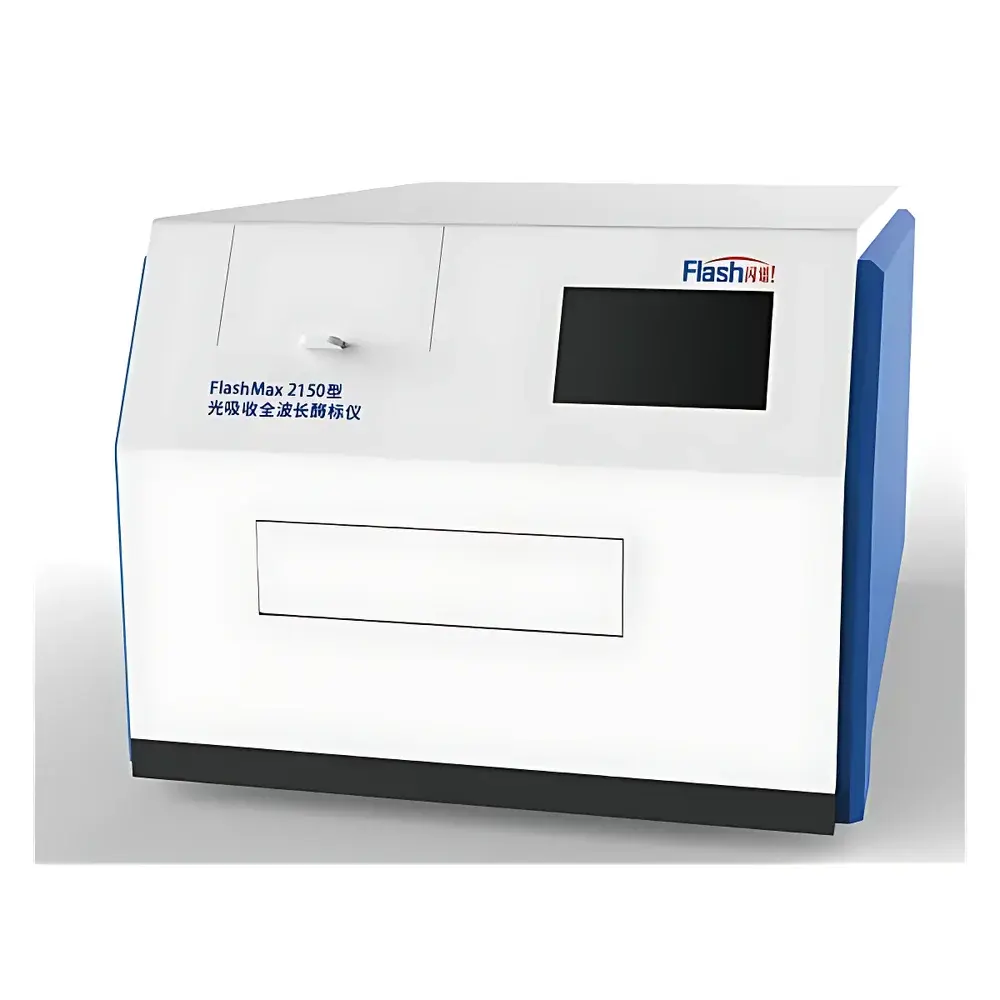
FlashMax 2150 UV-Vis Full-Range Absorbance Microplate Reader
| Brand | Shanghai Flash Spectrum |
|---|---|
| Origin | Shanghai, China |
| Instrument Type | Absorbance-Based Microplate Reader |
| Automation Level | Fully Automated |
| Wavelength Range | 190–1000 nm |
| Optical System | Monochromator-Based (Grating) with Dual-Detector Architecture (8 Sample + 8 Reference Channels) |
| Temperature Control | Ambient to 65 °C (Uniformity: ±0.2 °C at 37 °C) |
| Built-in Functions | Plate Incubation, Orbital Shaking |
| Optional Module | Standalone Cuvette Holder (1-cm Pathlength) |
| Pathlength Correction | Integrated Optical Pathlength Conversion Algorithm (Converts Microplate OD to Equivalent 1-cm Cuvette OD) |
| Data Analysis Models | Linear, Quadratic, Cubic, Quartic, 4-Parameter Logistic (4PL), 5-Parameter Logistic (5PL), Logarithmic, Exponential, Double-Logarithmic Fitting |
| Software | PC-Based Control & Analysis Suite with Formula Editor, Audit Trail, and Export (CSV, Excel, PDF) |
Overview
The FlashMax 2150 is a high-performance, fully automated UV-Vis absorbance microplate reader engineered for precision quantification and kinetic profiling in life science laboratories. Based on monochromator-driven grating optics, it delivers continuous spectral acquisition across a broad wavelength range of 190–1000 nm—enabling reliable detection of nucleic acids (260 nm), proteins (280 nm), colorimetric enzyme assays (e.g., pNPP at 405 nm), and redox indicators (e.g., MTT at 570 nm). Its dual-detector architecture—comprising eight independent sample photodiodes and eight matched reference detectors—minimizes inter-channel variability and enhances measurement reproducibility by compensating for lamp drift and optical path fluctuations in real time. Designed for compliance-critical environments, the instrument supports traceable operation through timestamped data logging, user-access controls, and configurable audit trails aligned with GLP and FDA 21 CFR Part 11 principles.
Key Features
- Fully automated microplate handling with programmable incubation (ambient to 65 °C) and orbital shaking—optimized for ELISA, cell viability, and enzymatic kinetics.
- High-fidelity monochromator system with <1.5 nm bandwidth resolution ensures accurate spectral discrimination and minimal stray light interference.
- Integrated pathlength correction algorithm automatically converts raw microplate absorbance (OD) values into equivalent 1-cm cuvette absorbance, enabling direct comparison with spectrophotometric reference standards.
- Optional standalone cuvette module provides full UV-Vis absorbance capability for macro-volume samples (up to 3 mL), eliminating the need for secondary instrumentation during method development or calibration verification.
- Robust thermal control system maintains ±0.2 °C uniformity at 37 °C across all 96- or 384-well plate formats—critical for temperature-sensitive immunoassays and enzyme activity measurements.
Sample Compatibility & Compliance
The FlashMax 2150 accommodates standard ANSI/SLAS-compliant microplates (6–384-well), including clear-bottom, opaque, and UV-transparent polystyrene and polypropylene plates. It supports both endpoint and kinetic read modes, with configurable integration times (0.1–10 s per well) and averaging options (1–10 reads per well). The system meets essential performance benchmarks outlined in ISO 15197:2013 (for quantitative assay reliability) and ASTM E2535-21 (microplate reader verification protocols). All software operations—including method saving, result calculation, and export—are structured to support laboratory quality systems compliant with ISO/IEC 17025 and GxP requirements.
Software & Data Management
The FlashMax Control & Analysis Suite is a Windows-based application offering full instrument control, protocol sequencing, and advanced data reduction. It features a formula editor supporting custom mathematical expressions (e.g., % inhibition, fold-change, normalized response), batch processing for multi-plate studies, and automatic generation of calibration curves using eight nonlinear regression models—including 4PL and 5PL fitting widely adopted in immunoassay validation per USP . Raw and processed data are stored in encrypted project files with immutable metadata (operator ID, timestamp, instrument serial number, parameter set hash). Export options include CSV (tabular), Excel (.xlsx), and PDF (formatted reports with embedded graphs), all retaining full traceability for regulatory submissions.
Applications
- Protein quantification via Bradford, BCA, and Lowry assays
- ELISA and sandwich immunoassay development and QC
- Enzyme kinetic profiling (e.g., LDH, ALP, HRP, β-galactosidase)
- Cell proliferation and cytotoxicity screening (MTT, XTT, WST-1)
- Nucleic acid purity assessment (A260/A280, A260/A230 ratios)
- Microbial growth monitoring in liquid culture
- Validation of assay linearity, sensitivity, and dynamic range per ICH Q2(R2)
FAQ
Does the FlashMax 2150 support kinetic measurements?
Yes—it performs time-resolved absorbance readings with user-defined intervals (1 second to 24 hours) and up to 1,000 cycles per experiment.
Can the instrument validate assay performance per CLIA or CAP guidelines?
While not CLIA-certified as a clinical device, its analytical capabilities—including CV ≤1.2% at 0.5 OD and linearity R² ≥0.999 over 0–3.0 OD—meet technical thresholds referenced in CAP checklist MICRO.40500.
Is remote operation supported?
The software allows network deployment via LAN; however, remote desktop access must comply with institutional IT security policies and is not natively integrated.
How is wavelength accuracy verified?
Users may perform routine verification using NIST-traceable holmium oxide or didymium filters, with built-in calibration validation tools reporting deviation against certified peak positions.
What file formats are generated for raw data export?
Raw absorbance matrices are exported as UTF-8 CSV; analysis results and graphs are available in Excel (.xlsx) and print-ready PDF formats with embedded metadata.



