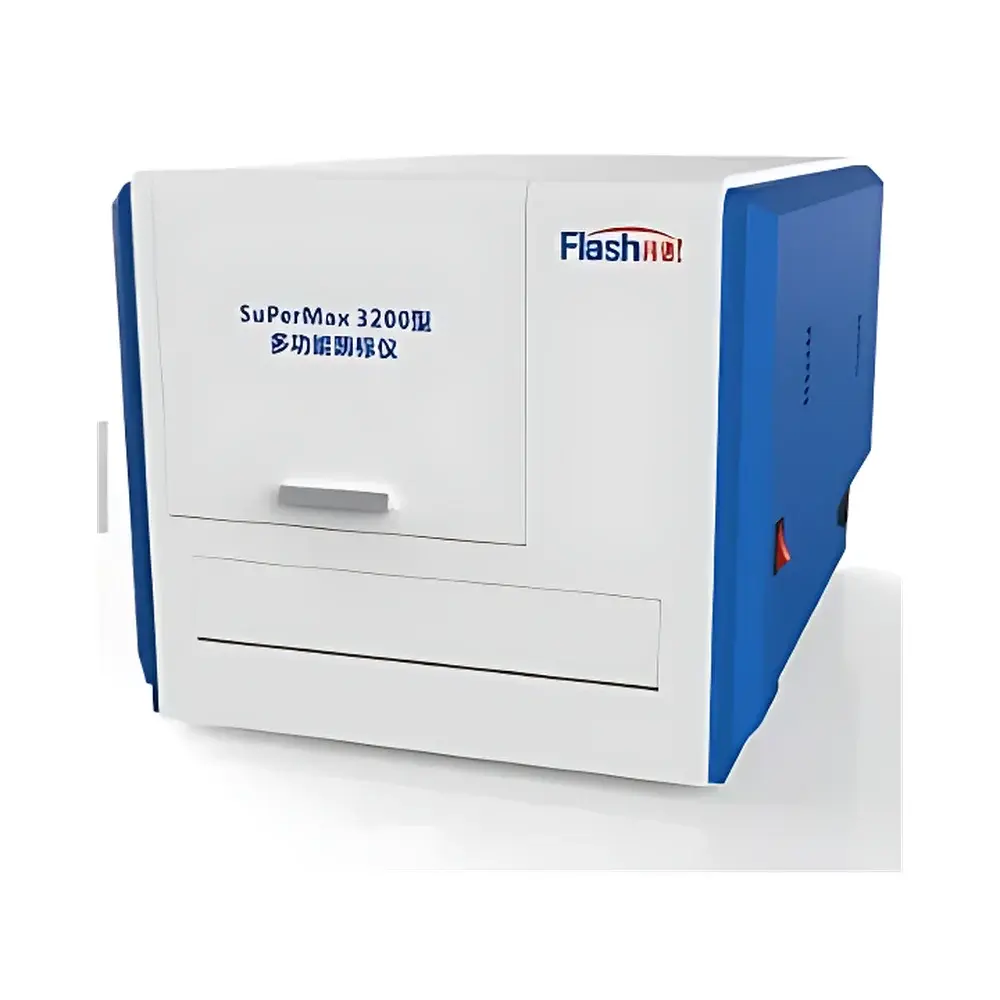
Flash Spectrum SuPerMax 3200 Multimode Microplate Reader
| Brand | Flash Spectrum (Shanghai Flash Spectrum Biotechnology Co., Ltd.) |
|---|---|
| Origin | Shanghai, China |
| Model | SuPerMax 3200 |
| Detection Modes | Absorbance, Fluorescence, Luminescence |
| Automation Level | Fully Automated |
| Wavelength Range | 190–1000 nm (Abs/Fluor Excitation), 270–850 nm (Fluor Emission), 300–650 nm (Luminescence) |
| Absorbance Linearity | 0–4 Abs (96-well, 450 nm), ±2% |
| Fluorescence Sensitivity | < 0.4 fmol FITC/well (top-read, 384-well plate) |
| Wavelength Resolution | 1 nm |
| Wavelength Accuracy | < ±0.2 nm |
| Temperature Control | RT+2°C to 65°C |
| Plate Formats | 6- to 384-well microplates |
| Read Modes | Top & Bottom Reading |
Overview
The Flash Spectrum SuPerMax 3200 Multimode Microplate Reader is an engineered platform for quantitative and kinetic analysis of biological and biochemical assays in life science research, drug discovery, and clinical diagnostics. Built upon a dual-grating monochromator architecture—featuring independent high-resolution excitation and emission gratings—it delivers low stray light performance (< 0.0005%) across a broad spectral range (190–1000 nm). The system implements photometric principles compliant with ISO 15197 and ASTM E2512 for absorbance, photon-counting methodology for luminescence per ICH Q5C guidance, and calibrated fluorescence intensity measurement traceable to NIST-traceable fluorescein standards. Its optical path correction technology dynamically normalizes measured absorbance values to a standard 1 cm pathlength—enabling direct comparability with cuvette-based spectrophotometers without manual dilution or correction factors. Designed for GLP-compliant environments, the instrument supports configurable audit trail logging (21 CFR Part 11-ready when enabled), temperature-controlled incubation, and integrated plate agitation—eliminating reliance on external peripherals in high-throughput screening workflows.
Key Features
- Dual monochromator design with independently tunable excitation (190–1000 nm) and emission (270–850 nm) optics, enabling optimal wavelength selection for multiplexed fluorescent probes including FRET pairs.
- High-sensitivity detection architecture: side-window photomultiplier tube (PMT) for fluorescence (top- and bottom-reading modes), photon-counting PMT for luminescence, and precision silicon photodiode for absorbance measurements.
- Integrated thermal control system maintaining uniform well-to-well temperature from ambient +2°C up to 65°C with ±0.3°C stability over 24 h—validated per ISO 8601 protocols for enzyme kinetics and cell-based assays.
- Three agitation modes (linear, orbital, circular) with adjustable amplitude and duration; programmable pre-read mixing eliminates sedimentation artifacts in suspension-based assays (e.g., bacterial growth, liposome binding).
- Spectral scanning capability across full excitation/emission ranges with 1 nm resolution and <0.2 nm repeatability—supports deconvolution of overlapping fluorophores and empirical optimization of assay windows.
- Optical pathlength correction sensor embedded in the detection head automatically converts raw OD readings into standardized 1 cm-equivalent absorbance values—critical for accurate protein/DNA quantification and inter-laboratory data harmonization.
- Xenon flash lamp source provides stable, broadband illumination with >10⁹ shot lifetime and negligible output drift (<0.2% h⁻¹), ensuring long-term measurement reproducibility across multi-day campaigns.
Sample Compatibility & Compliance
The SuPerMax 3200 accommodates standard ANSI/SLAS-format microplates (6-, 12-, 24-, 48-, 96-, and 384-well), including opaque black/white plates for fluorescence/luminescence, clear-bottom plates for cell-based imaging-compatible assays, and UV-transparent polystyrene for nucleic acid work. It supports common assay chemistries including but not limited to: Bradford, BCA, and NanoOrange protein assays; PicoGreen/RiboGreen nucleic acid quantification; luciferase reporter systems (Firefly/Renilla dual-luciferase); cAMP ELISAs; ATP bioluminescence (via firefly luciferase); ROS detection (DCFDA, DHE); and cytotoxicity endpoints (LDH, MTT, resazurin). Instrument firmware and software comply with ISO/IEC 17025:2017 requirements for testing laboratories, and optional audit trail functionality satisfies FDA 21 CFR Part 11 electronic record and signature criteria when configured with user authentication, event logging, and immutable data archiving.
Software & Data Management
The proprietary SuPerMax Workstation software provides a modular interface for protocol definition, real-time monitoring, and statistical analysis. Users define complex multi-step protocols—including temperature ramping, timed reagent addition (when equipped with optional injectors), kinetic sampling intervals, and spectral scan parameters—via drag-and-drop workflow builder. Raw data are stored in vendor-neutral .csv and .xlsx formats; processed results include coefficient of variation (CV%), Z’-factor, signal-to-background (S/B), and signal-to-noise (S/N) metrics calculated per plate and per well. Advanced curve-fitting engines support linear, quadratic, four-parameter logistic (4PL), and five-parameter logistic (5PL) regression models—aligned with CLSI EP22-A guidelines for immunoassay validation. All software modules undergo annual cybersecurity patching and are validated against NIST SP 800-53 controls for data integrity and access management.
Applications
The SuPerMax 3200 serves as a primary analytical platform in academic core facilities, CROs, and pharmaceutical QC labs conducting: high-content enzyme activity profiling (kinases, phosphatases, proteases); label-free and labeled receptor binding assays; cell viability and proliferation studies (including 3D spheroid models); endotoxin detection via LAL chromogenic assays; environmental toxin screening (e.g., heavy metal-induced oxidative stress); food safety testing (aflatoxin, pesticide residues); and biomarker validation in translational research cohorts. Its ability to execute simultaneous dual-wavelength absorbance ratioing (e.g., 260/280 nm for RNA purity) and time-resolved fluorescence (TRF) with delay gating makes it suitable for heterogeneous immunoassays requiring background suppression. In regulated settings, its documented IQ/OQ/PQ protocols and traceable calibration certificates support GMP-aligned method transfer and equipment qualification.
FAQ
Does the SuPerMax 3200 support time-resolved fluorescence (TRF) measurements?
Yes—the instrument’s programmable delay gate and high-speed PMT enable TRF detection using europium and terbium chelates, with default settings optimized for DELFIA®- and LANCE®-compatible protocols.
Can the system perform kinetic assays with variable read intervals?
Yes—users define custom kinetic schedules ranging from sub-second to multi-hour intervals, with up to 999 time points per run and automatic interpolation of missing reads due to plate movement or transient anomalies.
Is the optical path correction feature applicable to all absorbance wavelengths?
Yes—the built-in pathlength sensor operates continuously across the full 190–1000 nm range and applies wavelength-specific correction coefficients derived from NIST-traceable reference standards.
What regulatory documentation is provided for GMP environments?
Flash Spectrum supplies comprehensive qualification packages including Design Qualification (DQ), Installation Qualification (IQ), Operational Qualification (OQ), and Performance Qualification (PQ) templates aligned with Annex 15 and ASTM E2500-13 standards.
How is data integrity ensured during network transmission?
All USB-connected data transfers utilize TLS 1.2 encryption; optional Ethernet connectivity supports IEEE 802.1X port-based authentication and VLAN segmentation for secure lab network integration.
Related Products