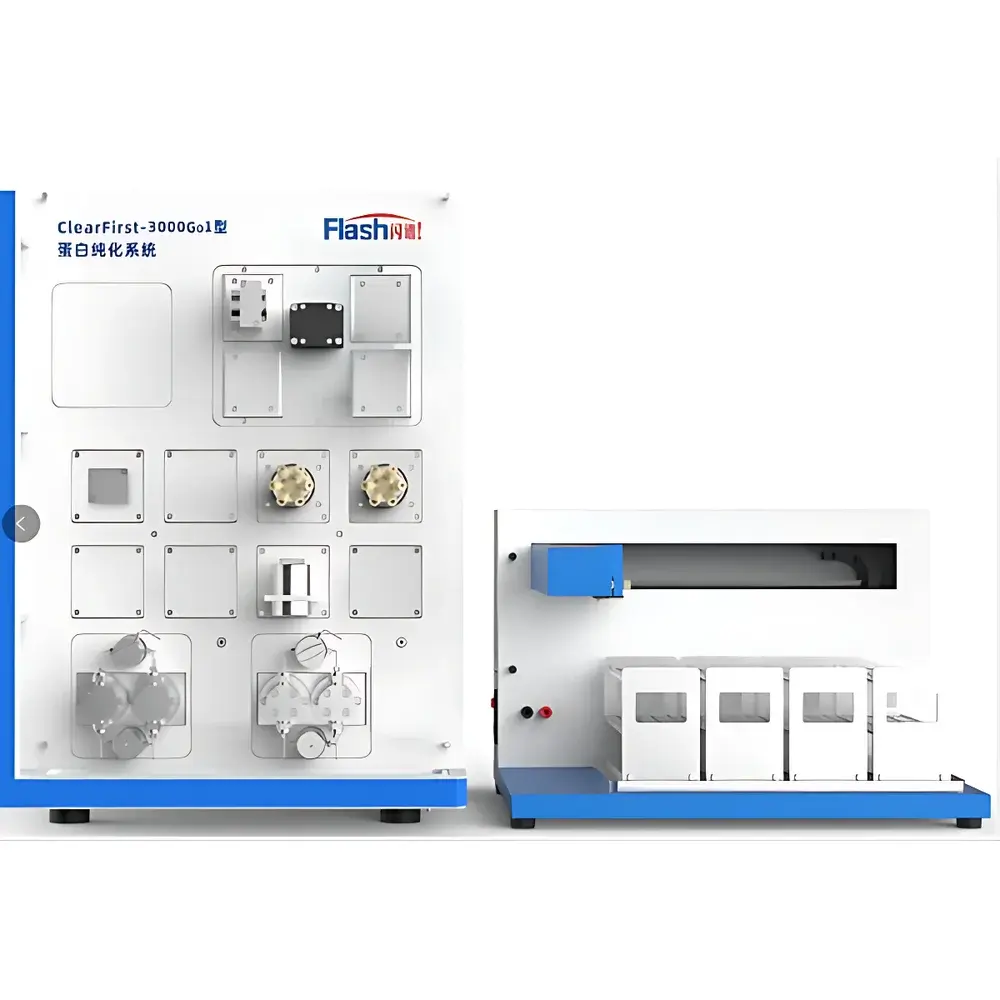
Flash Spectrum ClearFirst-3000Go1 Protein Purification System
| Brand | Flash Spectrum |
|---|---|
| Origin | Shanghai, China |
| Model | ClearFirst-3000Go1 |
| Flow Rate | 0.01–50 mL/min (optional 0.01–100 mL/min) |
| Max Pressure | 27 MPa (270 bar) at ≤25 mL/min |
| UV Detection | 280 nm (±3 nm accuracy, 2 mm pathlength) |
| Conductivity Range | 0–999.9 mS/cm |
| Gradient Formation | High-precision dual-pump gradient system |
| Sample Injection | Automated 3-position, 7-port valve with quantitative loop |
| Fraction Collection | X-Y matrix collector (standard 96-position, 18×150 mm tube compatibility) |
| Software | ClearFirst-3000 Series Workstation (PC-based, method library, user management, audit trail-ready architecture) |
| Compliance | Designed for GLP/GMP-aligned workflows |
Overview
The Flash Spectrum ClearFirst-3000Go1 Protein Purification System is an integrated, high-pressure liquid chromatography (HPLC)-based platform engineered for reproducible, scalable purification of biomolecules—including recombinant proteins, monoclonal antibodies, viral vectors, nucleic acids, and vaccine antigens. It operates on the principle of pressure-driven liquid chromatography, utilizing precise dual-pump gradient formation to deliver stable, low-pulsation flow across a range of column chemistries (affinity, ion exchange, hydrophobic interaction, size exclusion). The system’s architecture integrates biocompatible fluidic pathways—constructed from PEEK, titanium, and inert polymers—to ensure minimal metal leaching, low nonspecific binding, and compatibility with standard aqueous buffers (e.g., Tris-HCl, phosphate, sodium acetate, imidazole gradients). Its maximum operating pressure of 27 MPa (270 bar) enables use of both analytical-scale columns (e.g., 4.6 × 150 mm) and preparative columns (up to 26 mm ID), supporting applications from early-stage process development to mid-scale GMP-adjacent purification.
Key Features
- High-precision dual high-pressure constant-flow pumps with <0.1% flow pulsation, enabling baseline stability critical for UV absorbance quantitation and peak resolution.
- LED-based 280 nm UV detector with ±3 nm wavelength accuracy and interchangeable flow cells (standard 2 mm pathlength; optional 1 mm or 10 mm for extended dynamic range).
- Dedicated conductivity detector with 0–999.9 mS/cm range and temperature-compensated calibration—designed to match the measurement fidelity of leading international platforms.
- Optional integrated pH sensor featuring automatic temperature correction and NIST-traceable calibration protocols.
- Real-time pressure monitoring via dual-position sensors (pump outlet and column outlet), with programmable pressure-limit logic to protect column integrity and prevent over-pressurization.
- Automated 3-position, 7-port sample injection valve supporting quantitative loop loading, column loading, and waste diversion—eliminating air entrapment and ensuring volumetric repeatability.
- Modular gradient architecture with bypass and reverse-flush capabilities, allowing rapid buffer equilibration, on-line column cleaning, and bidirectional flow control without manual tubing reconfiguration.
- X-Y robotic fraction collector with zero-motor base design, minimizing vibration-induced tube misalignment and improving safety in cold room environments (compatible with standard 18 × 150 mm tubes, 15 mL conical tubes, and 96-well plates).
- Configurable multi-column selection valve (5-column + 1 bypass position), enabling automated method switching between orthogonal separation modes within a single run sequence.
- Expandable large-volume injection module (optional peristaltic or syringe pump) for direct loading of clarified lysates or fermentation supernatants up to 500 mL.
Sample Compatibility & Compliance
The ClearFirst-3000Go1 accommodates a broad spectrum of biological samples—from clarified bacterial or mammalian cell lysates to plasma-derived fractions and synthetic oligonucleotides—across viscosity ranges up to 5 cP. Its fluidic system is validated for use with common protein-stabilizing additives (e.g., glycerol, arginine, trehalose) and low-concentration organic modifiers (≤10% acetonitrile or ethanol). All wetted materials comply with USP Class VI biocompatibility standards and ISO 10993-5 cytotoxicity requirements. While the base configuration meets general laboratory quality standards, the system can be configured for regulated environments: optional software modules support 21 CFR Part 11 compliance (electronic signatures, audit trails, role-based access control), and method validation templates align with ICH Q5A, Q5D, and USP analytical instrument qualification guidelines. Routine operation adheres to ASTM E2500-13 (good practice for equipment qualification) and supports GLP documentation workflows.
Software & Data Management
The ClearFirst-3000 Series Workstation is a Windows-based control and analysis platform built on a modular architecture. It provides real-time chromatogram visualization (UV, conductivity, pH, pressure), synchronized fraction triggering, and method-driven automation. Key software capabilities include: a hierarchical method library with version-controlled storage; user-defined collection logic (peak threshold, time window, volume-based, or manual override); integrated sample tracking with barcode-compatible metadata fields; and export of raw data in vendor-neutral formats (e.g., ASCII, CSV, mzML-compatible chromatogram schema). Audit trail functionality records all parameter changes, method executions, and user logins with timestamps and operator IDs—enabling traceability required under ISO/IEC 17025 and FDA inspection protocols. Data integrity safeguards include write-protected archive folders, automatic backup scheduling, and optional encryption-at-rest for sensitive purification records.
Applications
The ClearFirst-3000Go1 supports end-to-end purification workflows across academic, biotech, and contract development laboratories. Typical applications include: affinity capture of His-tagged or GST-fusion proteins using Ni-NTA or glutathione resin; polishing steps via anion/cation exchange chromatography for charge variant resolution; hydrophobic interaction chromatography (HIC) of antibody aggregates; size-exclusion chromatography (SEC) for monomer purity assessment and aggregate quantitation; and multi-step tandem purification of bispecific antibodies or viral capsid proteins. Its flexibility extends to nucleic acid purification (e.g., plasmid DNA, mRNA, AAV vector intermediates) using anion exchange or gel filtration media. The system is routinely employed in upstream process characterization, formulation screening, stability-indicating assay development, and comparability studies during biosimilar development.
FAQ
What chromatographic techniques are supported by the ClearFirst-3000Go1?
It supports affinity, ion exchange (IEX), hydrophobic interaction (HIC), size exclusion (SEC), and mixed-mode chromatography—provided compatible columns and mobile phases are used.
Is the system suitable for GMP manufacturing environments?
The base hardware meets engineering specifications for cleanroom-compatible operation; full GMP compliance requires optional 21 CFR Part 11 software modules, IQ/OQ/PQ documentation packages, and qualified installation in controlled environments.
Can the system interface with third-party data systems (e.g., LIMS or ELN)?
Yes—via configurable ASCII/CSV export, OPC UA server integration (optional), and RESTful API endpoints for method upload, status polling, and event notification.
What is the minimum detectable absorbance change at 280 nm?
System noise level is <0.5 mAU (RMS) under standard flow conditions, enabling reliable detection of low-abundance peaks in complex lysate backgrounds.
How is column backpressure managed during gradient elution?
Real-time pressure feedback triggers automatic flow reduction if preset limits are exceeded; the bypass valve also allows immediate pressure relief without interrupting the run.