
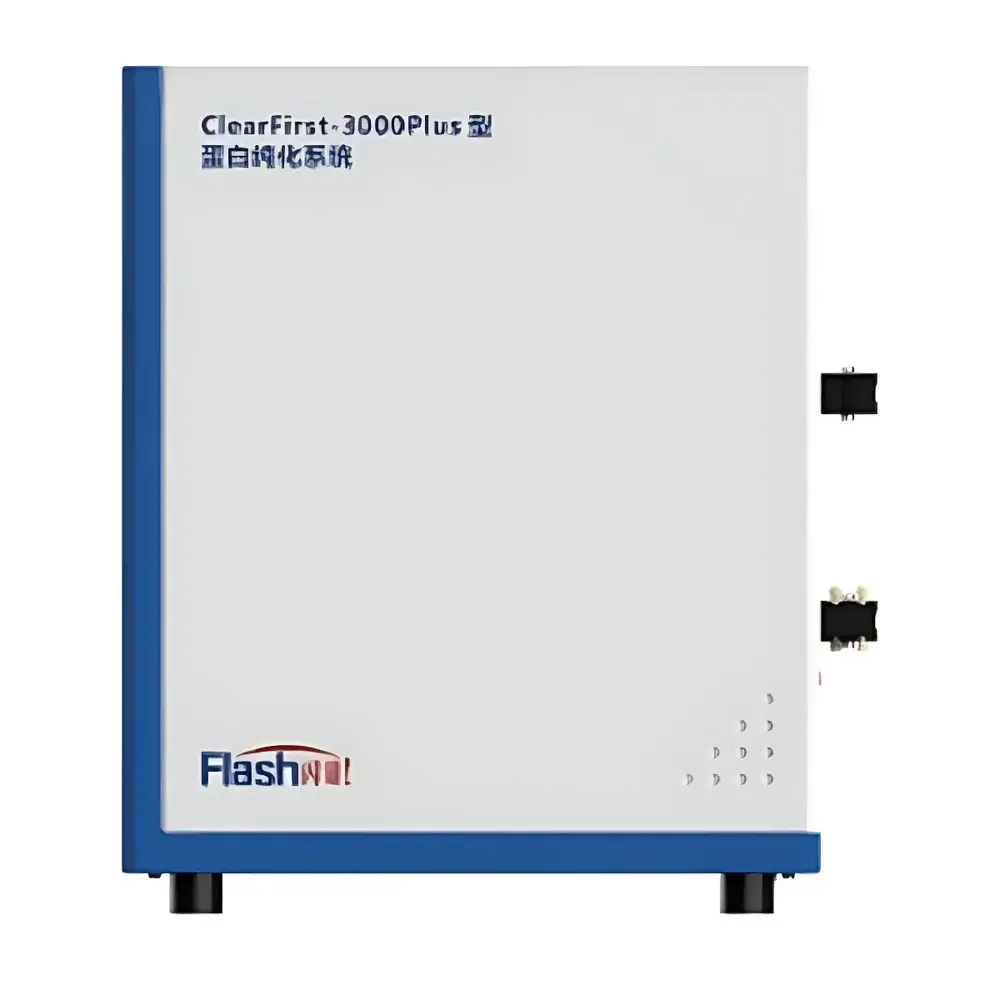
Flash Spectrum ClearFirst-3000Plus Protein Purification System
| Brand | Flash Spectrum |
|---|---|
| Origin | Shanghai, China |
| Model | ClearFirst-3000Plus |
| Flow Rate Range | 0.01–50 mL/min (optional 0.01–100 mL/min) |
| Max Pressure | 27 MPa (270 bar) at ≤25 mL/min |
| UV Wavelength Range | 190–850 nm |
| Wavelength Accuracy | ±1 nm |
| Wavelength Repeatability | ±0.2 nm |
| Conductivity Range | 0–999.9 mS/cm |
| Column Positions | Up to 5 |
| Detection Channels | Quad-wavelength UV-Vis + Conductivity + Optional pH/Pressure |
| Gradient Formation | High-precision dual-pump gradient mixing |
| Fraction Collection | X-Y matrix collector with 96-position 18 mm tube rack (standard), 11-position large-volume collection |
| Compliance | Designed for GLP-compliant workflows, supports audit trail-ready method storage and user management |
Overview
The Flash Spectrum ClearFirst-3000Plus Protein Purification System is an integrated, high-pressure liquid chromatography (HPLC)-based platform engineered for reproducible, scalable purification of proteins, antibodies, nucleic acids, and other biopolymers under native or denaturing conditions. Built upon a dual high-precision syringe-free piston pump architecture, the system delivers stable, pulse-free flow across its full operational range (0.01–50 mL/min, extendable to 100 mL/min), enabling both analytical characterization and milligram-to-gram scale preparative isolation. Its core fluidic design employs bio-inert, pressure-rated wetted materials—including PEEK, titanium, and sapphire—ensuring compatibility with aggressive aqueous buffers, low-pH eluents, and chaotropic agents commonly used in affinity, ion exchange, hydrophobic interaction, and size exclusion chromatography. The system operates on a closed-loop control principle, integrating real-time pressure feedback from column inlet and outlet sensors to dynamically regulate backpressure and safeguard column integrity—critical for maintaining resolution and column lifetime during extended runs.
Key Features
- High-fidelity gradient generation via digitally synchronized dual-pump mixing—eliminating reliance on passive gradient chambers and ensuring <±0.5% gradient accuracy across 0–100% B solvent transitions.
- Quad-wavelength UV-Vis detector based on a precision Czerny-Turner grating monochromator, offering selectable wavelengths between 190 nm and 850 nm with ±0.2 nm repeatability and sub-mAU baseline stability over 24-hour continuous operation.
- Modular optical path design: interchangeable flow cells with 2 mm (standard), 5 mm, and 10 mm pathlengths—optimized for low-concentration sample detection or high-salt buffer compatibility without signal saturation.
- Dedicated conductivity sensor with 0–999.9 mS/cm range and temperature-compensated calibration, matching the measurement principle and dynamic response of industry-standard benchtop analyzers.
- Optional integrated pH sensor featuring automatic temperature compensation and NIST-traceable calibration protocols, delivering ±0.02 pH unit accuracy within physiological and elution pH ranges (pH 2.0–12.0).
- Automated multi-position valve manifold supporting up to five independent columns, buffer selection from four inputs per pump, on-line column backflushing, and programmable bypass routing for rapid buffer equilibration or system priming.
- X-Y robotic fraction collector with brushless stepper actuation, zero-motor footprint beneath the collection tray, and positional repeatability of ±0.1 mm—enabling precise peak-aligned tube indexing without mechanical drift or tube-jump artifacts.
- Full-system automation via ClearFirst-3000 Series Workstation software: method-driven operation with scheduled auto-calibration, hardware self-diagnostics, role-based user access control, and electronic logbook compliant with ALCOA+ data integrity principles.
Sample Compatibility & Compliance
The ClearFirst-3000Plus accommodates a broad spectrum of biomolecular samples—from crude lysates and clarified supernatants to partially purified intermediates—across viscosity ranges up to 5 cP. Its fluidic pathway is validated for use with common chromatographic resins including agarose-, sepharose-, and polymer-based media (e.g., Capto, Source, Toyopearl, and POROS), as well as monolithic and membrane-based supports. The system meets essential functional requirements for GMP-aligned process development environments: all critical parameters (flow, pressure, UV absorbance, conductivity, pH, fraction timing) are timestamped and stored with immutable metadata; method files include version history and digital signatures; and audit trails record operator actions, parameter changes, and instrument events in accordance with FDA 21 CFR Part 11 Annex 11 expectations. While not certified as a Class I medical device, its architecture aligns with ISO 13485 risk management frameworks for laboratory instrumentation used in therapeutic protein process characterization.
Software & Data Management
The ClearFirst-3000 Series Workstation is a Windows-native application built on a modular, event-driven architecture. It provides a fully localized English interface (with optional multilingual support), method templating with drag-and-drop step sequencing, and real-time chromatogram overlay with dual-axis plotting (UV + conductivity). All raw detector signals are acquired at ≥10 Hz sampling rate and stored in HDF5 format—ensuring bit-level fidelity and cross-platform readability. Method libraries support hierarchical organization by application type (e.g., “mAb Capture”, “His-Tag Elution”, “SEC Stability Assay”) and include embedded SOP references, reagent lot tracking fields, and QC pass/fail thresholds. Data export options include CSV, PDF report generation with embedded chromatograms and summary statistics, and direct integration with LIMS via configurable REST API endpoints. Electronic signatures, session lockout timers, and password-protected method editing enforce procedural consistency in regulated labs.
Applications
The system is routinely deployed in academic core facilities, biopharma R&D labs, and contract development organizations for: purification of recombinant monoclonal antibodies and Fc-fusion proteins using Protein A affinity capture followed by polishing via cation exchange and SEC; isolation of His-tagged proteins under native conditions with imidazole gradient elution; removal of endotoxin and host-cell DNA from plasmid preparations via anion exchange; and high-resolution separation of protein isoforms or degradation products in forced degradation studies. Its flexibility extends to non-standard applications such as tag-cleavage reaction monitoring, ligand-binding stoichiometry assays via frontal analysis, and small-scale crystallization screening sample preparation. With optional large-volume injection modules and automated sample loaders, it supports unattended overnight purification campaigns—reducing manual intervention while preserving fraction purity and yield reproducibility across batches.
FAQ
What chromatographic techniques does the ClearFirst-3000Plus support?
It natively supports affinity, ion exchange (anion/cation), hydrophobic interaction, gel filtration (SEC), and reversed-phase chromatography—provided appropriate columns and mobile phases are used.
Is the system compatible with third-party columns and resins?
Yes. All standard 1/4″–28 threaded fittings and industry-typical column dimensions (e.g., 10×50 mm to 26×300 mm) are supported. Maximum system pressure allows use of rigid, high-efficiency media such as POROS or SOURCE.
Can the workstation software generate 21 CFR Part 11-compliant reports?
While the software includes audit trail logging, electronic signatures, and method locking, formal validation documentation must be performed by the end user per their internal SOPs. Flash Spectrum provides IQ/OQ templates and raw data file specifications to facilitate qualification.
Does the system support method transfer from AKTA platforms?
Gradient profiles, flow rates, and detection settings can be manually replicated; however, due to differences in pump dynamics and detector response time, retention time alignment requires empirical re-optimization—not direct import.
What maintenance intervals are recommended for routine operation?
Pump seals: every 6 months or 1,000 hours; UV lamp: every 2,000 hours; flow cell cleaning: after each high-salt or viscous sample run; full system leak test and pressure calibration: quarterly.





