
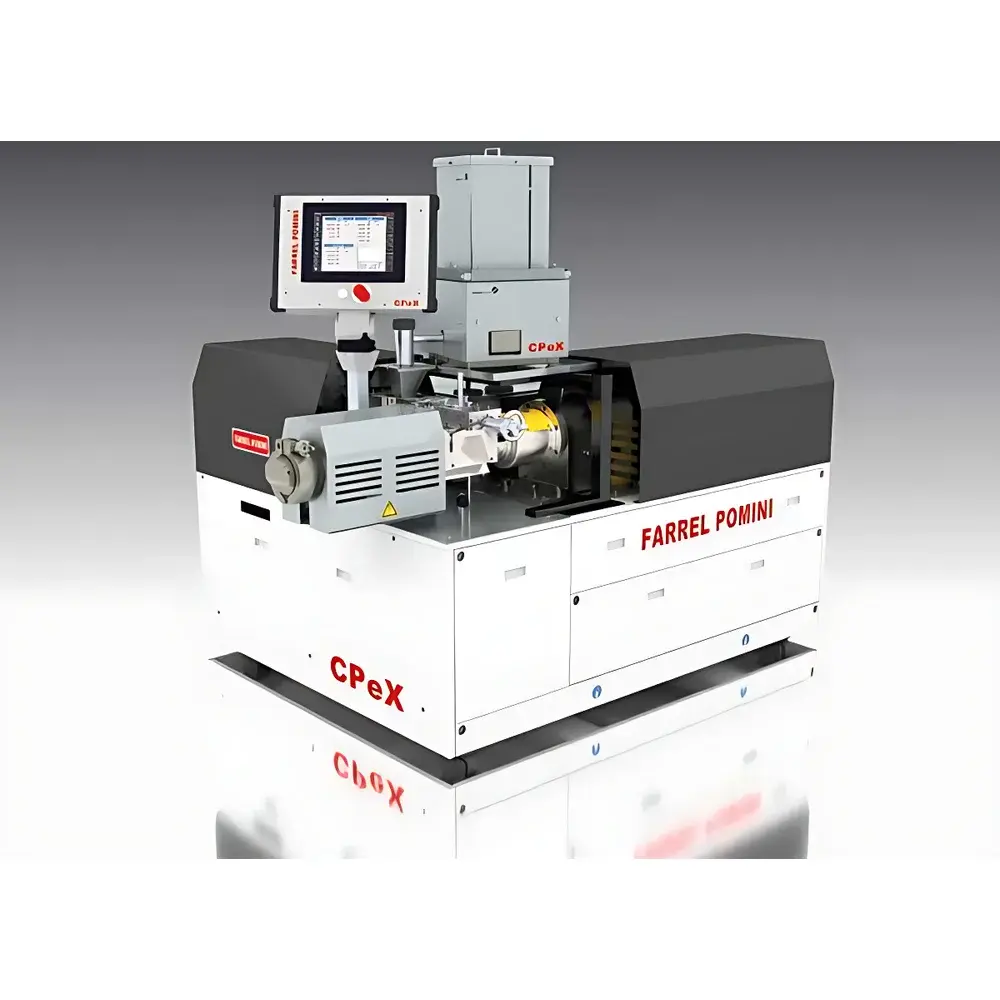
Farrel CPeX™ Compact Continuous Mixer
| Brand | Farrel |
|---|---|
| Origin | USA |
| Manufacturer Type | Authorized Distributor |
| Origin Category | Imported |
| Model | CPeX™ |
| Pricing | Available Upon Request |
Overview
The Farrel CPeX™ Compact Continuous Mixer is an engineered laboratory-scale continuous compounding system designed for rapid formulation development, process optimization, and small-batch production of polymer compounds, elastomers, thermoplastic composites, and functional masterbatches. Unlike batch mixers, the CPeX™ employs a proven Farrel Pomini twin-screw co-rotating continuous mixing architecture—originally developed for industrial-scale production—scaled and refined for R&D environments. Its core principle relies on controlled residence time distribution, precise thermal management via segmented barrel cooling/heating zones, and high-shear mechanical energy input to achieve homogeneous dispersion, distributive mixing, and controlled devolatilization. This enables reproducible material transformation under defined shear history and thermal profiles—critical for correlating lab-scale results with full-scale production outcomes.
Key Features
- Compact footprint (≤ 2.5 m length) optimized for standard laboratory floor space without requiring structural reinforcement or dedicated utility rooms.
- Modular twin-screw configuration with intermeshing co-rotating screws, available in multiple L/D ratios (16:1 and 20:1 standard) to accommodate varying residence time requirements.
- Segmented barrel with independent PID-controlled heating/cooling zones (up to 8 zones) enabling precise axial temperature profiling from feed throat to die exit.
- Variable-speed main drive (0–600 rpm) with torque monitoring and real-time power consumption logging for rheological feedback during mixing.
- Integrated gravimetric feeder(s) with ±0.5% accuracy for multi-component feeding (polymer, filler, plasticizer, additives), supporting both powder and pellet feedstocks.
- Quick-change die system compatible with strand, pellet, or sheet extrusion configurations—facilitating downstream processing evaluation.
- Robust stainless-steel construction compliant with ISO 14644-1 Class 8 cleanroom-compatible assembly protocols where required.
Sample Compatibility & Compliance
The CPeX™ handles a broad spectrum of viscoelastic materials including thermoplastics (PP, PE, PC, PA, TPU), thermoplastic elastomers (TPEs), silicone rubber compounds, conductive polymer blends, flame-retardant formulations, and highly filled composites (up to 80 wt% mineral or carbon-based fillers). It supports solvent-free processing and optional vacuum venting for moisture removal or volatile extraction. The system conforms to CE machinery directive 2006/42/EC and meets UL 508A industrial control panel safety standards. For regulated environments, it supports IQ/OQ documentation packages aligned with ASTM D3765 (rubber compounding), ISO 1133 (melt flow rate correlation), and USP analytical instrument qualification principles. Optional audit-trail-enabled HMI firmware complies with FDA 21 CFR Part 11 requirements for electronic records and signatures when integrated into GMP-compliant labs.
Software & Data Management
Controlled via Farrel’s proprietary CPeX™ Control Suite—a Windows-based SCADA interface offering real-time visualization of screw speed, torque, zone temperatures, melt pressure, feeder mass flow rates, and motor amperage. All parameters are logged at user-defined intervals (down to 100 ms) in CSV and SQL-compatible formats. The software includes recipe management with version control, alarm event logging with timestamped cause-action logs, and exportable PDF reports containing traceable process signatures. Historical data can be imported into statistical process control (SPC) platforms such as Minitab or JMP for DoE analysis. Optional OPC UA connectivity enables integration into enterprise MES systems for centralized batch record management and digital twin synchronization.
Applications
- Rapid screening of polymer-filler interactions and dispersion efficiency using image analysis of cryo-fractured samples.
- Development of recyclate-compatible formulations with controlled degradation kinetics and re-stabilization protocols.
- Optimization of nanocomposite dispersion (e.g., graphene, CNTs) through controlled shear ramping and residence time modulation.
- Validation of thermal stability windows for heat-sensitive additives (e.g., bio-based plasticizers, peroxides) under dynamic processing conditions.
- Scale-up studies supporting technology transfer from lab to pilot plant, with direct correlation to Farrel’s production-scale Banbury® and ZSK mixer databases.
- Regulatory submission support—including extractables/leachables pre-screening for medical-grade polymers per ISO 10993-12.
FAQ
What is the typical throughput range for the CPeX™ in lab mode?
Typical throughput ranges from 0.5 kg/h to 15 kg/h depending on material viscosity, screw configuration, and feed rate—optimized for statistically valid sample generation rather than bulk output.
Can the CPeX™ handle abrasive fillers like silica or wollastonite?
Yes; hardened alloy screw elements and barrel liners (HRC 62+ surface hardness) are available as factory options for extended service life with highly abrasive formulations.
Is offline rheological characterization supported?
The CPeX™ is fully compatible with inline melt indexers and capillary rheometers (e.g., Gottfert Rheotens); melt samples can also be directly collected for subsequent DSC, TGA, or DMA testing.
Does Farrel provide application engineering support?
Yes; qualified polymer processing engineers offer remote and on-site technical assistance, including formulation troubleshooting, screw design consultation, and scale-up modeling using Farrel’s proprietary COMPASS™ simulation toolkit.



