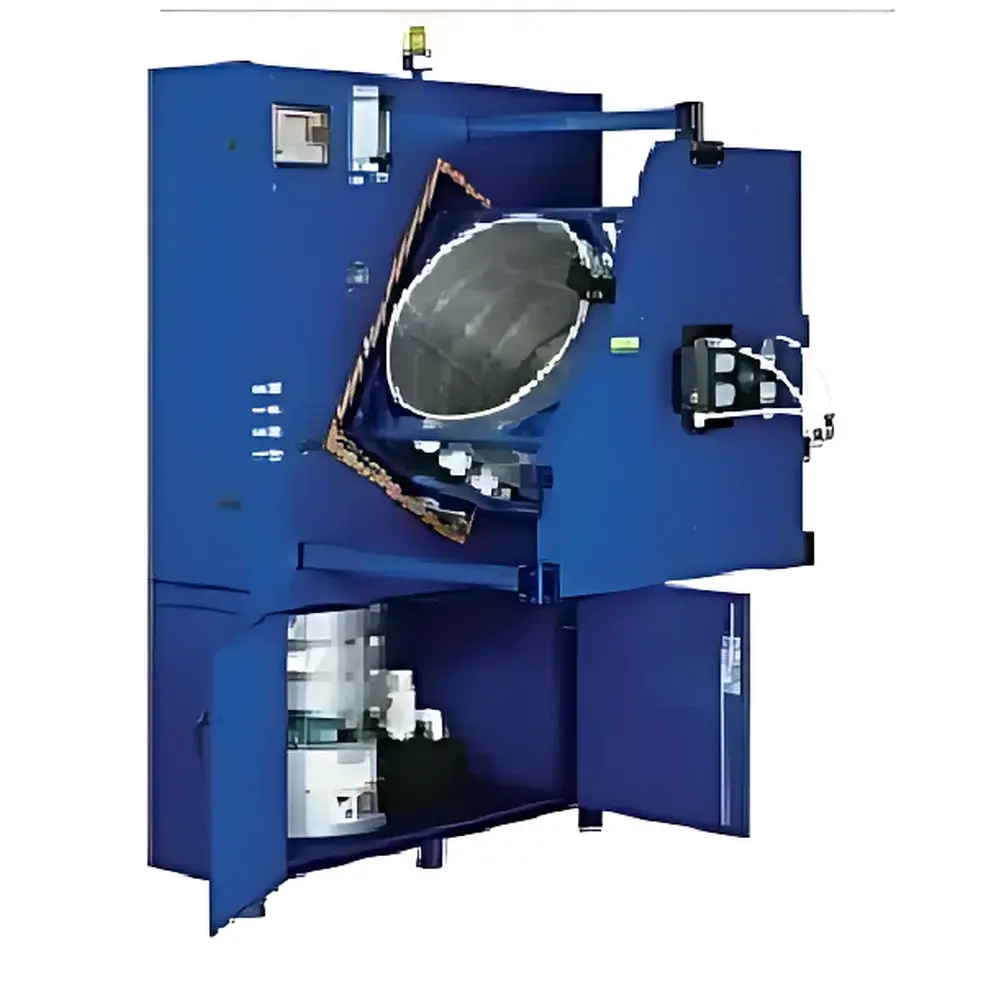
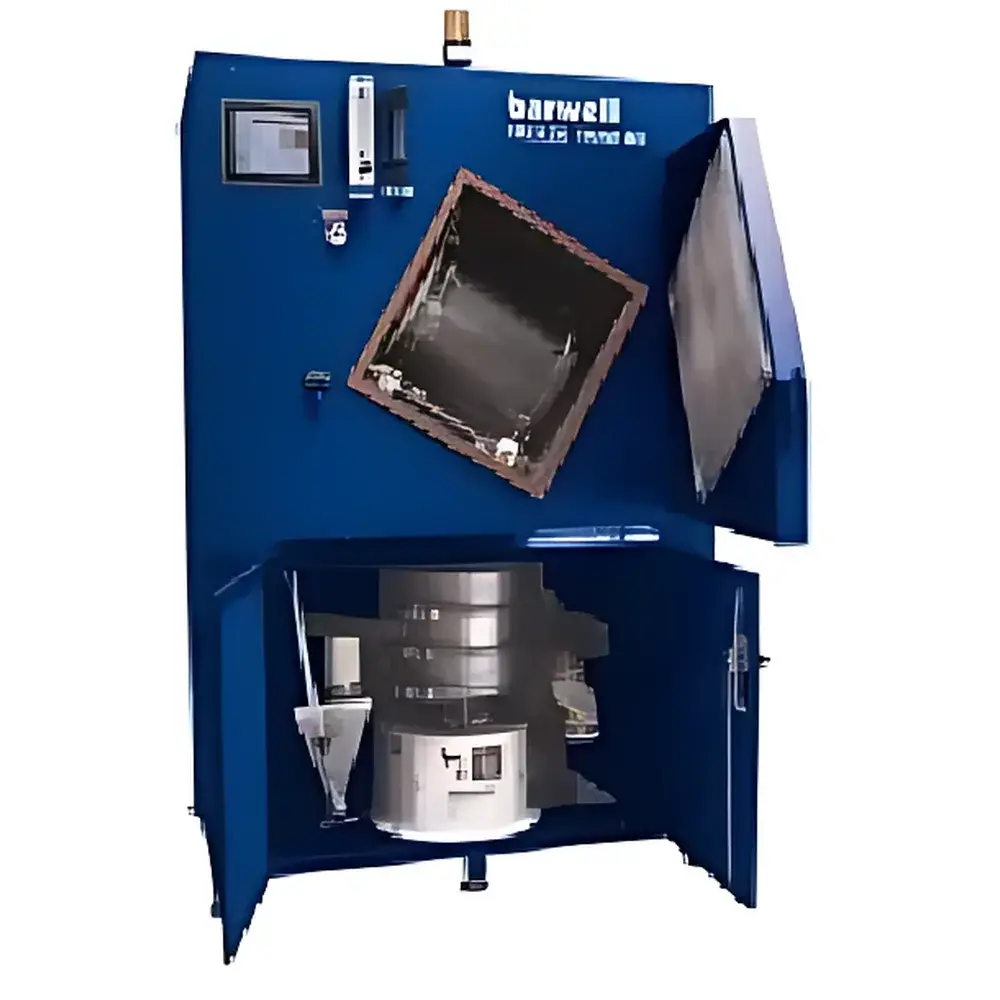
Barwell BFT-20 Cryogenic Deflashing Machine
| Brand | Barwell |
|---|---|
| Origin | United Kingdom |
| Model | BFT-20 / BFT-40 / BFT-140 |
| Refrigerant | Liquid nitrogen at −212 °C @ 3.5 bar |
| Propellant gas | Nitrogen or dry air @ 2.5 bar |
| Tumbling basket diameter | 300 mm |
| Tumbling basket depth | 300 mm |
| Basket volume | 20 L |
| Usable capacity | 7 L |
| Blast wheel diameter | 100 mm |
| Blast wheel speed | 20,000 rpm |
| Blast media | High-wear-resistant polyester particles |
| Control system | Omron PLC with 2,000 programmable part recipes |
| HMI | 8″ TFT color touchscreen |
| Insulation | 50 mm rigid polyurethane foam |
| Compliance | CE-marked per EU Machinery Directive 2006/42/EC and PED 2014/68/EU |
| Particle sieve separation | Integrated vibratory screen |
| Operation modes | Fully automatic or manual |
| Security | Password-protected parameter access |
| Maintenance | Built-in checklist and service log |
Overview
The Barwell BFT-20 Cryogenic Deflashing Machine is an engineered solution for precision post-molding deburring of elastomeric, thermoplastic, and metal alloy components. It operates on the principle of cryogenic embrittlement: liquid nitrogen (−212 °C at 3.5 bar) rapidly cools parts to their glass transition temperature (Tg), rendering flash and burrs brittle while preserving substrate ductility. A high-speed centrifugal blast wheel (20,000 rpm) then propels inert polyester particles—non-abrasive and dimensionally stable—against the frozen surface. This selective impact fractures flash without marring the base material, eliminating mechanical stress, thermal distortion, or chemical residue associated with manual trimming or solvent-based methods.
Key Features
- Robust cryogenic architecture: Dual-wall stainless-steel tumbling basket with 50 mm rigid polyurethane insulation minimizes LN2 boil-off and ensures stable thermal profiles across batch cycles.
- Precision media delivery: Propellant gas (nitrogen or dry air at 2.5 bar) is metered via proportional valves; flow uniformity is validated per ISO 8502-3 for consistent kinetic energy transfer.
- Intelligent process control: Omron PLC governs all operational sequences—including cooldown ramping, dwell time, blast duration, and purge cycles—with traceable recipe storage for up to 2,000 part configurations.
- Human-machine interface: 8″ TFT color touchscreen supports multilingual operation (English, German, French, Spanish, Chinese), real-time fault diagnostics, and password-protected engineering-level parameter access.
- Integrated particle recovery: Vibratory screening separates spent media from detached flash; screen mesh (6.35 mm aperture) complies with ISO 2591-1 for repeatable separation efficiency (>98.7% media retention).
- Maintenance-integrated design: On-screen service checklists, automated lubrication reminders, and hardened impeller geometry extend mean time between failures (MTBF) beyond 12,000 operating hours.
Sample Compatibility & Compliance
The BFT-20 accommodates complex geometries—including O-rings, gaskets, seals, and injection-molded connectors—with a usable capacity of 7 L per cycle. Parts must exhibit a Tg ≥ −40 °C to ensure effective embrittlement; compatibility is verified per ASTM D746 (impact brittleness temperature) and ISO 2818 (cryogenic conditioning protocols). All electrical, pneumatic, and pressure systems conform to CE requirements under the EU Machinery Directive 2006/42/EC and Pressure Equipment Directive 2014/68/EU. No desiccants or hazardous solvents are required—making it suitable for ISO 14001-certified facilities and compliant with REACH Annex XVII restrictions on volatile organic compounds.
Software & Data Management
Firmware includes audit-trail functionality meeting GLP/GMP documentation standards: every cycle logs timestamp, operator ID, recipe name, LN2 consumption (kg), blast duration (s), and final inspection pass/fail status. Data export is supported via USB 2.0 (CSV format) or optional Ethernet/IP integration for MES/SCADA linkage. The system does not require FDA 21 CFR Part 11 compliance out-of-the-box but supports optional electronic signature modules for regulated pharmaceutical or medical device manufacturing environments.
Applications
- Automotive: EPDM and fluorosilicone valve seals, brake caliper boots, and turbocharger gaskets.
- Medical devices: Silicone catheter hubs, thermoplastic elastomer (TPE) syringe components, and implant-grade polyurethane enclosures.
- Aerospace: Viton® O-rings for hydraulic manifolds and nitrile-butadiene rubber (NBR) fuel system grommets.
- Electronics: Thermoplastic polyurethane (TPU) cable strain reliefs and LSR keypad membranes.
- Industrial: Polyamide (PA66) gear housings and PEEK bushings requiring edge integrity below ±10 µm tolerance.
FAQ
What materials are compatible with the BFT-20?
Elastomers (silicone, EPDM, NBR, FKM), thermoplastics (TPU, TPE, POM), and low-melting-point alloys (e.g., zinc die-cast) exhibiting glass transition temperatures between −70 °C and −20 °C.
Is liquid nitrogen consumption monitored per cycle?
Yes—integrated mass flow sensors record LN2 usage in kilograms and correlate it with part mass and flash volume for cost-per-part analytics.
Can the machine be integrated into an automated production line?
Standard RS-485 Modbus RTU and optional EtherNet/IP enable seamless handshaking with robotic loaders, conveyors, and MES systems.
Does the polyester media require periodic replacement?
Media life exceeds 200 cycles under nominal load; wear is tracked via particle size distribution analysis (per ISO 11171) and scheduled replacement alerts appear on the HMI.
How is operator safety ensured during LN2 handling?
The system incorporates redundant pressure relief valves, oxygen deficiency monitors (ODM), and interlocked access doors meeting EN 60204-1 Category 3 safety requirements.