
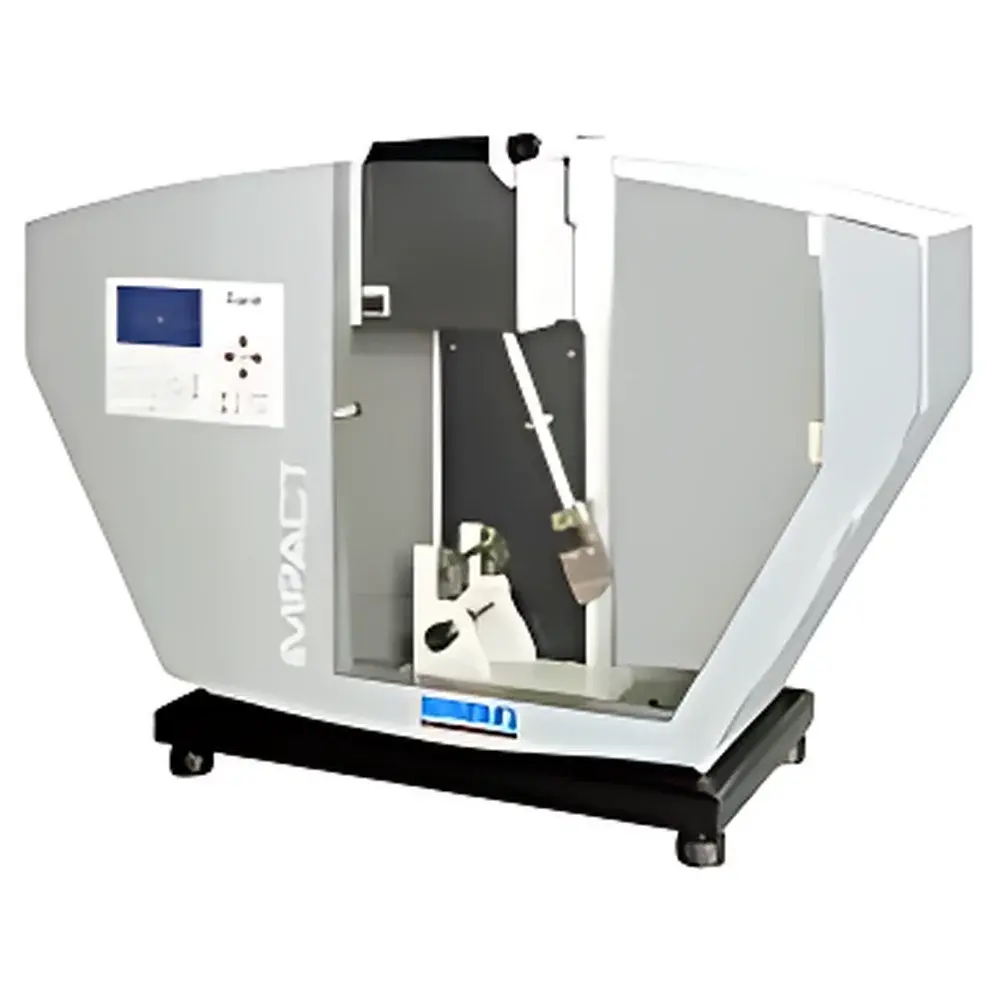
Kaelge IMPact 5.5/15(25) Pendulum Impact Tester
| Brand | Kaelge |
|---|---|
| Origin | Germany |
| Model | IMPact 5.5/15(25) |
| Impact Energy Range | 0.5–5.5 J (IMPact 5.5) |
| Compliance Standards | EN ISO 179, EN ISO 180, ASTM D 256 (Methods A & B), ISO 8256 |
| Test Configurations | Charpy (simply supported beam), Izod (cantilever beam), Tensile Impact |
| Control System | Microprocessor-based with keypad and LCD display (4-language support) |
| Output Interfaces | RS-232 serial port, parallel printer port |
| Key Functions | Automatic pendulum braking, built-in sample centering for Charpy fixtures, real-time energy calculation (absorbed energy, recovered elastic energy, rise angle, impact velocity), on-access auto-test initiation, pendulum calibration verification and report generation, FIFO storage of up to 50 test results with statistical evaluation (mean, standard deviation) |
Overview
The Kaelge IMPact 5.5/15(25) Pendulum Impact Tester is a precision-engineered mechanical testing instrument designed for quantitative determination of impact resistance in polymeric materials, thermoplastics, composites, and rigid plastics according to internationally recognized quasi-static and dynamic fracture mechanics protocols. Based on the classical pendulum principle—where gravitational potential energy is converted into kinetic energy upon release—the system measures the energy absorbed by a notched or unnotched specimen during brittle or ductile fracture under standardized loading conditions. The dual-range configuration (0.5–5.5 J and 0.5–15 J / 25 J) enables seamless transition between low-energy Charpy-type tests on thin films or small molded parts and high-energy Izod or tensile-impact evaluations on structural components. Its design adheres to the fundamental physics of impact loading: energy conservation, angular momentum transfer, and post-fracture kinetic recovery measurement. This architecture ensures traceable, repeatable, and operator-independent results essential for quality control laboratories operating under ISO/IEC 17025-accredited environments.
Key Features
- Microprocessor-controlled operation with integrated keypad and backlit LCD display supporting English, German, French, and Spanish—enabling multilingual lab deployment without firmware modification.
- Automatic pendulum arrest mechanism eliminates manual intervention post-impact, reducing operator variability and enhancing safety compliance per EN 61000-6-2 and EN ISO 12100.
- Built-in mechanical centering system for Charpy specimens ensures precise alignment within ±0.1 mm tolerance, minimizing bending moment errors and improving inter-laboratory reproducibility.
- Real-time calculation and display of multiple physical parameters: absorbed impact energy (J), recovered elastic energy (J), pendulum rise angle (°), theoretical impact velocity (m/s), and normalized energy per unit cross-section (kJ/m²).
- On-access auto-test initiation: system performs self-checks—including hammer position verification, zero-energy calibration validation, and fixture detection—prior to each test sequence.
- FIFO data buffer stores up to 50 test records with timestamp, specimen ID, energy values, and statistical metadata (mean, standard deviation, coefficient of variation), supporting internal audit readiness.
Sample Compatibility & Compliance
The IMPact series accommodates standardized specimen geometries defined in EN ISO 179 (Charpy), EN ISO 180 (Izod), ASTM D 256 (Methods A and B), and ISO 8256 (tensile impact). Compatible fixtures include adjustable supports for 80 × 10 × 4 mm Charpy bars, clamping jaws for 63.5 × 12.7 × 3.2 mm Izod specimens, and tensile-impact holders conforming to ISO 8256 Annex A. All mechanical interfaces are manufactured from hardened tool steel with surface roughness ≤ Ra 0.8 µm to prevent slippage-induced energy loss. The instrument is supplied with full documentation traceable to DIN EN ISO/IEC 17025:2017 requirements, including factory calibration certificates issued against NIST-traceable reference standards. It supports GLP-compliant workflows through configurable user access levels, electronic signature capability (when paired with validated PC software), and audit-trail-enabled data export.
Software & Data Management
While the IMPact 5.5/15(25) operates autonomously via its embedded controller, optional Windows-compatible software (IMPact Suite v3.x) provides extended functionality: automated report generation compliant with ASTM E29 and ISO/IEC 17025 clause 7.8.2; statistical process control (SPC) charting; trend analysis across batches; and export to CSV, PDF, or XML formats for LIMS integration. The RS-232 interface supports ASCII command protocol for bidirectional communication, enabling synchronization with enterprise MES systems. All data files include embedded metadata: operator ID, environmental conditions (if externally logged), calibration status flags, and digital signatures where enabled. Software validation packages—including IQ/OQ documentation and 21 CFR Part 11 compliance modules—are available upon request for regulated pharmaceutical or medical device manufacturing environments.
Applications
This impact tester serves critical roles in R&D labs evaluating polymer formulation robustness; QC departments validating incoming raw material specifications; failure analysis units investigating brittle fracture mechanisms in automotive interior components; and certification bodies performing third-party conformity assessments per CE marking directives (e.g., Construction Products Regulation, Machinery Directive). Typical use cases include comparative assessment of impact modifiers in PVC compounds, aging studies of UV-exposed polycarbonate sheets, qualification of recycled PET blends for food-contact packaging, and validation of flame-retardant additives in engineering thermoplastics. Its modular fixture architecture also supports custom test configurations for non-standard geometries under customer-specific test plans approved per ISO 17025 clause 7.2.2.
FAQ
What standards does the IMPact 5.5/15(25) directly support?
EN ISO 179, EN ISO 180, ASTM D 256 (Methods A and B), ISO 8256, and DIN 53438.
Is calibration verification traceable to national metrology institutes?
Yes—each unit ships with a factory calibration certificate referencing NIST or PTB traceable reference hammers and certified reference specimens.
Can the system be integrated into a centralized laboratory information management system (LIMS)?
Yes—via RS-232 ASCII protocol or optional Ethernet gateway; data fields map to ASTM E1467 and ISO/IEC 17025-compliant schema.
Does the instrument meet electrical safety and EMC requirements for EU deployment?
Yes—CE marked per EN 61000-6-2 (immunity) and EN 61000-6-3 (emissions), with mechanical safety compliance verified per EN ISO 12100.
Are replacement fixtures and calibration accessories available separately?
Yes—standardized Charpy/Izod/tensile fixtures, notching tools (Type A/B/C per ISO 179), and certified calibration hammers are stocked and supplied with individual calibration reports.



