
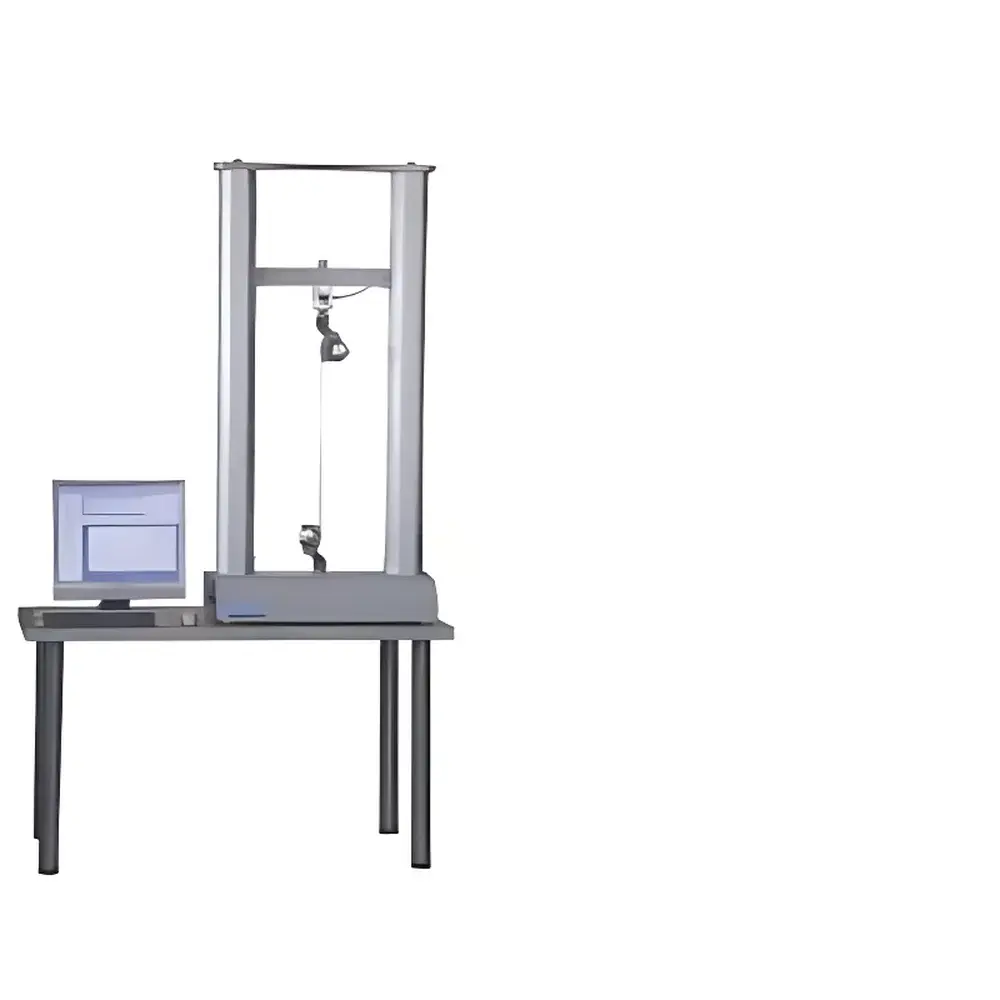
Kegge smarTens Universal Testing Machine
| Brand | Kegge |
|---|---|
| Origin | Germany |
| Model | smarTens |
| Load Capacity | 20 kN |
| Load Accuracy | Class 1 per DIN EN ISO 7500 (optional Class 0.5) |
| Crosshead Positioning Accuracy | < 1 µm |
| Speed Range | 0.01–1000 mm/min |
| Control System | Solid-state servo motor with dual-arm screw drive |
| Software | Integrated PC-based control and analysis platform |
| Compliance | DIN EN ISO 7500-1, ASTM E4, ASTM E8/E21, ISO 6892-1, ISO 178, ISO 14129, ISO 14130 |
| Sample Compatibility | Metals, plastics, elastomers, foams, paper, wood, textiles, composites, wire, finished components |
| Safety Features | Adjustable overload cutoff, quick-release load cell & fixture interface, precision crosshead guidance system |
Overview
The Kegge smarTens Universal Testing Machine is an electromechanical static testing system engineered for high-precision mechanical characterization of solid materials under uniaxial tensile, compressive, flexural, shear, and peel loading conditions. It operates on the principle of controlled displacement or force actuation via a dual-arm precision screw drive mechanism, coupled with a solid-state servo motor and closed-loop digital control architecture. The system integrates a 120,000-count analog-to-digital resolution load measurement channel, enabling traceable force quantification across 1–100% of full scale — certified to DIN EN ISO 7500-1 Class 1 accuracy (with optional Class 0.5 configuration available for metrology-critical applications). Designed for laboratory, quality assurance, and R&D environments, the smarTens platform delivers reproducible mechanical property data including modulus, yield strength, ultimate tensile strength, elongation at break, bending stiffness, and energy absorption — all compliant with internationally recognized test standards.
Key Features
- Dual-arm precision screw drive system with preloaded ball screws and low-backlash gearing for minimal axial play and high positional repeatability
- Crosshead positioning accuracy better than 1 µm, ensuring sub-micron displacement fidelity during creep, relaxation, and cyclic tests
- Adjustable mechanical overload cutoff with programmable threshold limits to protect both specimen and transducer integrity
- Modular quick-disconnect interface for load cells and grips — enabling tool-free sensor exchange and fixture reconfiguration in under 60 seconds
- Integrated crosshead guidance system with linear motion bearings and anti-rotation stabilization to eliminate lateral deflection during high-force compression
- Wide dynamic speed range: 0.01 mm/min (for quasi-static creep studies) to 1000 mm/min (for impact-simulated rate-dependent response)
- Real-time synchronization of force, displacement, and strain (when equipped with extensometry) at up to 1 kHz sampling rate
Sample Compatibility & Compliance
The smarTens accommodates specimens ranging from thin polymer films (0.05 mm thickness) to structural metal coupons (up to 20 kN ultimate load), including finished assemblies such as automotive fasteners, medical device components, and electronic housings. Its modular grip and fixture portfolio supports standardized geometries per ASTM E8/E21 (metals), ISO 527 (plastics), ISO 178 (flexure), ISO 14129 (interlaminar shear), and ISO 14130 (short-beam shear for composites). All hardware and firmware are designed to support GLP/GMP audit readiness, with optional 21 CFR Part 11-compliant software modules providing electronic signatures, audit trails, and user access controls. Calibration certificates are NIST-traceable and include uncertainty budgets per ISO/IEC 17025 requirements.
Software & Data Management
The proprietary smarTens ControlSuite software provides a unified interface for test method definition, real-time monitoring, automated pass/fail evaluation, and post-test reporting. Preconfigured test templates align with ASTM D638, ISO 6892-1, ISO 178, and EN 1367-1, allowing one-click execution of standardized protocols. Raw data export is supported in CSV, XML, and universal HDF5 formats; metadata embedding includes environmental conditions (optional temperature/humidity integration), operator ID, calibration history, and instrument firmware version. The software architecture supports multi-user role-based permissions and encrypted local database storage, facilitating compliance with internal QA documentation systems and external regulatory submissions.
Applications
- Materials development labs validating thermoplastic formulations, elastomer compounds, and fiber-reinforced composites
- Production line QC for incoming raw material verification and in-process mechanical screening of extruded profiles or injection-molded parts
- Failure analysis of brittle ceramics, adhesively bonded joints, and thin-film coatings under combined tension–peel loading
- Mechanical validation of biomedical polymers (e.g., PEEK, UHMWPE) per ISO 5834 and ASTM F2026
- Structural assessment of packaging substrates (corrugated board, laminated films) per TAPPI T813 and ISO 1924
- Dynamic mechanical profiling of viscoelastic behavior through controlled-rate ramp-and-hold sequences
FAQ
What international standards does the smarTens comply with for force calibration?
It meets DIN EN ISO 7500-1 Class 1 accuracy requirements across its entire operating range (1–100% FS); optional Class 0.5 configuration is available for accredited metrology laboratories.
Can the system be integrated with external extensometers or environmental chambers?
Yes — it features standard analog/digital I/O ports and EtherCAT-compatible expansion modules for seamless integration with clip-on axial extensometers, video extensometry systems, and climate-controlled test enclosures.
Is audit trail functionality included in the base software package?
Basic event logging is standard; full 21 CFR Part 11-compliant audit trail with electronic signatures requires the validated software option package and associated IQ/OQ documentation.
What maintenance intervals are recommended for the dual-arm drive system?
Lubrication and preload verification of the screw drive assembly is recommended every 12 months or after 5,000 test cycles, whichever occurs first — documented in the included preventive maintenance checklist.
Does the system support automated test sequencing for batch processing?
Yes — the software allows creation of multi-step test sequences with conditional branching, automatic result archiving, and configurable pass/fail logic based on user-defined tolerance bands.



