
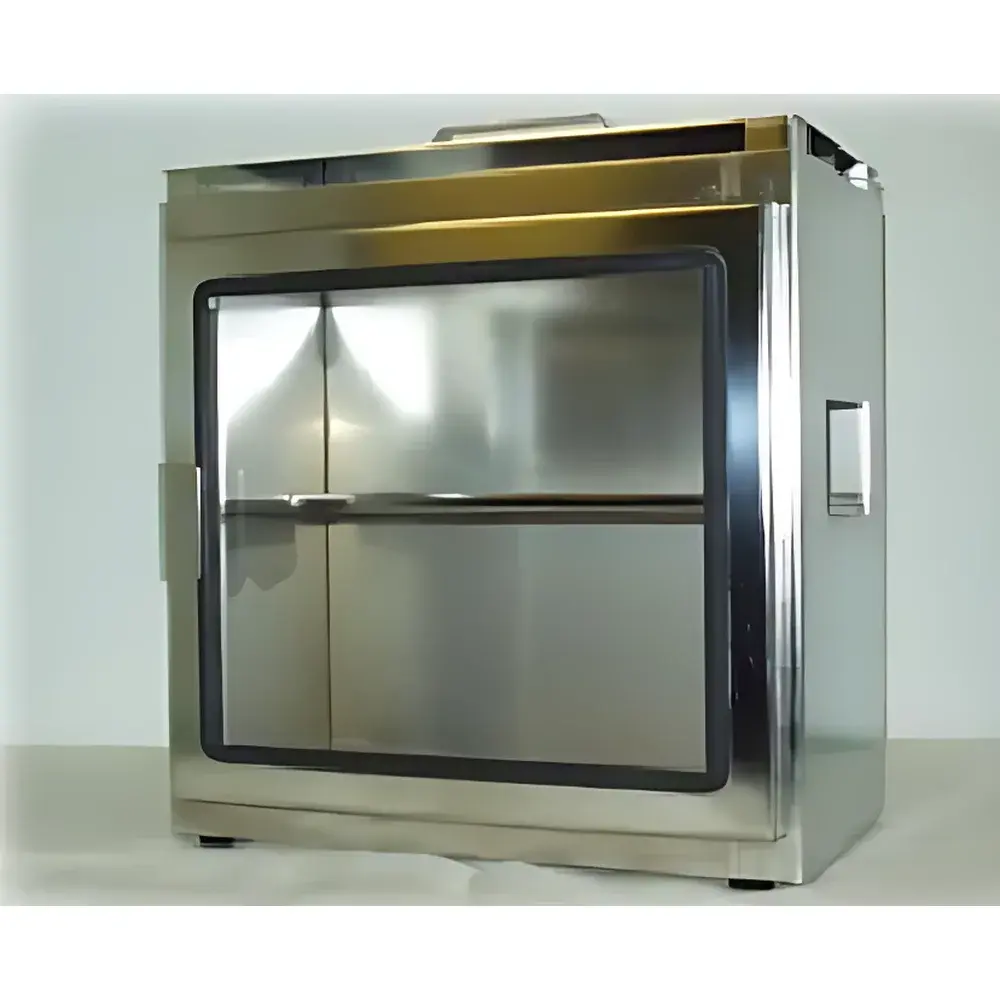
KARG FMVSS 302 Horizontal Burning Test Chamber
| Brand | KARG |
|---|---|
| Origin | Germany |
| Model | FMVSS 302 |
| Compliance | FMVSS 302, ISO 3795, DIN 75200 |
| Chamber Material | V4A Stainless Steel (1.4404 / AISI 316L) |
| Sample Holder | Type A & Type B Configurations |
| Flame Source | Adjustable Propane/Butane Burner with Precision Needle Valve |
| Viewing Window | Heat-Resistant Borosilicate Glass |
| Service Access | Side Maintenance Door |
| Optional Fixtures | VW TL 1010 & Porsche PTL 8501 Compliant Sample Clamps |
| Dimensions (W×H×D) | 500 × 385 × 245 mm |
| Weight | 22 kg |
Overview
The KARG FMVSS 302 Horizontal Burning Test Chamber is a precision-engineered laboratory instrument designed for the standardized evaluation of flame propagation behavior in automotive interior materials under controlled horizontal orientation. It operates in strict accordance with the U.S. Federal Motor Vehicle Safety Standard No. 302 (FMVSS 302), as well as its internationally harmonized equivalents—ISO 3795 and DIN 75200. These standards define test methodology for assessing the burning rate of materials used in vehicle occupant compartments, including seat fabrics, headliners, door trims, carpeting, and insulation foams. The chamber employs a calibrated open-flame ignition source (propane or butane, specified at order) applied to the free end of a horizontally mounted specimen. Flame front progression is visually monitored through a heat-resistant borosilicate observation window, and the time required for flame to travel a defined reference distance (typically 100 mm) is recorded to calculate the linear burning rate (mm/min). This measurement serves as a critical pass/fail criterion in regulatory qualification workflows for Tier 1 suppliers and OEM validation laboratories.
Key Features
- V4A stainless steel (1.4404 / AISI 316L) construction ensures long-term corrosion resistance against combustion byproducts and repeated thermal cycling.
- Dual-configurable sample holders (Type A and Type B) accommodate varying specimen geometries and mounting requirements per standard clauses.
- Precision needle valve-controlled gas burner enables stable, reproducible flame height (20 ± 1 mm) and impingement angle—critical for inter-laboratory comparability.
- Integrated side service door facilitates routine maintenance, burner alignment verification, and residue removal without disassembly.
- Optically clear, high-temperature borosilicate viewing window provides unobstructed real-time observation while maintaining structural integrity at elevated ambient temperatures.
- Compact footprint (500 × 385 × 245 mm) and lightweight design (22 kg) support flexible benchtop integration in QA/QC labs, R&D facilities, and accredited testing centers.
- Optional sample clamping systems compliant with Volkswagen TL 1010 and Porsche PTL 8501 specifications enable direct cross-OEM validation without fixture requalification.
Sample Compatibility & Compliance
The FMVSS 302 chamber accepts flat, rigid or semi-rigid specimens measuring 356 mm × 102 mm × thickness ≤ 13 mm, cut from production-representative material batches. Specimens are conditioned per ASTM D618 or ISO 291 prior to testing. The system supports full traceability to regulatory frameworks governing automotive safety certification—including NHTSA compliance documentation, EU Whole Vehicle Type Approval (WVTA) Annex XV requirements, and UN Regulation No. 118. All operational parameters—including burner gas flow rate, flame positioning, and environmental temperature (23 ± 2 °C) —are maintained within tolerances mandated by FMVSS 302 Section S5.1 and ISO 3795 Clause 6. Test reports generated using this chamber meet evidentiary requirements for GLP-compliant submissions and ISO/IEC 17025 accredited testing laboratories.
Software & Data Management
While the KARG FMVSS 302 is a manually operated, analog-based test chamber, it is fully compatible with digital data capture workflows. Laboratories may integrate external high-speed cameras (e.g., 240 fps minimum) and calibrated timing systems to record flame propagation events. Video metadata, operator annotations, environmental logs, and raw timing data can be archived in LIMS or ELN platforms supporting 21 CFR Part 11 audit trails. Calibration records for burner gas pressure regulators, thermocouples (if optional ambient monitoring is installed), and stopwatch instrumentation must be retained per ISO/IEC 17025 Clause 6.5. For automated reporting, users commonly employ validated Excel templates or custom Python scripts that parse timestamped video frames and compute burning rate per FMVSS 302 Equation 1.
Applications
- Pre-certification screening of textile, polymer, and composite substrates for automotive interior trim components.
- Root cause analysis of non-conforming burning rates during material formulation development.
- Supplier qualification audits requiring on-site demonstration of FMVSS 302 conformance.
- Internal quality control for Tier 2 material manufacturers supplying to Tier 1 module integrators.
- Technical due diligence assessments during M&A transactions involving automotive component portfolios.
- Training platform for laboratory personnel on standardized horizontal flame testing methodology and failure mode recognition.
FAQ
Is the KARG FMVSS 302 chamber certified to ISO/IEC 17025?
No—the chamber itself is not “certified”; rather, it is a measurement instrument used within laboratories that hold ISO/IEC 17025 accreditation. Its metrological suitability is verified via periodic calibration of ancillary equipment (e.g., stopwatch, gas flow meter, thermometer) per Clause 6.5 of the standard.
Can propane and butane be interchanged without hardware modification?
Yes—gas selection is finalized at order; the burner assembly and pressure regulator are pre-configured for the specified fuel. Switching fuels post-delivery requires recalibration and validation per FMVSS 302 Appendix A.
Does the chamber include flame height measurement tools?
It does not include integrated flame height gauges; however, it is designed to accept standard ASTM E136-compliant flame height rulers positioned adjacent to the burner per FMVSS 302 Section S5.1.3.
What maintenance intervals are recommended for the V4A chamber body?
Visual inspection and wipe-down with pH-neutral cleaner after each test series; annual verification of door gasket integrity and burner orifice cleanliness is advised.
Is third-party installation support available?
KARG authorizes qualified regional service partners to perform commissioning, including gas line connection verification, flame calibration, and operator training—subject to local regulatory permitting requirements.



