
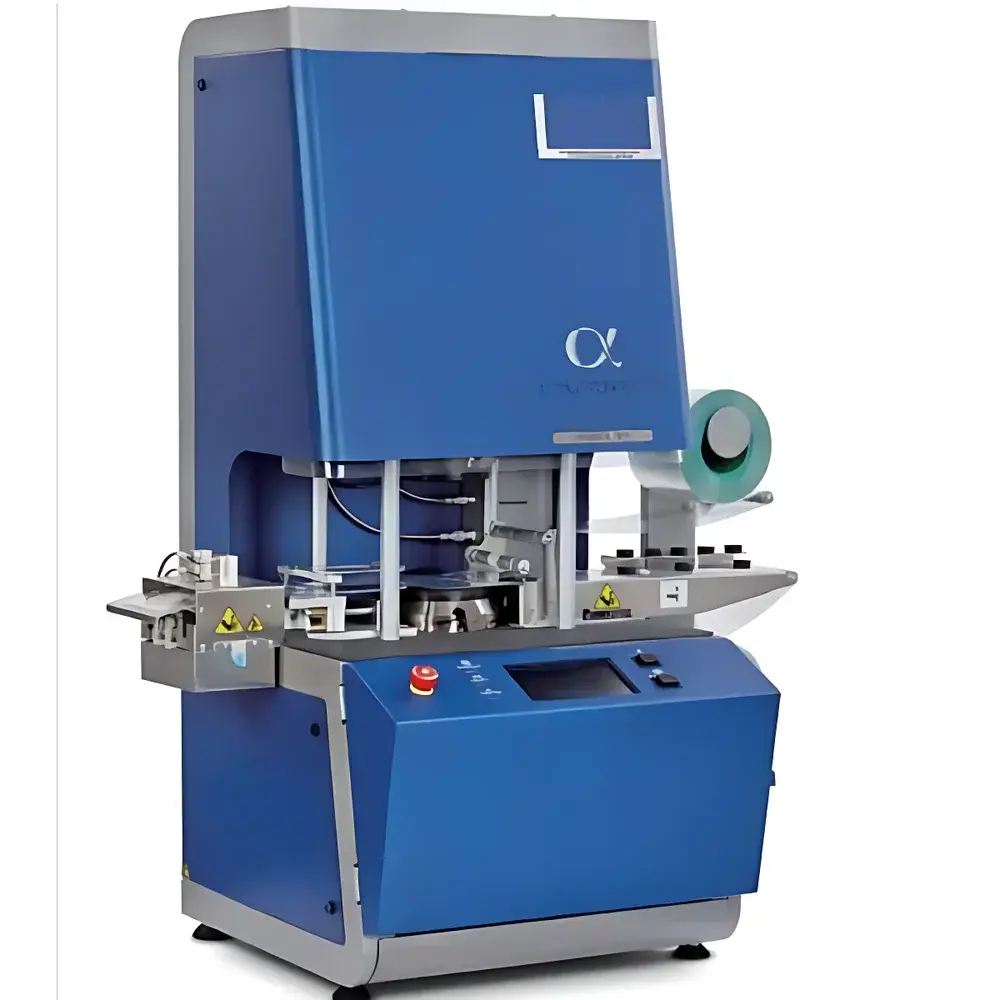
Alpha ALPHA Premier RPA Rubber Processing Analyzer
| Brand | Alpha |
|---|---|
| Origin | USA |
| Manufacturer Type | Authorized Distributor |
| Origin Category | Imported |
| Model | Premier RPA |
| Pricing | Upon Request |
Overview
The Alpha Premier RPA Rubber Processing Analyzer is a high-precision, computer-controlled dynamic mechanical rheometer engineered specifically for the rubber and elastomer industry. It operates on the principle of oscillatory shear deformation within a sealed, dual-conical cavity under controlled temperature and strain conditions—enabling real-time characterization of viscoelastic behavior across all stages of rubber processing: raw polymer evaluation, masterbatch and final compound assessment, vulcanization kinetics monitoring, and post-cure property analysis. Unlike conventional moving-die rheometers (MDR) or oscillating disk curemeters (ODR), the Premier RPA employs true dynamic symmetry and smart alignment technology to eliminate mechanical eccentricity and ensure reproducible gap control—critical for detecting subtle compositional variations (e.g., filler dispersion, curative concentration, polymer branching) that directly influence processability, scorch safety, crosslink density, and final product performance.
Key Features
- Dual-conical, hermetically sealed test cavity (sample volume ≈ 4.5 cm³) with independent upper/lower mold temperature control—enabling rapid heating/cooling rates up to 1 °C/s from ambient (25 °C)
- Dynamic Symmetry™ actuation system ensures precise parallel closure of molds, minimizing torque measurement artifacts caused by misalignment
- Smart Alignment™ mechanism guarantees consistent cavity geometry and seal integrity across thousands of cycles—delivering exceptional inter-laboratory reproducibility
- NIST-traceable calibration standards integrated into routine operation, supporting global comparability and regulatory audit readiness
- Wide dynamic range: strain amplitude 0.005°–90° (±0.07%–±1256% strain), frequency 0.0016–50 Hz (0.1–3000 cpm), torque 0.01–225 dN·m
- Pressure sensor option for foam rubber characterization, enabling simultaneous monitoring of gas evolution and viscoelastic response during expansion
- Dedicated electronics architecture optimized for low-noise signal acquisition across the full torque spectrum—eliminating range-switching artifacts
Sample Compatibility & Compliance
The Premier RPA accommodates uncured, semi-cured, and fully vulcanized elastomeric compounds—including natural rubber (NR), synthetic polyisoprene (IR), SBR, BR, EPDM, NBR, CR, and thermoplastic elastomers (TPEs). Its sealed cavity design prevents volatile loss and oxidation during high-temperature testing, ensuring fidelity in scorch and cure profiling. The instrument complies with ASTM D6204 (Standard Test Method for Rubber Property—Viscoelastic Properties Using a Rubber Process Analyzer), ASTM D5289 (Standard Test Method for Rubber Property—Vulcanization Using Oscillating Disk Curemeter), and ASTM D6601 (Standard Test Method for Rubber Property—Dynamic Mechanical Properties Using a Rubber Process Analyzer). It supports GLP/GMP-aligned workflows through secure user authentication, electronic signatures, and full audit trail functionality in Enterprise software—meeting FDA 21 CFR Part 11 requirements for regulated environments.
Software & Data Management
The Enterprise software platform provides comprehensive test method definition, real-time data visualization, advanced Fourier transform-based rheological analysis (including long-chain branching index estimation via LAOS protocols), and automated report generation compliant with ISO/IEC 17025 documentation standards. All raw and processed data—including time-temperature-strain-frequency matrices—are stored in encrypted, version-controlled databases with configurable backup policies. Statistical process control (SPC) tools enable batch-to-batch comparison, trend analysis, and outlier detection—facilitating root-cause investigation in quality deviations. Export options include CSV, PDF, and XML formats compatible with LIMS integration.
Applications
- Raw material qualification: screening synthetic rubbers, oils, fillers, and curatives for consistency and compatibility
- Compound development: optimizing cure systems, evaluating scorch delay, and predicting processing window stability
- Production QC: rapid verification of masterbatch homogeneity, final compound uniformity, and lot-to-lot equivalence
- R&D for advanced elastomers: quantifying long-chain branching (LCB), filler network dynamics, and nonlinear viscoelastic signatures
- Foam formulation: correlating pressure rise profiles with cell nucleation kinetics and melt strength development
- Failure analysis: diagnosing premature scorch, under-cure, over-cure, or filler agglomeration through deviation mapping in master curves
FAQ
What distinguishes the Premier RPA from conventional MDR instruments?
It utilizes dual-conical geometry with Dynamic Symmetry™ and Smart Alignment™—ensuring superior repeatability, broader strain/frequency range, and direct access to fundamental viscoelastic moduli (G′, G″, η*), unlike fixed-amplitude MDRs.
Can the Premier RPA perform LAOS (Large Amplitude Oscillatory Shear) tests?
Yes—its high-fidelity torque transducer and synchronized data acquisition support full Fourier-transform rheology (FT-Rheology) for nonlinear parameter extraction, including LCB quantification.
Is the system compliant with FDA 21 CFR Part 11 for pharmaceutical-grade elastomer testing?
When configured with Enterprise software’s audit trail, role-based access, and electronic signature modules, it meets Part 11 requirements for regulated medical device component validation.
How is temperature calibration verified across the operating range?
NIST-traceable platinum resistance thermometers (PRTs) are embedded in both molds; calibration certificates are provided with each instrument and can be re-verified using external reference probes.
Does the system support automated sample loading?
While manual loading is standard, third-party robotic integration kits are available for high-throughput labs requiring unattended operation across shift cycles.





