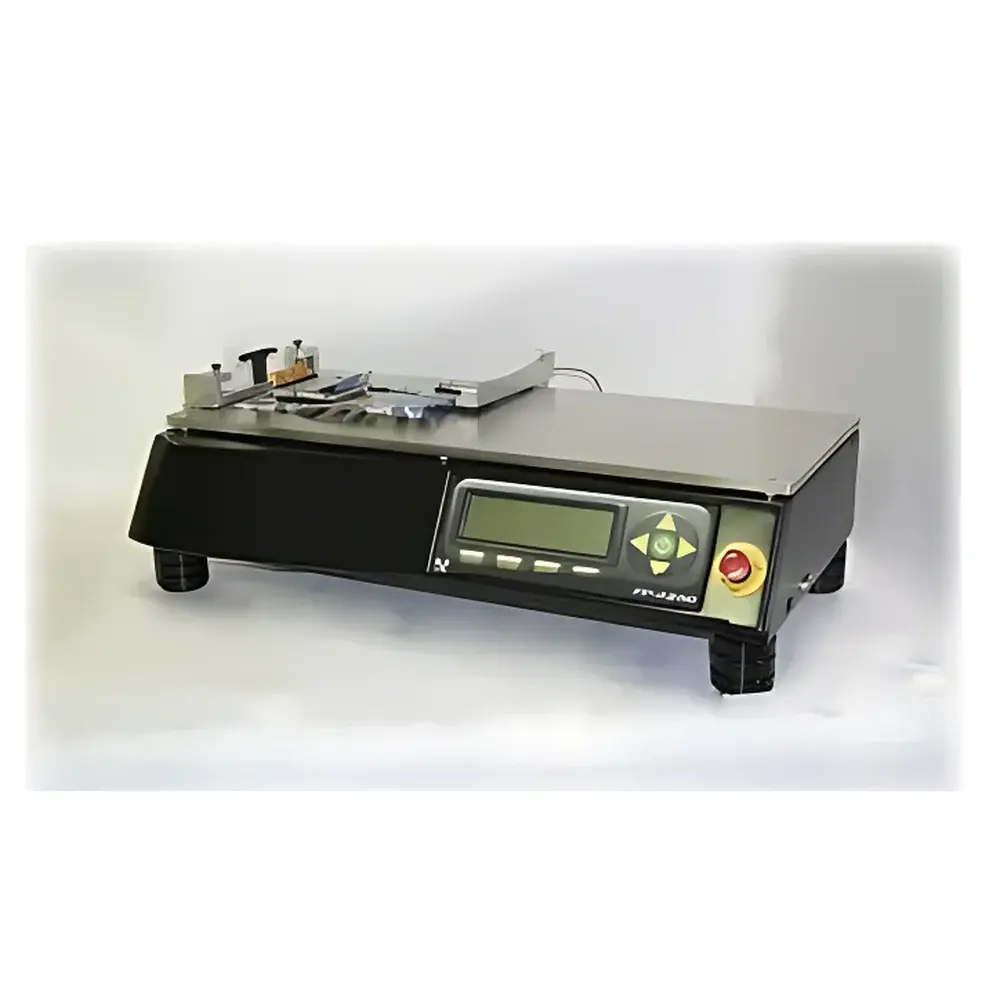
Koehler FP2255 Coefficient of Friction and Peel Strength Tester
| Brand | Koehler |
|---|---|
| Origin | Germany |
| Model | FP2255 |
| Force Sensor Options | 0.5 kg / 2 kg / 10 kg |
| Force Resolution | 0.1 g |
| Force Accuracy | ±0.25% of full scale |
| Force Units | g, kg, lbs, oz, N |
| Test Area | 225 × 350 mm |
| Test Speed Range | 25–500 mm/min |
| Display | 240 × 64 mm LCD |
| Compliance Standards | ASTM D1894, ASTM D4521, ASTM D3330, ASTM F88, EN ISO 8295, TAPPI T816, BS 2782, FINAT 1/2/3/9 |
| Data Interface | USB port for real-time curve export and result transfer |
| Statistical Storage | Onboard memory with recall functionality |
| Test Modes | Static & kinetic COF, 90° peel, 180° peel, T-peel, seal strength |
Overview
The Koehler FP2255 Coefficient of Friction and Peel Strength Tester is a precision-engineered benchtop instrument designed for quantitative evaluation of interfacial mechanical behavior in flexible packaging and sheet-based materials. Based on the fundamental principles of tribology and tensile mechanics, it measures static and kinetic coefficients of friction (COF) under controlled normal load and sliding velocity, as well as peel strength via standardized angular configurations (90°, 180°, T-peel) and seal integrity testing. Its architecture follows a dual-mode force transduction system—combining high-resolution load cell measurement with programmable crosshead motion—to ensure traceable, repeatable results across diverse substrates including paperboard, corrugated board, laminated films, pressure-sensitive adhesives, labels, and heat-sealed pouches. The FP2255 is not a general-purpose tensile tester; rather, it is purpose-built to meet the geometric, kinematic, and metrological requirements defined in international standards for packaging performance validation.
Key Features
- Modular force sensor system with three calibrated options (0.5 kg, 2 kg, 10 kg), each delivering ≤0.1 g resolution and ±0.25% full-scale accuracy—certified per ISO/IEC 17025 traceable calibration protocols.
- Adjustable test speed from 25 to 500 mm/min, digitally regulated via closed-loop DC motor control to maintain ±1% speed stability throughout the test cycle.
- Standardized test bed (225 × 350 mm) accommodating industry-standard sleds and peel fixtures—including ASTM-compliant 200 g sled mass, 90° and 180° peel jigs, and T-peel alignment guides—ensuring geometric fidelity to method specifications.
- Backlit monochrome LCD (240 × 64 mm) with intuitive menu navigation, real-time force/time curve display, and on-screen statistical summary (mean, SD, min/max, n-value).
- Onboard non-volatile memory storing up to 1,000 test records with timestamp, operator ID, method ID, and raw force-vs-time data points—supporting GLP-compliant audit trails when paired with optional user access control firmware.
- USB 2.0 interface enabling direct export of ASCII-formatted datasets and continuous force/time curves (.csv) to Windows-based PCs for post-processing in Excel, MATLAB, or LIMS environments.
Sample Compatibility & Compliance
The FP2255 is validated for use with planar, flexible, and semi-rigid substrates ranging from 25 µm polyester film to 5 mm corrugated board. It accommodates both single-layer and multilayer structures—including metallized PET, PE-laminated kraft paper, acrylic PSA-coated labels, and medical-grade Tyvek®-based pouches. All test modes comply with the dimensional, procedural, and reporting requirements of ASTM D1894 (COF of plastic film), ASTM F88 (seal strength of flexible barrier materials), EN ISO 8295 (plastic film and sheeting COF), TAPPI T816 (peel adhesion of pressure-sensitive tapes), and FINAT Test Methods 1 (COF), 2 (90° peel), 3 (180° peel), and 9 (seal strength). Instrument qualification documentation—including Installation Qualification (IQ), Operational Qualification (OQ), and Performance Qualification (PQ) templates—is available upon request to support GMP-regulated environments subject to FDA 21 CFR Part 11 or EU Annex 11 compliance.
Software & Data Management
The FP2255 operates with embedded firmware supporting method-driven test execution—each stored method defining speed, dwell time, trigger threshold, and pass/fail criteria. Raw data acquisition occurs at ≥100 Hz sampling rate, preserving transient peak events during peel initiation or stick-slip transitions. Exported .csv files contain columns for elapsed time (ms), applied force (N), displacement (mm), and calculated COF or peel force (N/25 mm). No proprietary software installation is required for basic data retrieval; however, Koehler’s optional KoehlerLab Suite (v3.2+) provides advanced features: automated report generation (PDF/HTML), multi-curve overlay analysis, statistical process control (SPC) charting, and integration with enterprise LIMS via HL7 or ASTM E1384 interfaces. Audit trail logs record all parameter changes, test executions, and memory clear events—with timestamps and user identifiers—meeting ALCOA+ data integrity principles.
Applications
- Quality control of extrusion-coated and laminated packaging films for confectionery, dairy, and pharmaceutical blister packaging.
- Evaluation of release liner performance in medical adhesive tapes and transdermal patch manufacturing.
- Validation of hot-melt and solvent-based adhesive bonds in label application systems across temperature and humidity gradients.
- Seal integrity assessment of thermoformed trays and pouches used in sterile device packaging per ISO 11607-2.
- Research into surface energy modification effects—e.g., corona treatment, plasma activation, or siliconization—on COF and peel behavior.
- Teaching laboratories for polymer physics, materials science, and packaging engineering curricula requiring hands-on standard-method instruction.
FAQ
What standards does the FP2255 directly support?
ASTM D1894, ASTM D4521, ASTM D3330, ASTM F88, EN ISO 8295, TAPPI T816, BS 2782, and FINAT Test Methods 1, 2, 3, and 9.
Can the FP2255 perform both COF and peel tests without hardware reconfiguration?
Yes—the base configuration includes interchangeable sleds, peel fixtures, and clamping assemblies; no tools are required for mode switching.
Is calibration traceable to national metrology institutes?
All force sensors ship with UKAS-accredited calibration certificates (ISO/IEC 17025), and field recalibration services are available through Koehler’s authorized service centers in Europe and North America.
Does the instrument support 21 CFR Part 11 compliance?
With optional firmware upgrade and networked PC integration, the FP2255 supports electronic signatures, role-based access control, and immutable audit trails—fully aligned with FDA 21 CFR Part 11 and EU Annex 11 requirements.
What is the maximum sample width supported for 180° peel testing?
The standard peel fixture accepts samples up to 150 mm wide; custom fixtures for wider specimens (up to 300 mm) are available as factory-installed options.