
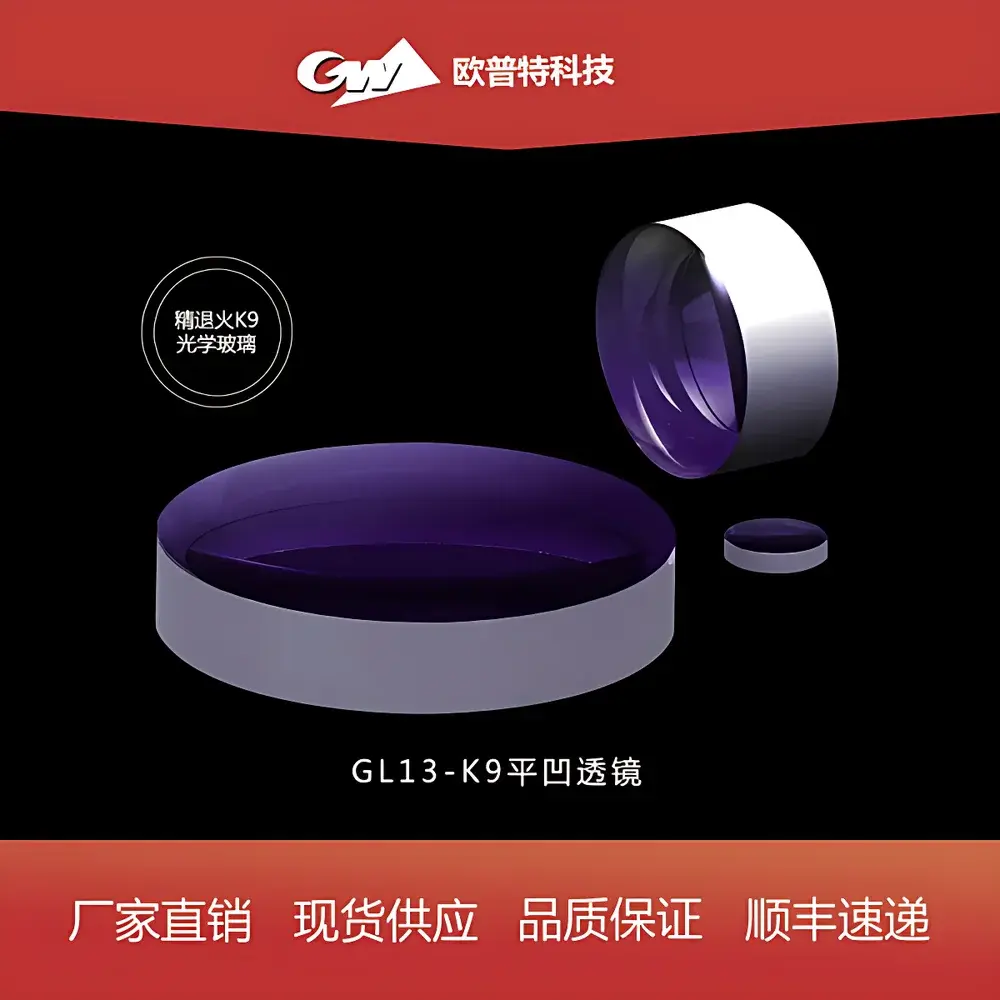
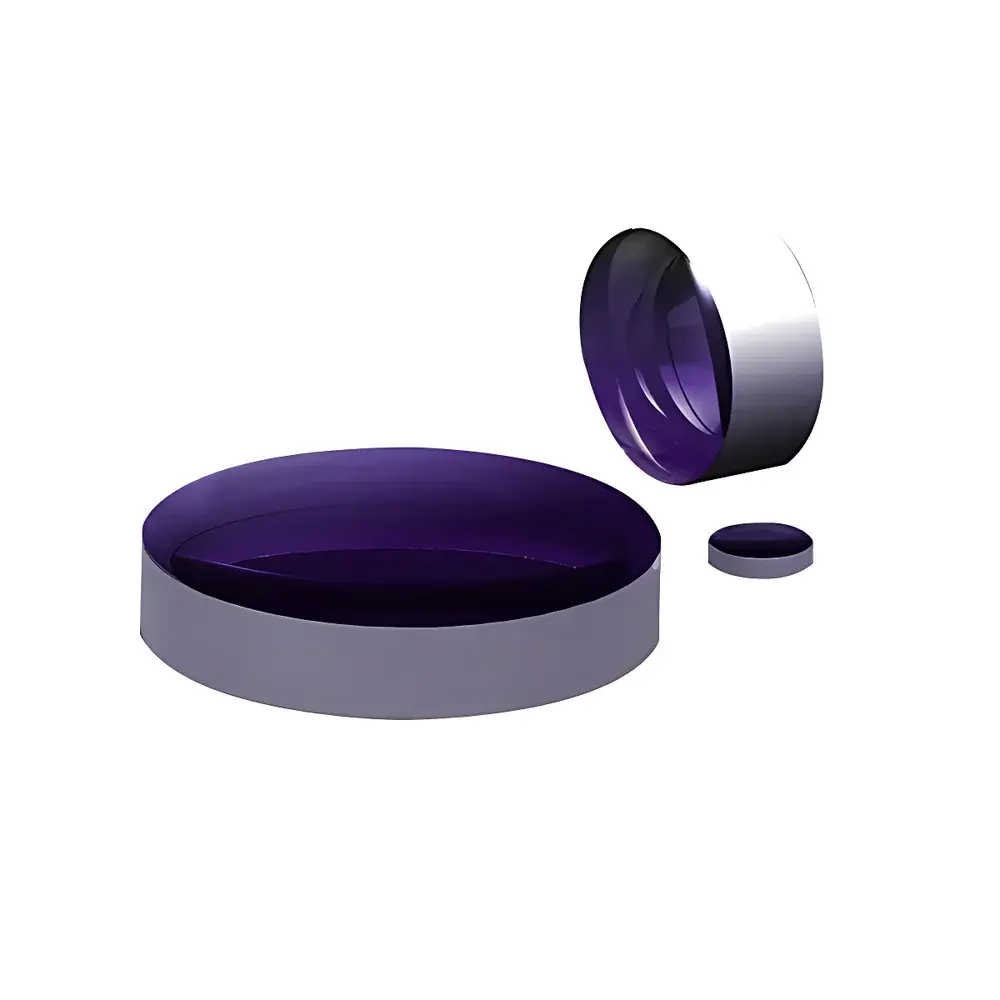
GL13-K9 Plano-Concave Lens (Uncoated), 4–50 mm Diameter
| Origin | Beijing |
|---|---|
| Manufacturer Type | Distributor |
| Origin Category | Domestic (China) |
| Model | GL13 |
| Price Range | USD 0.15–75.00 |
| Component Category | Optical Element |
| Material | Precision-Annealed K9 Optical Glass |
| Design Wavelength | 587.6 nm |
| Diameter Tolerance | +0.0 / −0.1 mm |
| Center Thickness Tolerance | ±0.2 mm |
| Surface Flatness | λ/4 @ 632.8 nm |
| Focal Length Tolerance | ±2% |
| Surface Irregularity | ≤λ/4 |
| Surface Quality | 3–4 Scratch-Dig |
| Edge Treatment | 0.2 mm × 45° Chamfer |
| Effective Focal Length (EFL) | Negative (Diverging) |
| Back Focal Length (BFL) | Equal to EFL (Plane surface incident) |
| Radius of Curvature (R₁) | Concave side only |
Overview
The GL13-K9 Plano-Concave Lens is a precision optical component engineered for controlled beam divergence in laboratory, industrial, and OEM optical systems. Fabricated from precision-annealed K9 borosilicate crown glass—a material conforming to ISO 10110-2 and GB/T 903 standards—the lens exhibits excellent homogeneity, low bubble/inclusion content, and minimal stress birefringence. Its plano-concave geometry produces a negative focal length, enabling collimated input beams to diverge with predictable angular spread. The design wavelength is specified at 587.6 nm (d-line), ensuring consistent performance in monochromatic alignment, interferometry reference paths, and laser cavity mode control. As an uncoated element, it delivers broadband transmission from ~350 nm to 2.0 µm, subject to Fresnel reflection losses (~4% per surface in the visible spectrum). This makes the GL13 series suitable for applications where spectral neutrality, thermal stability, or compatibility with subsequent custom coating processes is required.
Key Features
- Precision-annealed K9 optical glass substrate meeting ISO 10110-2 surface and bulk quality specifications
- Diameter range from 4 mm to 50 mm, with tight mechanical tolerances: +0.0 / −0.1 mm diameter, ±0.2 mm center thickness
- Surface figure accuracy of λ/4 @ 632.8 nm (HeNe wavelength), verified via interferometric testing
- Surface quality rated 3–4 scratch-dig per MIL-PRF-13830B, ensuring minimal scatter in high-sensitivity imaging or metrology setups
- Edge treatment: 0.2 mm × 45° protective chamfer applied to both peripheries to mitigate chipping during mounting and handling
- Negatively signed effective focal length (EFL), enabling precise beam expansion ratios when paired with collimating or focusing elements
- No residual coating—ideal for UV-VIS-NIR-SWIR applications where AR coating selection must be application-specific or process-integrated
Sample Compatibility & Compliance
The GL13 lens is fully compatible with standard optomechanical mounting solutions—including SM-threaded lens tubes (e.g., Thorlabs SM05, SM1), kinematic lens mounts, and custom-designed cell holders. Its dimensional consistency enables interchangeability across multi-element assemblies without recalibration. All units are manufactured under controlled cleanroom conditions (ISO Class 7 or better) and undergo 100% visual inspection and interferometric verification. While not certified to ISO 9001 by the distributor, the K9 substrate material complies with national standards GB/T 903–2008 and international optical glass specification SCHOTT N-BK7 equivalents. No RoHS or REACH non-compliance has been reported; lead oxide content is within permissible limits (<0.1% w/w) per EU Directive 2011/65/EU Annex II.
Software & Data Management
As a passive optical component, the GL13 lens does not incorporate embedded electronics, firmware, or software interfaces. However, its geometric and material parameters are fully supported in industry-standard optical design platforms including Zemax OpticStudio (version 22+), CODE V, and Synopsys LightTools. A complete .ZMX file template and material dispersion data (Sellmeier coefficients for K9 at 587.6 nm, 632.8 nm, and 1064 nm) are available upon request for system-level modeling. For traceability, each batch is assigned a unique identifier linked to interferometric test reports and dimensional QA records—retained for five years in accordance with GLP-aligned documentation practices.
Applications
- Beam expansion in HeNe, diode, and DPSS laser systems where controlled divergence is required prior to spatial filtering or relay imaging
- Field lens elements in wide-angle projection optics and retroreflective measurement setups
- Negative power correction elements in aberration-compensated microscope objectives and telecentric lenses
- Reference optics in Michelson and Mach–Zehnder interferometers, particularly where path-length matching demands low wavefront distortion
- Entrance optics for spectrometer fore-optics requiring achromatic divergence control across UV-VIS bands
- OEM integration into laser processing heads, LIDAR receivers, and fiber-coupling modules where environmental stability and reproducible mounting are critical
FAQ
Is this lens suitable for UV applications below 350 nm?
While uncoated K9 transmits down to ~350 nm, absorption increases significantly below this threshold due to iron impurity bands. For deep-UV use (e.g., 248 nm or 193 nm), fused silica or CaF₂ substrates are recommended.
Can I specify custom focal lengths outside the standard catalog offerings?
Yes—custom EFLs can be manufactured on request, subject to minimum order quantities and extended lead times. Radius of curvature and center thickness will be recalculated per paraxial design constraints and ISO 10110 tolerancing rules.
What is the maximum permissible power density for continuous-wave lasers?
For uncoated K9 at 1064 nm, the damage threshold is approximately 10 J/cm² for 10 ns pulses and ~1 MW/cm² for CW operation at room temperature—assuming clean surfaces and proper heat sinking. Actual limits depend on beam profile, dwell time, and ambient conditions.
Do you provide metrology reports with shipment?
Standard orders include a Certificate of Conformance. Full interferometric test reports (including Zernike decomposition and PV/RMS wavefront error) are available as a value-added service upon request and advance notice.






