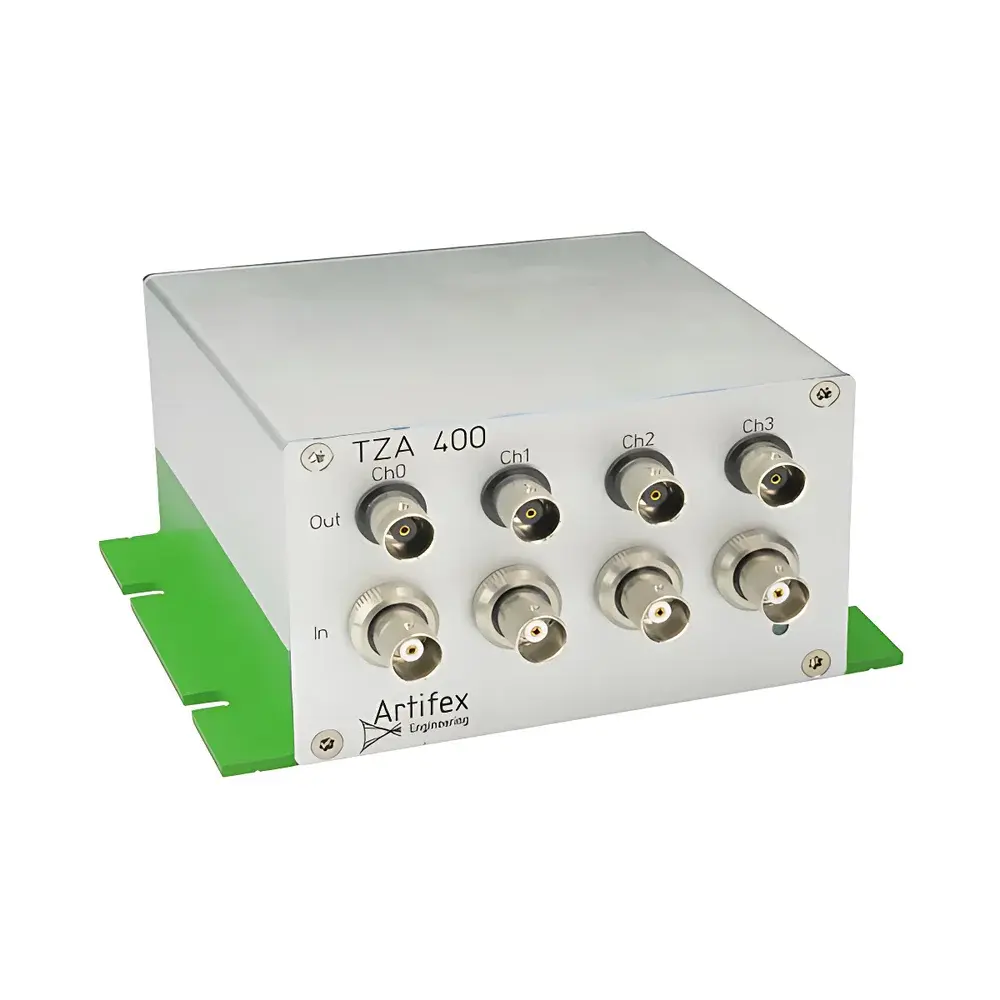
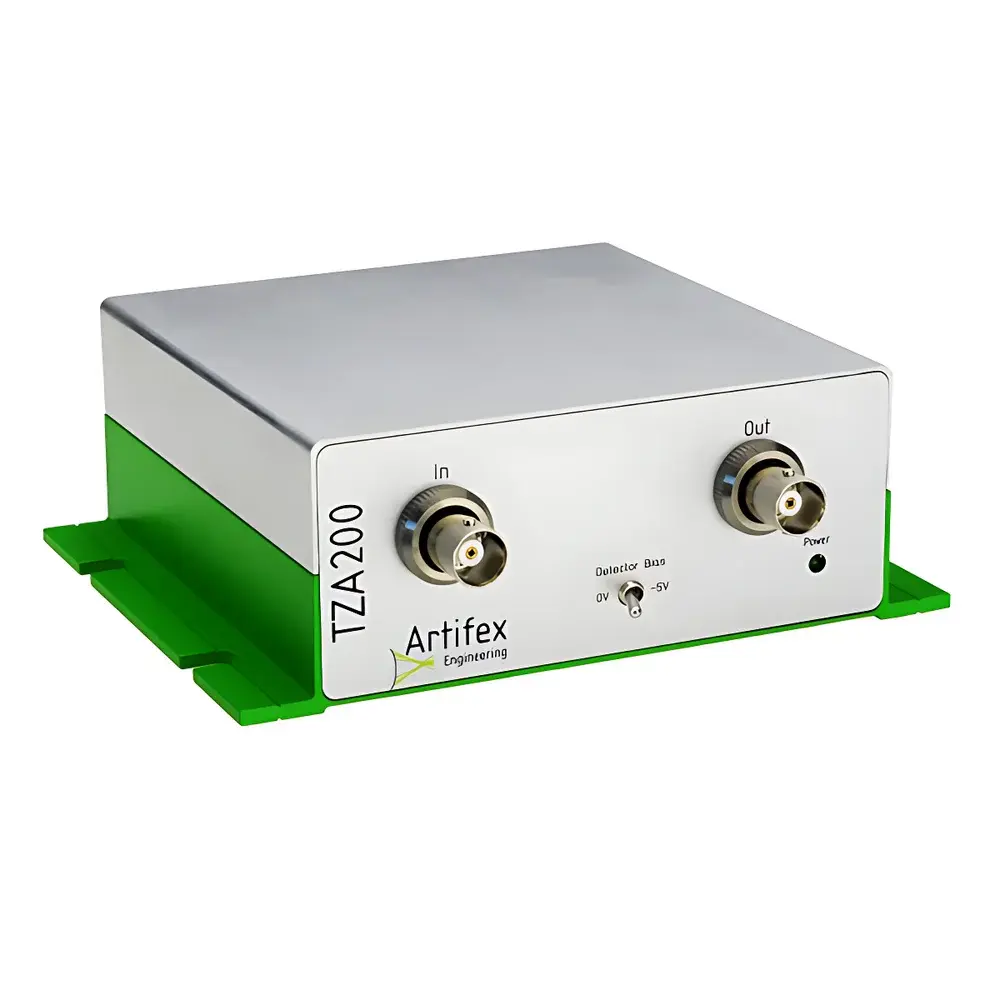
Artifex TZA500 High-Precision Programmable Transimpedance Amplifier
| Brand | Artifex |
|---|---|
| Origin | Germany |
| Model | TZA500 |
| Input Current Range | 100 nA – 100 mA (6 decades) |
| Noise-Equivalent Current (RMS) | 30 pA (at 100 nA range) |
| Rise Time | 45 µs (weak signal, −1→+1 V), 65 µs (strong signal, −10→+10 V) |
| Gain Control | USB & hardwired digital interface |
| Output Interface | BR21 and DB25 |
| Linearity | ±0.1–0.2 dB |
| Accuracy | ±1% |
| Power Supply | AC wall adapter |
| Dimensions (1-channel) | 105 × 45 × 116 mm (W×H×L) |
Overview
The Artifex TZA500 is a high-precision, programmable transimpedance amplifier engineered for low-noise, wide-dynamic-range current-to-voltage conversion in demanding scientific and industrial measurement applications. Based on optimized feedback topology with ultra-low input bias current op-amps and guarded layout design, the TZA500 delivers stable, linear amplification across six decades of input current — from 100 nA to 100 mA — while maintaining sub-picoampere-level noise-equivalent current (NEI) performance at its most sensitive gain settings. Its core architecture supports real-time reconfiguration of gain, bandwidth, and polarity via USB or TTL-compatible digital control lines, enabling seamless integration into automated test systems, time-resolved spectroscopy setups, and closed-loop feedback instrumentation. Unlike fixed-gain or manually switched amplifiers, the TZA500 eliminates mechanical relay wear and thermal drift-induced calibration drift, ensuring long-term measurement reproducibility under GLP/GMP-compliant laboratory conditions.
Key Features
- Programmable gain, bandwidth, and polarity via USB 2.0 or hardwired digital interface (TTL/CMOS compatible)
- Low noise-equivalent current: 30 pA RMS (at 100 nA full-scale range), scalable across all six decades
- Linear analog output: Vout = scale × Iin, with calibrated output scaling from 1 V/mA to 0.1 V/nA
- Fast transient response: 45 µs rise time (−1→+1 V), 100 µs settling time to 1% (weak signal)
- High linearity: ±0.1–0.2 dB over full dynamic range; accuracy maintained at ±1% FS
- Dual-output interface support: BR21 (for low-capacitance photodiode connections) and DB25 (for system integration)
- Input impedance effectively zero (virtual short-circuit), minimizing loading effects on high-impedance sources
- AC wall-powered operation with internal regulation; no external power supply unit required
Sample Compatibility & Compliance
The TZA500 interfaces directly with high-impedance current sources including photodiodes, photomultiplier tubes (PMTs), avalanche photodiodes (APDs), ionization chambers, piezoelectric sensors, and thermopiles. Its BR21 input connector accommodates low-capacitance, shielded cabling essential for femtoamp-level stability, while the DB25 interface enables synchronization with external trigger signals and multi-channel data acquisition systems. The amplifier complies with CE marking requirements for electromagnetic compatibility (EMC Directive 2014/30/EU) and low-voltage safety (LVD Directive 2014/35/EU). Its stable DC performance and traceable calibration protocol support adherence to ISO/IEC 17025-accredited testing environments. When integrated into regulated workflows, the USB control interface supports audit-trail logging compatible with FDA 21 CFR Part 11 requirements when paired with validated host software.
Software & Data Management
Artifex provides a Windows-based graphical user interface (GUI) with native USB HID-class driver support — requiring no additional runtime libraries or admin privileges. The GUI enables real-time parameter configuration (gain selection, bandwidth limiting, polarity inversion), live waveform preview, and export of timestamped measurement logs in CSV and HDF5 formats. An open-source Python SDK (PyTZA) is available via GitHub, supporting direct integration with LabVIEW, MATLAB, and Python-based automation frameworks (e.g., PyVISA, NIDAQmx). All configuration changes are non-volatile and retained across power cycles. Firmware updates are delivered via signed binary packages with SHA-256 checksum verification, ensuring integrity during remote maintenance in distributed lab networks.
Applications
- Time-resolved photoluminescence and fluorescence lifetime measurements using gated PMT or APD detectors
- In-line optical power monitoring in fiber-optic communication and laser manufacturing systems
- Low-current detection in scanning tunneling microscopy (STM) and atomic force microscopy (AFM) preamplification stages
- Ion beam current measurement and dosimetry in accelerator physics and radiation safety instrumentation
- Thermoelectric and pyroelectric sensor signal conditioning for precision calorimetry and environmental sensing
- OEM integration into analytical instruments requiring programmable front-end gain staging (e.g., mass spectrometers, Raman spectrometers)
FAQ
What is the minimum detectable current with the TZA500?
At the 100 nA full-scale range, the noise-equivalent current is 30 pA RMS (bandwidth-dependent); effective resolution is further enhanced by digital averaging in post-processing.
Can the TZA500 be synchronized with external triggers?
Yes — the DB25 interface includes dedicated TTL-compatible trigger-in and gate-out lines, supporting precise timing alignment with pulsed lasers, choppers, or data acquisition cards.
Is the TZA500 suitable for use in vacuum or temperature-controlled enclosures?
The unit is designed for ambient laboratory operation (15–35 °C, non-condensing). For extended environmental operation, consult Artifex Engineering for custom thermal management or hermetic packaging options.
Does the TZA500 support differential or floating inputs?
No — it operates as a single-ended, grounded-input transimpedance amplifier. For true differential current measurement, a matched pair of TZA500 units with common-mode rejection post-processing is recommended.
How is calibration traceability maintained?
Each unit ships with a factory calibration certificate traceable to PTB (Physikalisch-Technische Bundesanstalt) standards. Optional annual recalibration services include NIST-traceable documentation and uncertainty budget reporting.