
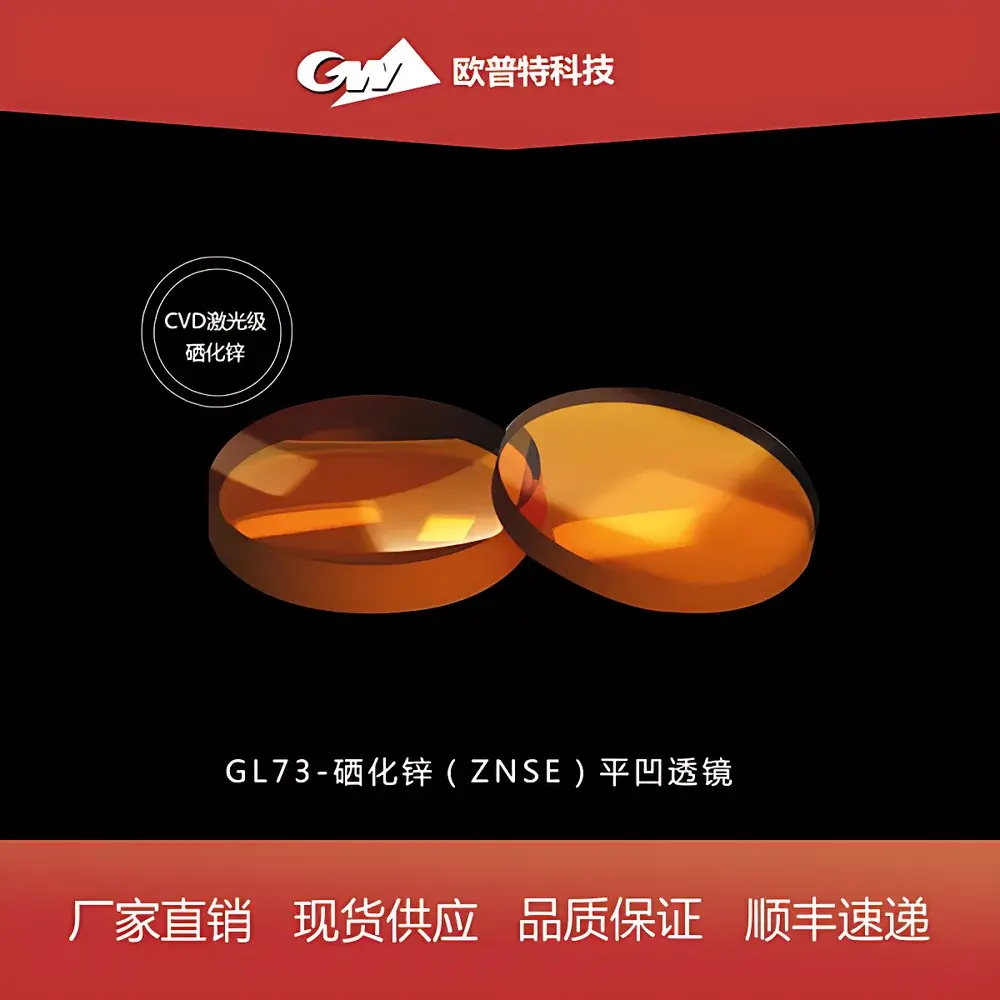
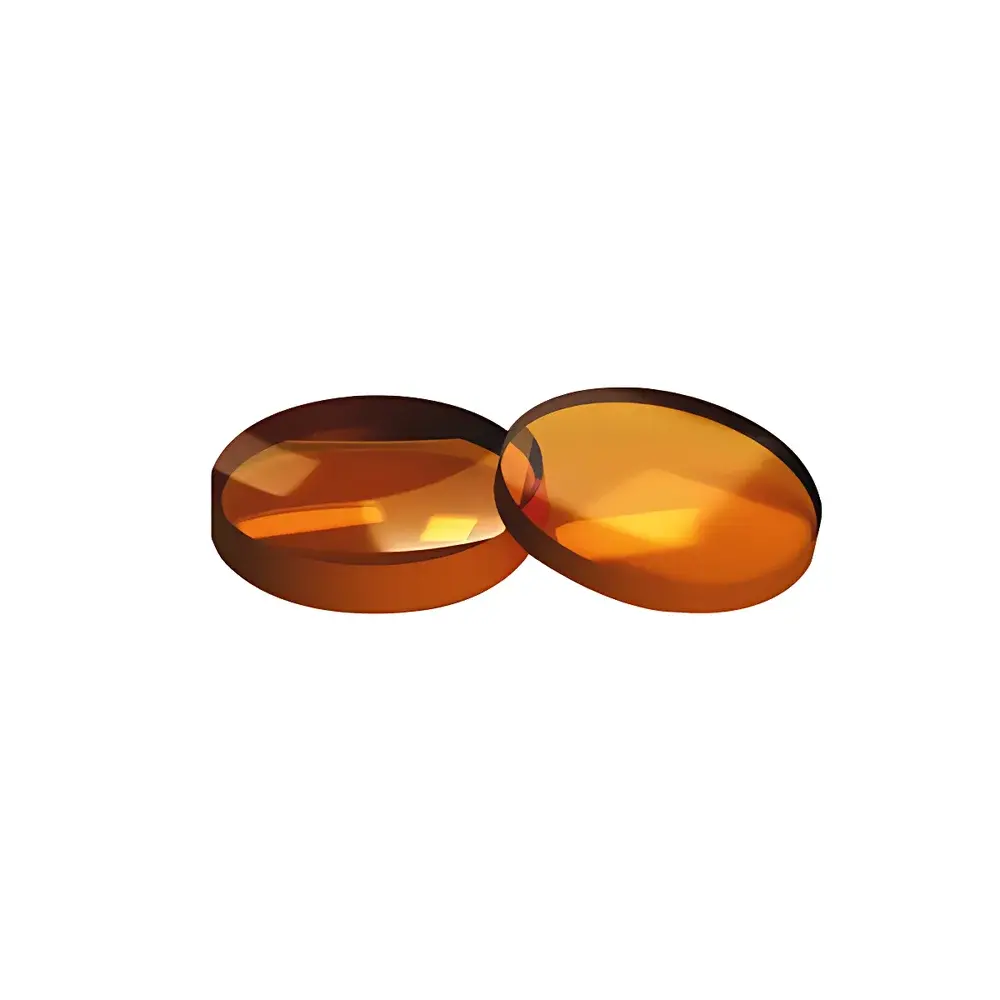
GL73 ZnSe Plano-Concave Lens (Uncoated or Broadband IR AR-Coated, 8–12 µm)
| Origin | Beijing |
|---|---|
| Manufacturer Type | Distributor |
| Origin Category | Domestic (China) |
| Model | GL73 |
| Price Range | USD 140–420 (est.) |
| Component Category | Optical Element |
| Substrate | CVD Grade ZnSe |
| Design Wavelength | 10.6 µm |
| Diameter Tolerance | +0.0 / −0.1 mm |
| Center Thickness Tolerance | ±0.1 mm |
| EFL Tolerance | ±1% |
| Centration Error | < 3 arcmin |
| Surface Quality | 3–4 scratch-dig |
| Edge Treatment | 0.2 mm × 45° chamfer |
| Coating Options | Uncoated or Broadband AR (Rₐᵥg < 1.5% @ 8–12 µm) |
Overview
The GL73 ZnSe Plano-Concave Lens is a precision optical component engineered for demanding mid-infrared (MIR) applications, particularly in CO₂ laser systems (10.6 µm), thermal imaging, FTIR spectroscopy, and gas sensing platforms. Constructed from chemical vapor deposition (CVD) grade zinc selenide (ZnSe), this lens exhibits high transmission (>70% bulk) across the 8–12 µm atmospheric window, low absorption at 10.6 µm, and excellent thermal stability under continuous-wave or pulsed irradiation. As a plano-concave configuration, it introduces negative optical power—diverging incident collimated beams—and is commonly employed in beam expansion, spatial filtering, telescope objectives, and optical cavity design where controlled wavefront divergence is required. Its uncoated variant provides baseline performance for alignment and low-power diagnostics, while the optional broadband anti-reflection (BBAR) coating—optimized for Rₐᵥg < 1.5% over 8–12 µm—minimizes Fresnel losses and ghost reflections in multi-element MIR assemblies.
Key Features
- CVD-synthesized ZnSe substrate ensures homogeneity, low scatter, and minimal internal stress—critical for diffraction-limited performance in interferometric and high-resolution systems.
- Tight mechanical tolerances: diameter tolerance of +0.0 / −0.1 mm, center thickness control within ±0.1 mm, and effective focal length (EFL) accuracy of ±1% support repeatable integration into kinematic mounts and OEM laser heads.
- Surface quality rated to 3–4 scratch-dig per MIL-PRF-13830B, enabling compatibility with Class 100 cleanroom handling and minimizing particulate-induced scattering in vacuum-compatible environments.
- Controlled centration error (< 3 arcminutes) ensures minimal beam walk-off and angular deviation—essential for alignment-critical setups such as heterodyne detection or dual-path interferometers.
- Standard edge treatment: 0.2 mm × 45° chamfer mitigates chipping during handling and mounting while preserving edge integrity under thermal cycling.
- Two coating options available: bare ZnSe surface (for calibration-grade reference use or high-damage-threshold applications) or broadband AR coating optimized for the full 8–12 µm range—validated via spectral reflectance measurement per ISO 9211-3.
Sample Compatibility & Compliance
The GL73 lens is compatible with standard SM-series lens mounts (e.g., SM1-threaded housings) and Ø3 mm kinematic cell adapters. It meets material traceability requirements per ISO 10110-1 for optical element documentation and conforms to RoHS Directive 2011/65/EU for hazardous substance restrictions. While not certified to IEC 61000-4-x immunity standards as a standalone passive component, its ZnSe substrate complies with ASTM F2634–19 for infrared-transmitting optical materials used in medical and industrial laser delivery systems. The BBAR coating process adheres to ISO 9211-4 specifications for coating durability (adhesion, abrasion, and humidity resistance). For regulated environments—including FDA-regulated laser-based analytical instruments—the lens supports full material lot traceability and certificate of conformance (CoC) upon request.
Software & Data Management
As a passive optical element, the GL73 lens does not incorporate embedded firmware or digital interfaces. However, its geometric and material parameters are fully integrated into industry-standard optical design software libraries—including Zemax OpticStudio (via user-defined material catalog entry for ZnSe), CODE V, and FRED—enabling accurate modeling of thermal lensing, dispersion, and polarization effects across the MIR band. Design files (STEP, SAT) and measured spectral transmittance data (400–14,000 cm⁻¹) are provided in standardized CSV and SDF formats for import into Lumerical INTERCONNECT or Ansys Speos for system-level simulation. Traceable metrology reports—including interferometric surface figure (λ/4 @ 633 nm HeNe reference), spectral reflectance scans, and dimensional inspection logs—are archived digitally and available under NDA for GMP/GLP audit purposes.
Applications
- Beam expansion in CO₂ laser resonators and external cavity configurations.
- Negative lens elements in Galilean-type beam expanders for MIR free-space optics.
- Collimation correction in quantum cascade laser (QCL) output trains.
- Reference optics in Michelson and Mach–Zehnder interferometers operating in the thermal infrared.
- Field lenses and relay optics in uncooled microbolometer imaging systems.
- Gas cell windows and focusing elements in photoacoustic spectroscopy (PAS) and cavity-enhanced absorption setups.
FAQ
What is the damage threshold for the uncoated GL73 ZnSe lens at 10.6 µm?
Typical CW damage threshold for CVD ZnSe is ≥ 500 W/cm²; pulsed (10 ns, 10 Hz) threshold exceeds 500 mJ/cm². Actual performance depends on beam uniformity, cooling, and contamination level.
Can the GL73 lens be used with femtosecond MIR sources?
Not recommended without prior dispersion characterization—the material exhibits significant group delay dispersion (GDD) above 10⁴ fs²/mm in the 8–12 µm range, requiring chirped mirror compensation in ultrafast systems.
Is the BBAR coating solvent-resistant for cleaning with isopropanol or acetone?
Yes—the coating passes ISO 9211-4 abrasion testing (CS-10 wheel, 1000 cycles) and withstands repeated wipe-cleaning with reagent-grade solvents per MIL-C-48497A.
Do you provide custom focal lengths or diameters beyond the standard GL73 series?
Yes—custom geometries (including aspheric variants and non-standard EFLs) are available under NRE agreement with lead times of 6–10 weeks and full metrological validation per ISO 10110-5.
How is thermal drift compensated in high-stability MIR interferometers using this lens?
ZnSe’s dn/dT ≈ +62 × 10⁻⁶ K⁻¹ requires mechanical athermalization—typically achieved via matched aluminum or Invar housing with calculated axial preload to offset focus shift over −10°C to +60°C ambient ranges.





