
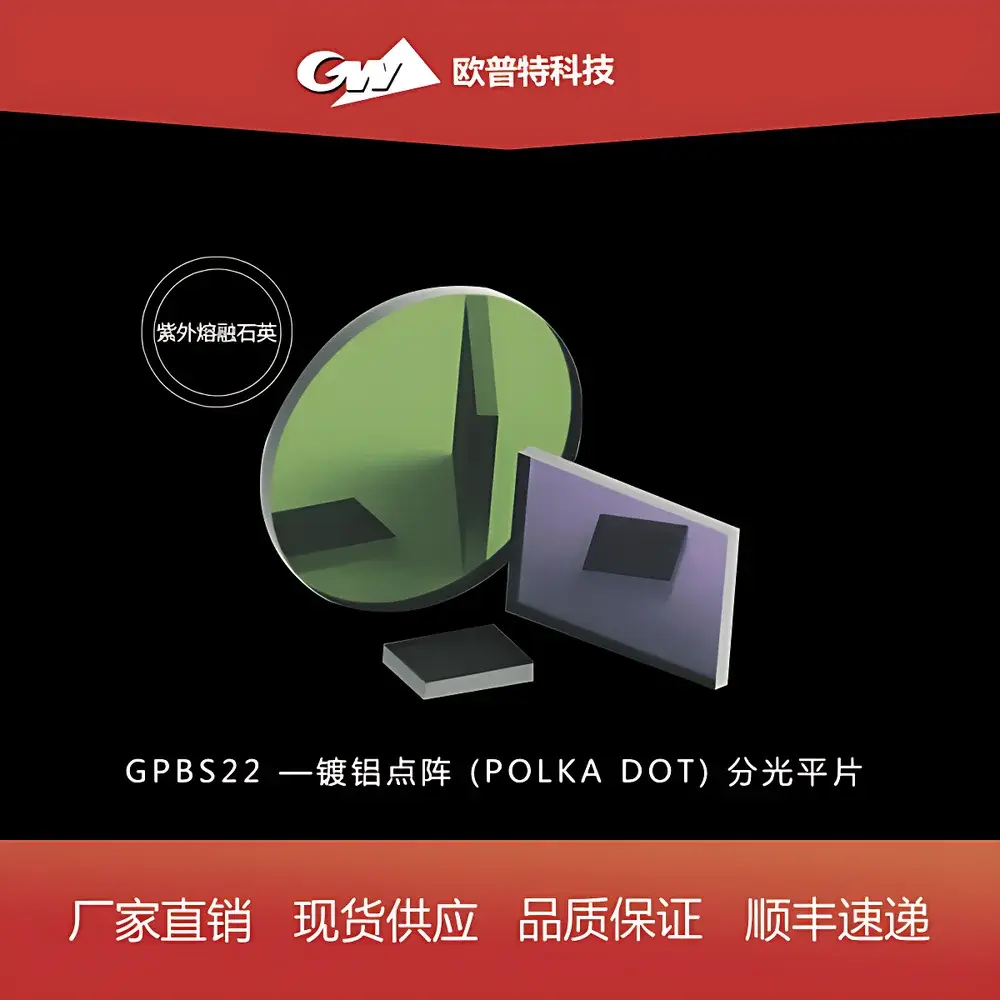
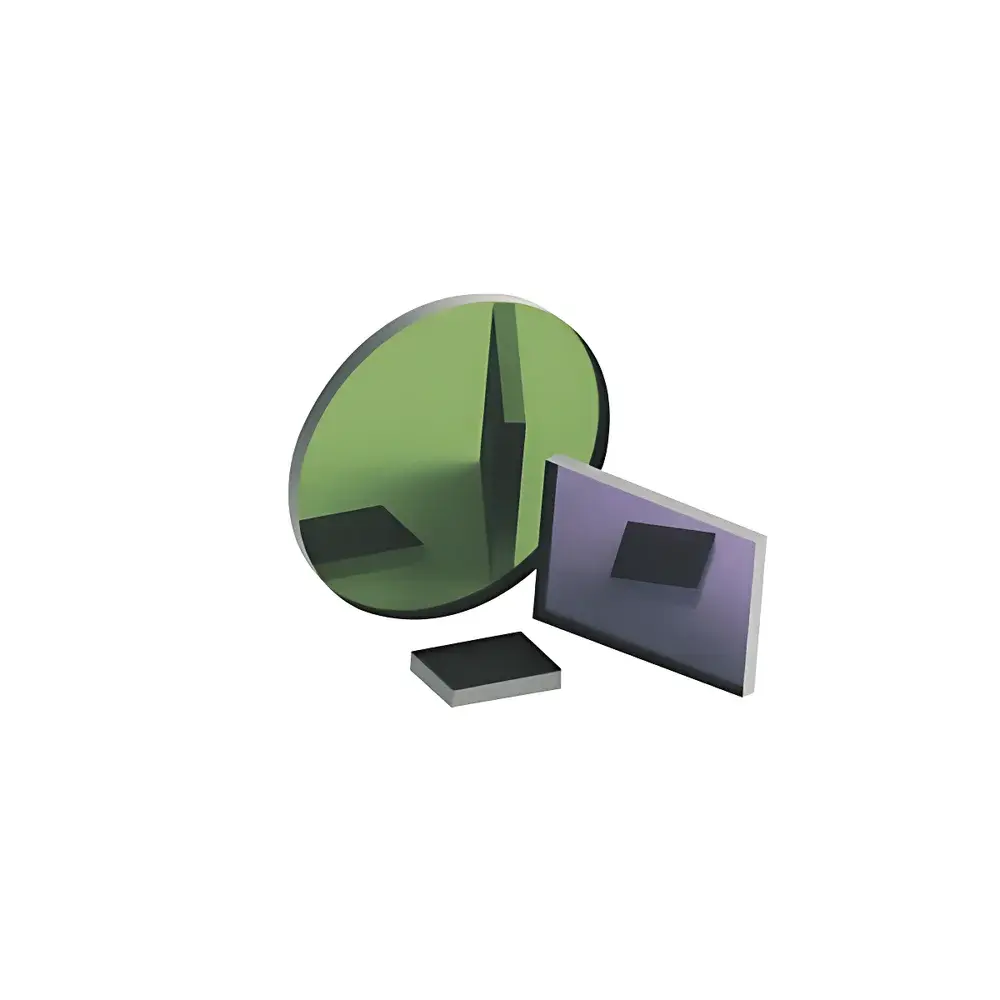
GPBS22 Polka-Dot Aluminum-Coated UV Fused Silica Beam Splitter Plate
| Material | UV Fused Silica |
|---|---|
| Surface Quality | 5/10 (Scratch-Dig) |
| Clear Aperture | ≥85% |
| Dimensional Tolerance | +0/−0.5 mm |
| Thickness | 1.5 mm (nominal) |
| Splitting Ratio (R/T) | ±5% over 250–2000 nm |
| Coating Type | Polka-dot pattern aluminum deposition |
| Minimum Beam Diameter | >2 mm |
| Available Configurations | 30R/70T, 50R/50T, 70R/30T |
Overview
The GPBS22 Polka-Dot Aluminum-Coated UV Fused Silica Beam Splitter Plate is a precision optical component engineered for broadband beam division in demanding spectroscopic, interferometric, and alignment applications. Unlike continuous thin-film dielectric splitters, this plate employs a spatially modulated aluminum deposition—commonly referred to as a “polka-dot” pattern—where discrete metallic micro-areas are distributed across a high-purity UV-grade fused silica substrate. This architecture ensures minimal wavefront distortion, low polarization dependence, and exceptional angular insensitivity across the deep ultraviolet through near-infrared spectrum (250–2000 nm). The substrate’s intrinsic properties—including low thermal expansion (5.5 × 10⁻⁷ /°C), high transmission down to 185 nm, and excellent homogeneity—make it suitable for applications requiring long-term stability under vacuum, UV irradiation, or thermal cycling. Designed for integration into OEM optical benches, laser cavities, and metrology systems, the GPBS22 delivers consistent splitting performance without stringent alignment constraints.
Key Features
- UV-grade fused silica substrate with certified transmission ≥99.5% at 254 nm and ≥95% at 193 nm (uncoated reference)
- Polka-dot aluminum coating applied via controlled vacuum evaporation, ensuring uniform dot density and edge definition
- Surface quality rated to MIL-PRF-13830B 5/10 scratch-dig specification, verified via interferometric inspection
- Clear aperture ≥85% of nominal diameter or side length, with tight dimensional tolerance (+0/−0.5 mm)
- Standard thickness of 1.5 mm provides mechanical rigidity while minimizing etalon effects in collimated beams
- Three standard splitting ratios available: 30R/70T, 50R/50T, and 70R/30T—each calibrated per ISO 10110-2 and traceable to NIST-traceable spectrophotometric standards
Sample Compatibility & Compliance
The GPBS22 is compatible with both free-space and fiber-coupled architectures operating at beam diameters exceeding 2 mm. Its polka-dot structure eliminates ghost reflections associated with parallel-surface interference, making it particularly suited for ultrafast laser systems (e.g., Ti:sapphire oscillators and amplifier chains) where temporal pulse fidelity must be preserved. The component complies with ISO 10110 optical drawing standards for surface form (λ/10 PV @ 633 nm), coating adhesion (ASTM D3359 Tape Test, Class 4B), and environmental durability (MIL-C-48497A for humidity and thermal shock). While not inherently compliant with FDA 21 CFR Part 11, its documentation package supports integration into GLP/GMP environments when paired with validated calibration records and lot-specific test reports.
Software & Data Management
As a passive optical element, the GPBS22 requires no embedded firmware or driver software. However, full spectral characterization data—including measured R/T curves from 250 nm to 2000 nm, angle-of-incidence sensitivity plots (0°–15°), and polarization-dependent loss (PDL) profiles (<0.15 dB across all ratios)—are supplied in CSV and PDF formats with each shipment. These datasets are compatible with common optical design platforms such as Zemax OpticStudio, CODE V, and FRED, enabling accurate system-level modeling. Traceability documentation includes substrate certificate of conformance (COC), coating process log, and spectrophotometer calibration certificate aligned to ISO/IEC 17025-accredited laboratories.
Applications
- Beam sampling in UV-VIS-NIR spectrophotometers and ellipsometers
- Reference path splitting in Michelson and Mach-Zehnder interferometers
- Alignment verification optics in EUV lithography tool subassemblies
- Pulse energy monitoring in femtosecond laser systems without nonlinear distortion
- Multi-channel detection schemes in fluorescence lifetime imaging (FLIM) and time-resolved spectroscopy
- OEM integration into portable Raman analyzers and handheld LIBS devices requiring compact, robust beam division
FAQ
What is the damage threshold for the GPBS22 under pulsed UV laser exposure?
The polka-dot aluminum coating exhibits a typical LIDT of 0.5 J/cm² at 266 nm, 10 ns, 10 Hz (measured per ISO 21254-1); actual performance depends on beam profile homogeneity and spot size.
Can the GPBS22 be mounted in kinematic fixtures without inducing stress birefringence?
Yes—its 1.5 mm thickness and fused silica’s low Young’s modulus (73 GPa) allow secure mounting using compliant pads or low-stress flexure mounts; finite-element analysis confirms <5 nm OPD change under standard 3-point contact loading.
Is custom splitting ratio or substrate thickness available?
Custom ratios (e.g., 10R/90T) and thicknesses (1.0 mm or 2.0 mm) are available under minimum order quantities of 25 units and extended lead times; custom designs undergo full spectral validation prior to release.
How does the polka-dot architecture affect wavefront error compared to continuous coatings?
Interferometric testing shows RMS wavefront error ≤λ/20 over clear aperture—comparable to high-end dielectric splitters—due to the absence of coating-induced stress gradients and substrate bending.
Are coated surfaces protected against cleaning-related abrasion?
The aluminum layer is unsealed but highly resistant to standard lens-tissue + spectroscopic-grade acetone/isopropanol cleaning protocols; aggressive wiping or ultrasonic immersion is not recommended.




