
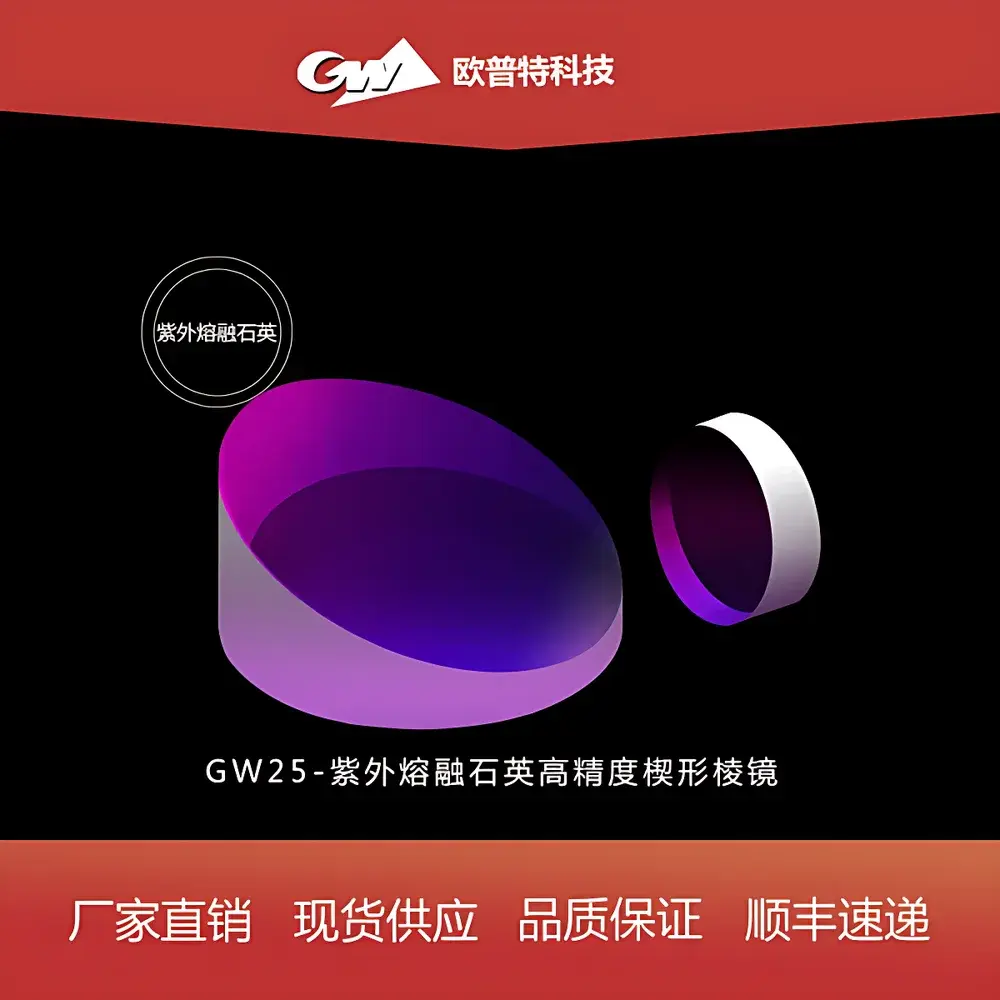
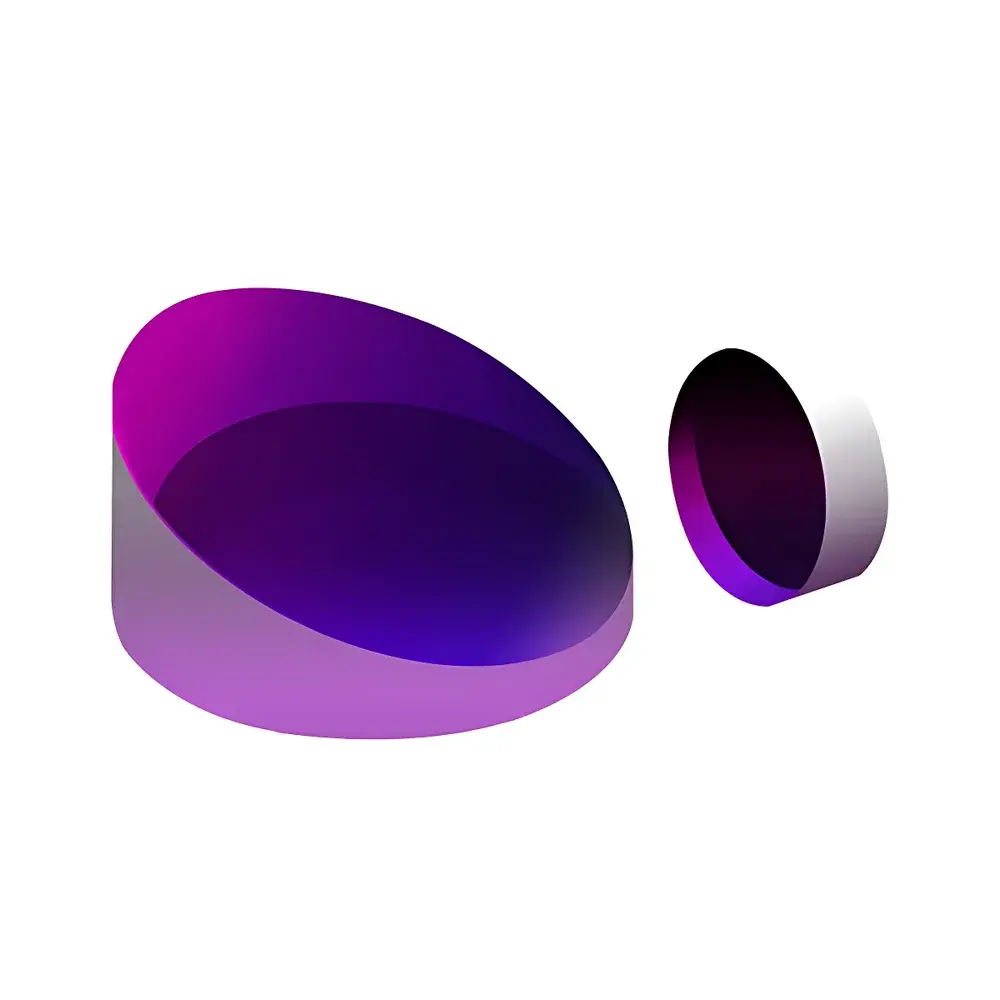
GW25 Precision Wedge Prism, UV Fused Silica
| Material | UV Fused Silica |
|---|---|
| Surface Flatness | λ/10 @ 633 nm |
| Wedge Angle Tolerance | ±15 arcseconds |
| Surface Quality | 20–30 scratch-dig (MIL-PRF-13830B) |
| Diameter Tolerance | +0.0 / –0.1 mm |
| Thickness Tolerance | ±0.2 mm |
| Edge Treatment | Protective 45° chamfer, 0.2–0.5 mm |
| Coating | Optional AR or custom broadband/VIS-UV/NIR coatings per specification |
| Compliance | ISO 10110–3, ISO 10110–7, ANSI/OEOSC OP1.002 |
Overview
The GW25 Precision Wedge Prism is an optically engineered component fabricated from high-purity ultraviolet-grade fused silica, designed for demanding beam steering, cavity isolation, and interference mitigation applications in laser systems, interferometry, and precision optical instrumentation. Unlike standard parallel windows, the controlled wedge geometry—engineered to a tight tolerance of ±15 arcseconds—introduces a deterministic angular deviation between incident and transmitted beams while eliminating parasitic etalon effects caused by coherent reflections between parallel surfaces. This design principle is critical in high-finesse resonators, ultrafast laser cavities, and low-noise spectroscopic setups where back-reflection-induced mode instability, power fluctuations, or longitudinal mode hopping must be suppressed. The prism’s λ/10 surface flatness (measured at 633 nm HeNe wavelength) and 20–30 scratch-dig surface quality ensure minimal wavefront distortion and scatter, supporting diffraction-limited performance in alignment-sensitive configurations.
Key Features
- Substrate material: Synthetic UV fused silica (SiO₂), with <0.5 ppm metallic impurities, OH content 99.5% per surface across 190–2100 nm (uncoated)
- Optical surface flatness specified to λ/10 @ 633 nm, verified via phase-shifting interferometry traceable to NIST standards
- Wedge angle accuracy maintained within ±15 arcseconds—achieved through precision diamond fly-cutting and iterative interferometric feedback during polishing
- Diameter tolerance of +0.0 / –0.1 mm ensures repeatable mounting in kinematic or threaded lens cells without radial stress-induced birefringence
- Thickness uniformity controlled to ±0.2 mm, minimizing axial displacement uncertainty in collimated beam paths
- Protective 45° edge chamfer (0.2–0.5 mm) mitigates chipping during handling and cleaning while preserving clear aperture integrity
- Optional broadband anti-reflection (BBAR) coatings available for VIS (400–700 nm), UV-VIS (250–700 nm), or NIR (700–1100 nm) spectral bands, with residual reflectivity <0.25% per surface (RMS)
Sample Compatibility & Compliance
The GW25 wedge prism is compatible with standard Ø25.4 mm (1″) optical mounts, including SM1-threaded lens tubes, kinematic mirror mounts, and translation stages with integrated retaining rings. Its fused silica substrate exhibits negligible thermal expansion (α ≈ 0.55 × 10⁻⁶ /°C), enabling stable alignment under ambient temperature fluctuations typical in metrology labs and cleanroom environments. Manufacturing adheres to ISO 10110–3 (surface imperfections) and ISO 10110–7 (wedge and thickness tolerances), with full inspection documentation provided per batch. All prisms undergo 100% visual inspection under dark-field illumination and quantitative surface roughness verification (Ra < 5 Å) via atomic force microscopy (AFM) sampling. For regulated environments—including ISO 13485-certified medical device R&D labs or FDA-audited photonics manufacturing—the prism can be supplied with full traceability (lot number, interferogram reports, coating spectral curves, and material COA).
Software & Data Management
While the GW25 is a passive optical component, its integration into automated optical systems benefits from standardized digital asset management. Each unit ships with a unique QR-coded label linking to a secure web portal containing downloadable calibration reports (interferograms, spectral transmittance curves, coating performance data), STEP/IGES mechanical models for CAD integration, and Zemax-compatible surface prescription files (.ZBF). For customers implementing LabWare LIMS or Veeva Vault QMS, metadata templates are available to map prism attributes (wedge angle measured value, surface flatness RMS, coating lot ID) directly into audit-ready electronic records. All documentation conforms to 21 CFR Part 11 requirements for electronic signatures and audit trails when hosted on validated platforms.
Applications
- Laser cavity isolation: Prevents destabilizing optical feedback into diode-pumped solid-state (DPSS) and fiber lasers by angularly separating forward and backward propagating beams
- Beam steering arrays: Paired GW25 prisms mounted on motorized rotation stages enable continuous, non-mechanical beam pointing over solid angles up to ±2.5° (depending on wedge orientation)
- Interference-free imaging windows: Replaces parallel substrates in high-NA microscope objectives and OCT sample arms to eliminate Fabry–Pérot fringes
- Ellipsometry and polarimetry: Serves as a polarization-preserving beam offsetter in Mueller matrix measurement setups requiring minimal depolarization
- UV lithography tooling: Used as a harmonic separation element in excimer laser beam delivery systems due to deep-UV transparency and radiation hardness
- Space-qualified optics: Qualified per ECSS-Q-ST-70-02C for outgassing (CVCM < 0.1%, TML < 1.0%) and proton irradiation resilience (10⁹ rad(Si))
FAQ
What is the maximum recommended laser power density for uncoated GW25 prisms?
For continuous-wave (CW) operation at 532 nm, the damage threshold is ≥10 J/cm² (tested per ISO 21254–1 with 10 ns pulses, 10 Hz); for CW use, thermal lensing remains negligible below 5 kW/cm² with proper heat sinking.
Can the wedge angle be customized beyond ±15 arcseconds?
Yes—custom wedge angles from 10 arcseconds to 30 arcminutes are available under OEM agreement, with corresponding adjustments to surface flatness and coating specifications.
Is vacuum-compatible mounting hardware included?
No—standard mounting accessories are not supplied; however, vacuum-rated kinematic mounts (e.g., Thorlabs KM100V) and indium wire gasketing protocols are documented in the Integration Guide.
Do you provide wavefront error maps for individual units?
Yes—interferometric wavefront error maps (Zernike coefficients up to n=6) are included in the Certificate of Conformance for all units ordered with “Metrology Grade” designation.
How does the GW25 compare to BK7-based wedge prisms in UV applications?
BK7 exhibits strong absorption below 350 nm and higher thermal drift; fused silica provides superior transmission down to 185 nm and 1/10th the thermal coefficient, making it mandatory for deep-UV lithography and synchrotron beamlines.





