
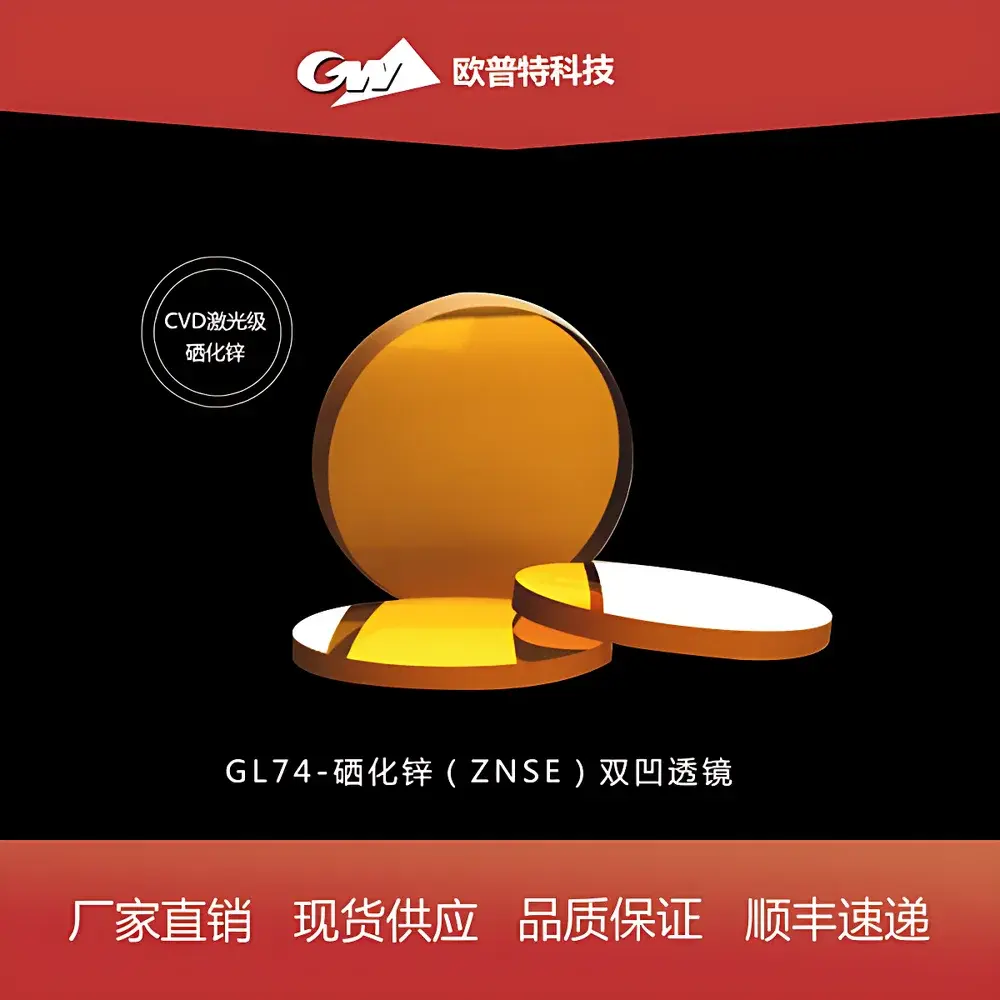
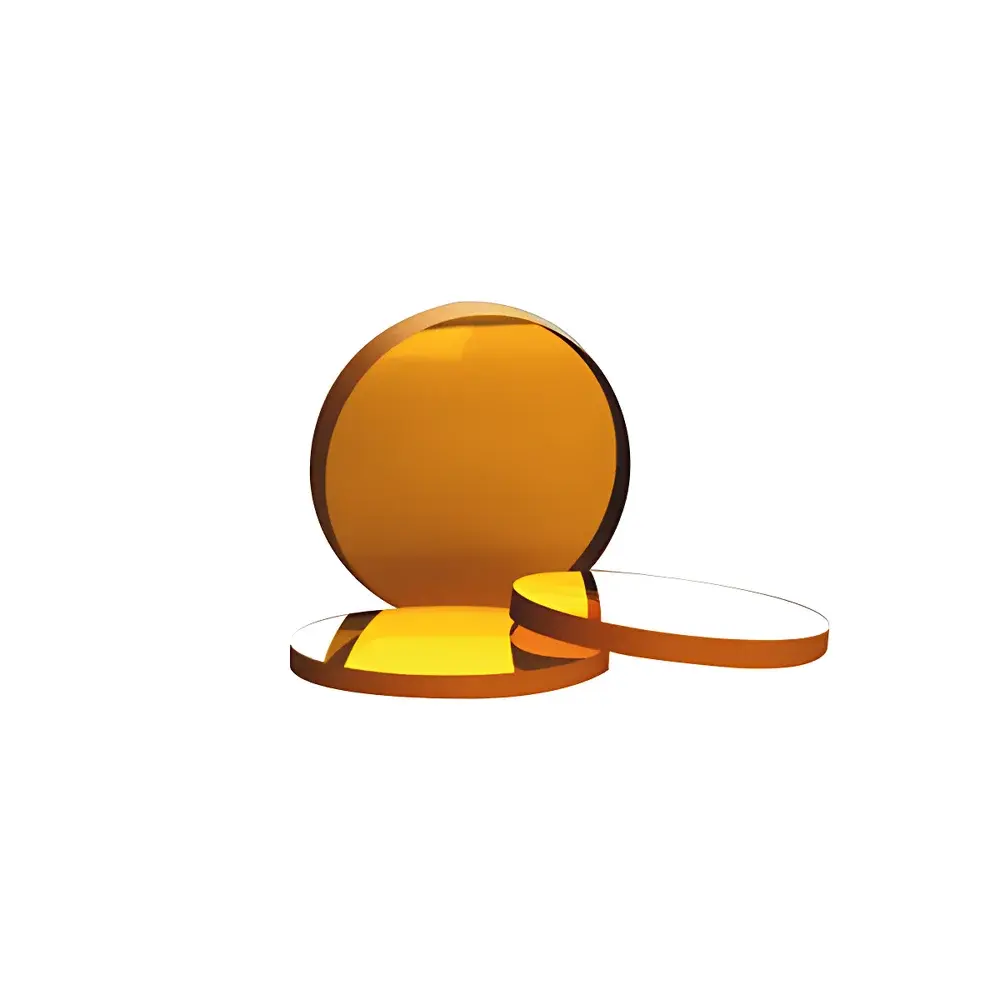
ZnSe Biconcave Lens GL74 (Uncoated & IR Broadband AR-Coated, 8–12 µm)
| Origin | Beijing |
|---|---|
| Manufacturer Type | Distributor |
| Origin Category | Domestic (China) |
| Model | GL74 |
| Price Range | USD 140–420 |
| Component Category | Optical Element |
| Material | CVD-Grown Laser-Grade ZnSe |
| Design Wavelength | 10.6 µm |
| Diameter Tolerance | +0.0 / −0.1 mm |
| Center Thickness Tolerance | ±0.1 mm |
| EFL Tolerance | ±1% |
| Lens Centration Error | < 3 arcmin |
| Surface Quality | 3–4 scratch-dig |
| Edge Treatment | 0.2 mm × 45° chamfer |
| Coating Options | Uncoated or IR Broadband AR (Rₐᵥg < 1.5% @ 8–12 µm) |
Overview
The GL74 ZnSe biconcave lens is a precision optical component engineered for demanding mid-infrared (MIR) applications, particularly in CO₂ laser systems (10.6 µm), thermal imaging optics, FTIR spectrometers, and gas sensing platforms. Fabricated from chemical vapor deposition (CVD)-grown laser-grade zinc selenide, this lens exhibits high transmission (>70% bulk transmittance) across the 8–12 µm atmospheric window, low absorption coefficient (<0.001 cm⁻¹ at 10.6 µm), and excellent thermal stability (dn/dT ≈ 62 × 10⁻⁶ K⁻¹). Its biconcave geometry introduces negative focal power, enabling beam expansion, divergence correction, and relay imaging in collimated MIR beam paths. Unlike plano-convex lenses—often misreferenced in the source description—the GL74 is strictly biconcave; its symmetric curvature distribution minimizes spherical aberration under collimated illumination and ensures predictable wavefront divergence in telecentric or afocal configurations.
Key Features
- CVD-synthesized ZnSe substrate with controlled stoichiometry and minimal sub-surface damage, validated per MIL-PRF-13830B for laser damage threshold (LDT > 500 MW/cm², 10.6 µm, 10 ns pulse)
- Biconcave geometry with matched radii of curvature—designed to maintain conjugate symmetry and reduce off-axis coma in wide-field MIR assemblies
- Tight mechanical tolerances: diameter tolerance +0.0/−0.1 mm ensures repeatable mounting in SM1- or RMS-threaded lens tubes; center thickness tolerance ±0.1 mm supports precise air-gap spacing in multi-element objectives
- Surface quality rated 3–4 scratch-dig per ANSI/OPI-1.017, verified via interferometric inspection at 632.8 nm (HeNe) and corroborated with MIR-compatible Nomarski contrast microscopy
- Edge treatment: 0.2 mm × 45° protective chamfer prevents chipping during handling and mounting—critical for brittle ZnSe under mechanical clamping loads
- Optional broadband anti-reflection coating (IR2): Rₐᵥg < 1.5% over 8–12 µm, deposited via ion-assisted e-beam evaporation; coating adhesion qualified per ISO 9211-3 for environmental durability (damp heat, thermal cycling)
Sample Compatibility & Compliance
The GL74 lens is compatible with standard optomechanical mounts (e.g., Thorlabs SM1-threaded lens cells, Newport 1-inch kinematic mounts) and integrates seamlessly into ISO-standard optical tables and breadboards. It complies with RoHS Directive 2011/65/EU for hazardous substance restrictions and meets the material traceability requirements outlined in ISO 10110-7 for optical element certification. While not inherently FDA-regulated, its CVD ZnSe grade satisfies the raw material purity benchmarks referenced in ASTM F2657–21 (Standard Guide for Infrared Optical Materials for Medical Laser Systems). No biocompatibility testing is applicable, as the component is intended solely for non-contact optical path use.
Software & Data Management
As a passive optical element, the GL74 requires no embedded firmware, drivers, or software interface. However, its geometric and material parameters are fully supported in industry-standard optical design platforms—including Zemax OpticStudio (v23+), CODE V (v12.2+), and FRED—via built-in ZnSe dispersion models (Sellmeier coefficients sourced from Malitson’s 1965 empirical fit, extended to 12 µm using FIR extrapolation). Lens prescription data (radius, thickness, conic constant) is provided in both .zmx and .seq formats upon request. All calibration certificates—including interferometric surface figure (λ/10 @ 632.8 nm) and spectral transmittance curves (FTIR-measured, 2 cm⁻¹ resolution)—are archived digitally with unique lot-number traceability and comply with ISO/IEC 17025 documentation standards.
Applications
- Beam expansion in CO₂ laser resonators and harmonic generation setups requiring negative focal elements to control mode volume
- Divergence compensation in quantum cascade laser (QCL) output conditioning, especially where thermal lensing in gain media necessitates dynamic wavefront correction
- Objective elements in reflective-refractive hybrid spectrometers operating across the fingerprint region (9–11 µm) for VOC detection
- Reference optics in NIST-traceable MIR radiometry systems, where uncoated variants serve as calibrated attenuators with known Fresnel losses
- Telescopic relays in long-path open-air gas monitoring, leveraging ZnSe’s low hygroscopicity and resistance to ambient humidity-induced index drift
FAQ
Is the GL74 lens suitable for pulsed CO₂ laser applications?
Yes—when used within specified fluence limits and with appropriate beam homogenization, the CVD ZnSe substrate sustains peak powers typical of TEA and RF-excited CO₂ lasers.
What is the maximum operating temperature for sustained use?
Continuous operation up to 150 °C is permissible; above this, thermo-optic drift exceeds ±0.5% EFL shift per 10 K, requiring active thermal stabilization in precision systems.
Can the uncoated version be retrofitted with custom coatings post-purchase?
No—ZnSe’s sensitivity to thermal stress and coating adhesion failure prohibits re-coating after initial fabrication; coating selection must be finalized prior to order.
Does the ±1% EFL tolerance apply at 10.6 µm or across the full 8–12 µm band?
The tolerance is specified at the design wavelength (10.6 µm); chromatic focal shift across 8–12 µm is approximately −0.8% per µm, calculable via the ZnSe Sellmeier equation.
Are test reports available for individual lens lots?
Yes—each shipped unit includes a certificate of conformance with interferometric surface map, spectral transmittance plot, and dimensional verification report, archived for 10 years per ISO 10012.



