
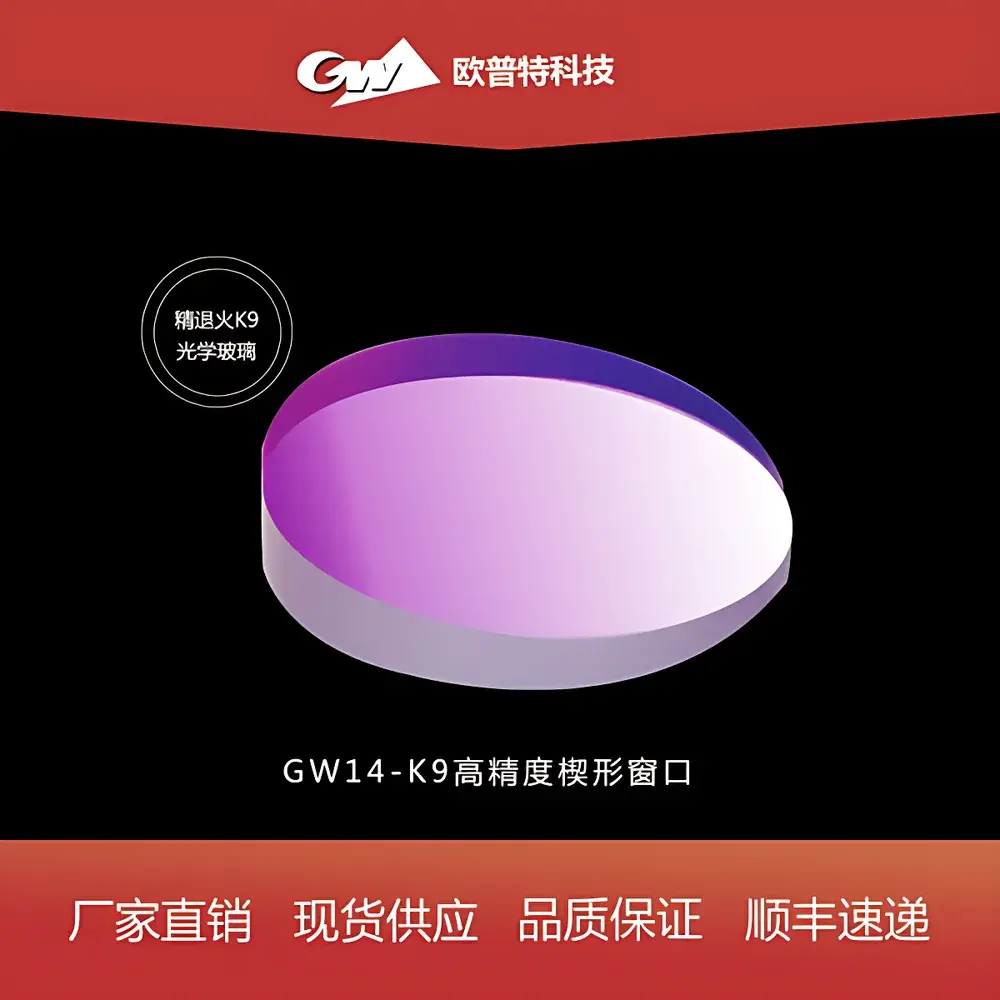
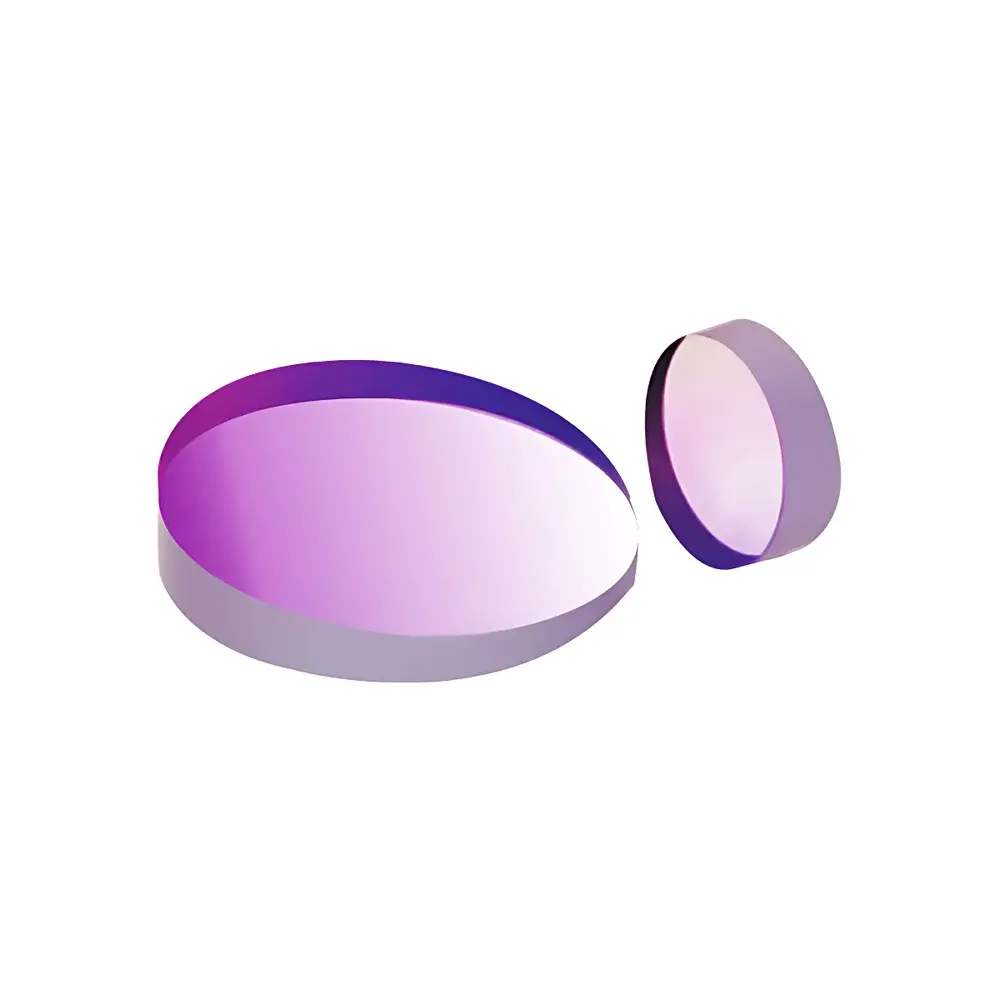
GW14-K9 Precision Wedge Optical Window
| Origin | Beijing, China |
|---|---|
| Manufacturer Type | Authorized Distributor |
| Origin Category | Domestic (PRC) |
| Model | GW14 |
| Price Range | USD 0.15–75.00 (per unit, ex-works) |
| Component Category | Optical Element |
| Material | K9 Borosilicate Crown Glass |
| Wedge Angle | 0.5° ± 0.1° (standard) |
| Surface Quality | 20–10 scratch-dig |
| Flatness | λ/4 @ 632.8 nm |
| Parallelism | < 1 arcmin |
| Clear Aperture | ≥ 90% of diameter |
| Transmission Range | VIS (350–700 nm), NIR (600–1100 nm), SWIR (900–1700 nm) |
| Coating Options | Broadband AR (VIS/NIR/SWIR variants), Uncoated |
Overview
The GW14-K9 Precision Wedge Optical Window is a high-stability, low-birefringence optical component engineered for critical beam steering, cavity alignment, and laser path correction in demanding photonic systems. Constructed from optically homogeneous Schott K9 borosilicate crown glass—a material with exceptional transmission uniformity, low thermal expansion (7.1 × 10⁻⁶ /K), and high surface hardness (620–670 HK)—the window incorporates a precisely controlled wedge angle of 0.5° ± 0.1° to eliminate unwanted interference fringes in collimated or quasi-collimated optical setups. Unlike parallel plates, the wedge geometry prevents etalon effects by ensuring reflected beams are angularly displaced outside the primary optical path—making it indispensable in interferometric metrology, ultrafast laser cavities, fiber coupling assemblies, and vacuum feedthrough applications where ghost reflections must be suppressed without introducing polarization-dependent loss.
Key Features
- Precision-ground wedge geometry with angular tolerance ≤ ±0.1°, verified via autocollimation and interferometric angle metrology
- K9 substrate meeting ISO 10110-3 standards for surface figure (λ/4 @ 632.8 nm) and subsurface damage control
- Multiple standard diameters (Φ12.5 mm to Φ50.8 mm) and thicknesses (3.0 mm to 10.0 mm), all with ≥90% clear aperture specification
- Three broadband anti-reflection coating options: VIS (350–700 nm, R<0.5% avg), NIR (600–1100 nm, R<0.4% avg), and SWIR (900–1700 nm, R<0.6% avg), deposited via ion-assisted e-beam evaporation per MIL-C-48497A
- Uncoated variant available for UV-compatible applications or custom coating integration
- Traceable dimensional certification included; each unit serialized and supplied with measured transmission curve (200–2000 nm, ±0.3 nm resolution)
Sample Compatibility & Compliance
The GW14-K9 window is compatible with standard SM1 (1.035″-40) and SM2 (2.035″-40) lens tube systems, as well as kinematic mounts compliant with ANSI/ISO 10110-7 mounting interface guidelines. Its K9 composition ensures full compatibility with Class 100 cleanroom handling protocols and withstands bake-out temperatures up to 250°C under vacuum (≤10⁻⁶ Torr). All coated variants comply with ISO 9211-3 for coating adhesion (tape test per ASTM D3359) and environmental durability (damp heat per ISO 9211-4). The product meets RoHS 2015/863/EU and REACH SVHC screening requirements; material certificates (EN 10204 3.1) and spectral transmission reports are provided upon request for GMP/GLP-regulated optical assembly validation.
Software & Data Management
Each GW14-K9 unit ships with a digital spectral transmission certificate in CSV and PDF formats, aligned to NIST-traceable spectrophotometer calibration (PerkinElmer Lambda 1050+ with 150 mm integrating sphere). Raw data includes wavelength (nm), absolute transmission (%), and measurement uncertainty (k=2) at every 1 nm step across 200–2000 nm. Integration-ready metadata conforms to IEEE 1596.2 (Photonics Metadata Standard) and supports automated import into Zemax OpticStudio (via .DAT), CODE V (via .TXT), and MATLAB-based optical system modeling workflows. For traceability in regulated environments, batch-level audit logs—including grinding parameters, coating run ID, and interferometric flatness maps—are archived for 10 years and accessible under non-disclosure agreement.
Applications
- Laser cavity isolation and beam walk-off compensation in Ti:sapphire, Yb:fiber, and OPO systems
- Vacuum-compatible viewport windows for spectroscopic ellipsometers and FTIR sampling chambers
- Reference wedges in white-light interferometry and phase-shifting profilometry
- Alignment fiducials in multi-axis optomechanical assemblies requiring repeatable angular offset
- Input/output couplers for free-space-to-fiber interfaces where polarization extinction ratio >30 dB is required
- Calibration standards for spectral radiance transfer between integrating spheres and imaging spectrometers
FAQ
Is the wedge angle customizable beyond the standard 0.5°?
Yes—custom wedge angles from 0.1° to 5.0° are available under OEM agreement, subject to minimum order quantity and extended lead time.
Can the GW14-K9 be used in ultraviolet (UV) applications below 350 nm?
Only the uncoated variant is recommended for UV use; however, transmission drops significantly below 350 nm due to K9’s intrinsic absorption edge—consult spectral data for specific cutoff thresholds.
What is the maximum continuous wave (CW) laser power density this window can withstand?
For uncoated K9 at 1064 nm, the damage threshold is ≥10 J/cm² (10 ns pulse, 10 Hz); for CW operation, thermal lensing becomes limiting above 5 kW/cm²—contact engineering support for application-specific LIDT verification.
Are mounting fixtures or kinematic adapters included with purchase?
No—mounting hardware is sold separately; we recommend SM1-threaded retaining rings (e.g., Thorlabs SM1RR) or kinematic mounts compliant with ISO 10110-7 centering tolerances.
Do you provide ISO/IEC 17025-accredited calibration reports?
Spectral transmission reports are traceable to NIST SRM 2036 but are not issued under ISO/IEC 17025 accreditation; third-party accredited calibration services can be arranged upon request.




