
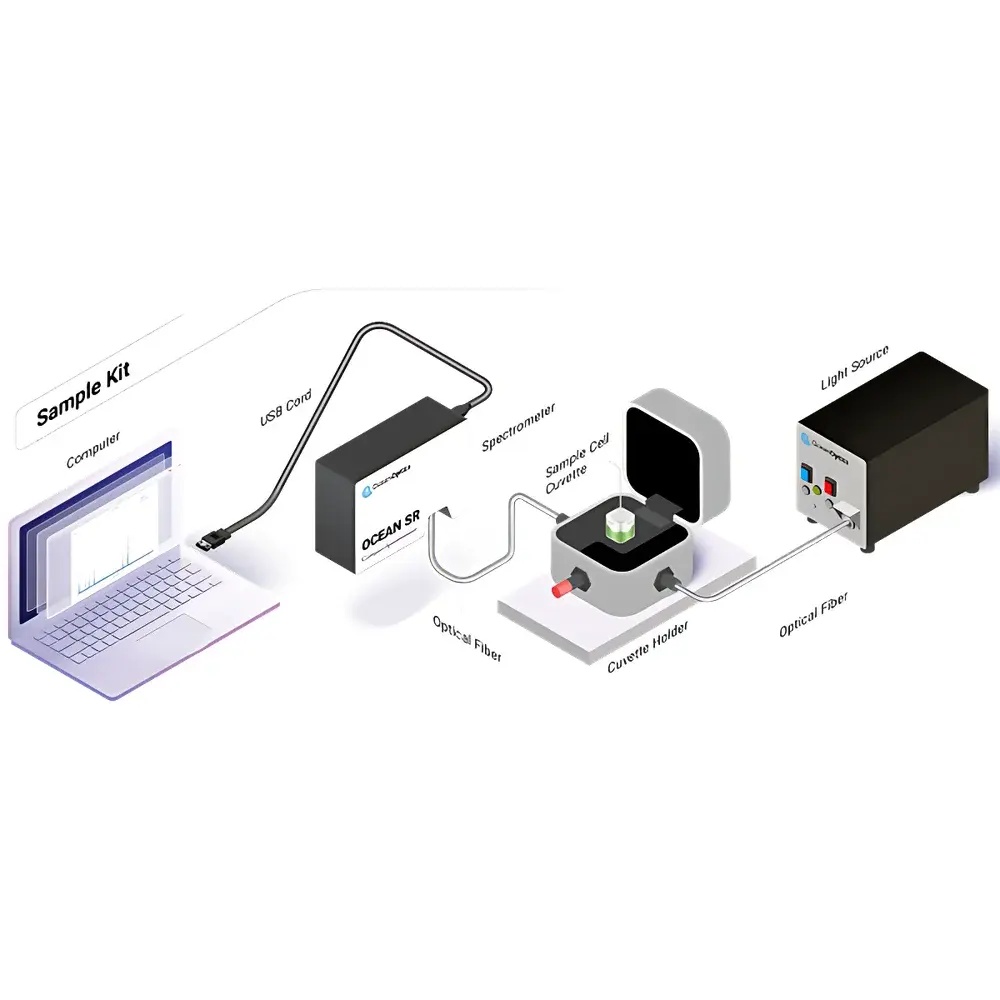
Ocean Optics Spectral Measurement Kit
| Brand | Ocean Optics |
|---|---|
| Origin | USA |
| Manufacturer Type | Authorized Distributor |
| Product Origin | Imported |
| Model | Ocean Optics Spectral Measurement Kit |
| Spectral Range | 200–1100 nm (configurable) |
| Detector Type | CCD or CMOS (model-dependent) |
| Optical Resolution | 0.1–10 nm FWHM (configuration-dependent) |
| Sensitivity | 1–5000 photons/count (typical, varies with grating & detector) |
| Signal-to-Noise Ratio | ≥300:1 (full signal, 1s integration) |
| Dynamic Range | >4 × 10⁴ (with auto-ranging) |
| Stray Light | <0.05% at 600 nm (typical, grating-dependent) |
Overview
The Ocean Optics Spectral Measurement Kit is a turnkey, modular optical spectroscopy platform engineered for quantitative spectral acquisition across the ultraviolet, visible, and near-infrared (UV-VIS-NIR) regions—from 200 nm to 1100 nm. Built upon Ocean Optics’ legacy of fiber-coupled spectrometer design, the system operates on the principle of dispersive spectroscopy: incoming light is collimated, diffracted by a ruled or holographic grating, and focused onto a linear array detector (CCD or CMOS), where photon intensity versus wavelength is digitized with high linearity and repeatability. This architecture enables precise measurement of absorbance, transmittance, reflectance, fluorescence, and radiance—critical parameters in method development, process monitoring, and fundamental research. The kit is not a single instrument but a purpose-integrated ecosystem: each component—including spectrometer, stabilized broadband or LED-based illumination source, low-OH silica optical fiber, and application-optimized sampling interface—is selected and pre-aligned to minimize coupling loss and maximize signal fidelity. Designed for benchtop deployment in controlled laboratory environments, it supports both steady-state and time-resolved measurements with integration times ranging from microseconds to minutes.
Key Features
- Modular, application-driven configuration: Users select from pre-validated combinations optimized for liquid cuvette, solid surface, diffuse reflectance, or fiber-in-fiber-out setups.
- UV-VIS-NIR coverage (200–1100 nm) achieved via interchangeable grating modules and detector options—no hardware modification required for spectral range shifts.
- High optical throughput enabled by f/4 imaging optics and anti-reflection coated fibers (NA 0.22), reducing integration time without compromising SNR.
- Thermoelectrically stabilized detectors (optional) for long-duration measurements requiring baseline drift suppression (<0.01 nm/°C wavelength shift).
- Factory-calibrated radiometric and photometric response curves traceable to NIST standards, supporting quantitative intensity reporting per ASTM E308 and ISO/CIE 15.
- Rugged aluminum chassis and locking SMA 905 connectors ensure mechanical stability during repeated setup changes and transport between teaching labs and field sites.
Sample Compatibility & Compliance
The kit accommodates diverse sample formats—including transparent liquids in 1–10 mm pathlength quartz cuvettes, powders and films using integrating spheres (e.g., ISP-REF or ISR series), and biological tissues via contact probes with adjustable working distance. All optical interfaces comply with ISO 17025 calibration traceability requirements when used with certified reference materials (e.g., NIST SRM 2036 for absorbance, SRM 1930 for reflectance). For regulated environments, the included OceanView software supports 21 CFR Part 11-compliant audit trails, electronic signatures, and user-access controls when deployed with validated installation qualification (IQ) and operational qualification (OQ) documentation. The system meets IEC 61326-1 for electromagnetic compatibility and UL/CSA 61010-1 for electrical safety in laboratory use.
Software & Data Management
OceanView v2.5+ serves as the native acquisition and analysis engine—freely bundled with every kit. It provides real-time spectral preview, multi-channel averaging, dark/baseline correction, peak identification (with centroid and FWHM calculation), and export to CSV, TXT, or HDF5 for downstream processing in MATLAB, Python (via PyOcean), or LabVIEW. Batch processing workflows support automated measurement sequences across multiple samples, with metadata tagging (operator ID, timestamp, environmental conditions). Raw data files retain full detector gain/integration settings and calibration coefficients, ensuring full reproducibility. Optional add-ons include ChemCam for multivariate calibration (PLS, PCA) and SpectraSuite for cloud-based collaborative spectral library management.
Applications
- Academic teaching: UV-Vis quantitative analysis (Beer-Lambert law verification), colorimetry labs, LED spectral characterization, and undergraduate spectroscopy experiments.
- Environmental monitoring: Chlorophyll-a quantification in water samples, dissolved organic carbon (DOC) assessment via UV254 absorbance, and turbidity correction using dual-wavelength ratios.
- Materials science: Thin-film thickness determination via interference fringe analysis, bandgap estimation from Tauc plots, and pigment dispersion uniformity mapping.
- Life sciences: Protein concentration (A280), nucleic acid purity (A260/A280), and enzyme kinetics monitored via time-resolved absorbance changes.
- Quality control: LED binning by dominant wavelength and color rendering index (CRI), pharmaceutical tablet coating uniformity, and polymer degradation tracking via carbonyl index (1710 cm⁻¹ equivalent in NIR).
FAQ
What spectral resolution can I expect with this kit?
Resolution depends on the selected spectrometer model, grating density, and slit width—ranging from ~0.1 nm (HR4000 with 2400 l/mm grating, 5 µm slit) to ~10 nm (USB2000+ with 300 l/mm grating, 200 µm slit). Typical configurations for general-purpose use deliver 1.5–3.0 nm FWHM.
Is calibration included, and how often is recalibration needed?
Each kit ships with factory wavelength and intensity calibration certificates. Wavelength calibration remains stable for >12 months under normal lab conditions; intensity calibration should be verified quarterly using a tungsten-halogen standard lamp (e.g., LS-1-CAL) if quantitative accuracy is critical.
Can I integrate this system with third-party hardware such as automated stages or pumps?
Yes—OceanView supports ASCII command protocol over USB/RS-232 and offers LabVIEW, Python, and .NET SDKs for custom automation. TTL triggers enable synchronization with external devices operating at ≤10 kHz repetition rates.
Are there options for extended spectral ranges beyond 1100 nm?
For NIR applications up to 2500 nm, Ocean Optics offers InGaAs-based spectrometers (e.g., NIRQuest+) compatible with the same fiber and software ecosystem—but these require separate configuration and are not part of the base kit.
Does the kit support Good Laboratory Practice (GLP) documentation requirements?
When used with OceanView’s optional Validation Package (including IQ/OQ protocols, change control logs, and version-controlled software builds), the system meets core GLP and GMP data integrity expectations for non-clinical laboratory studies.



