
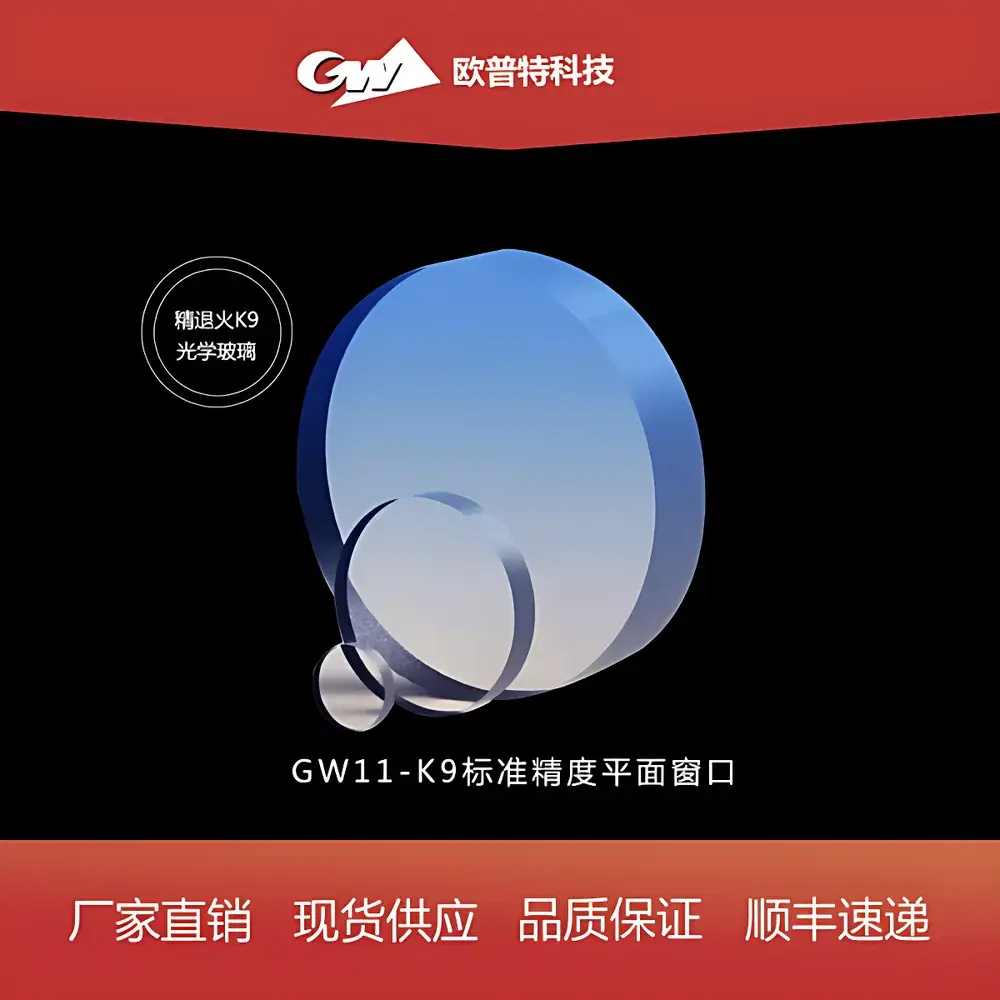
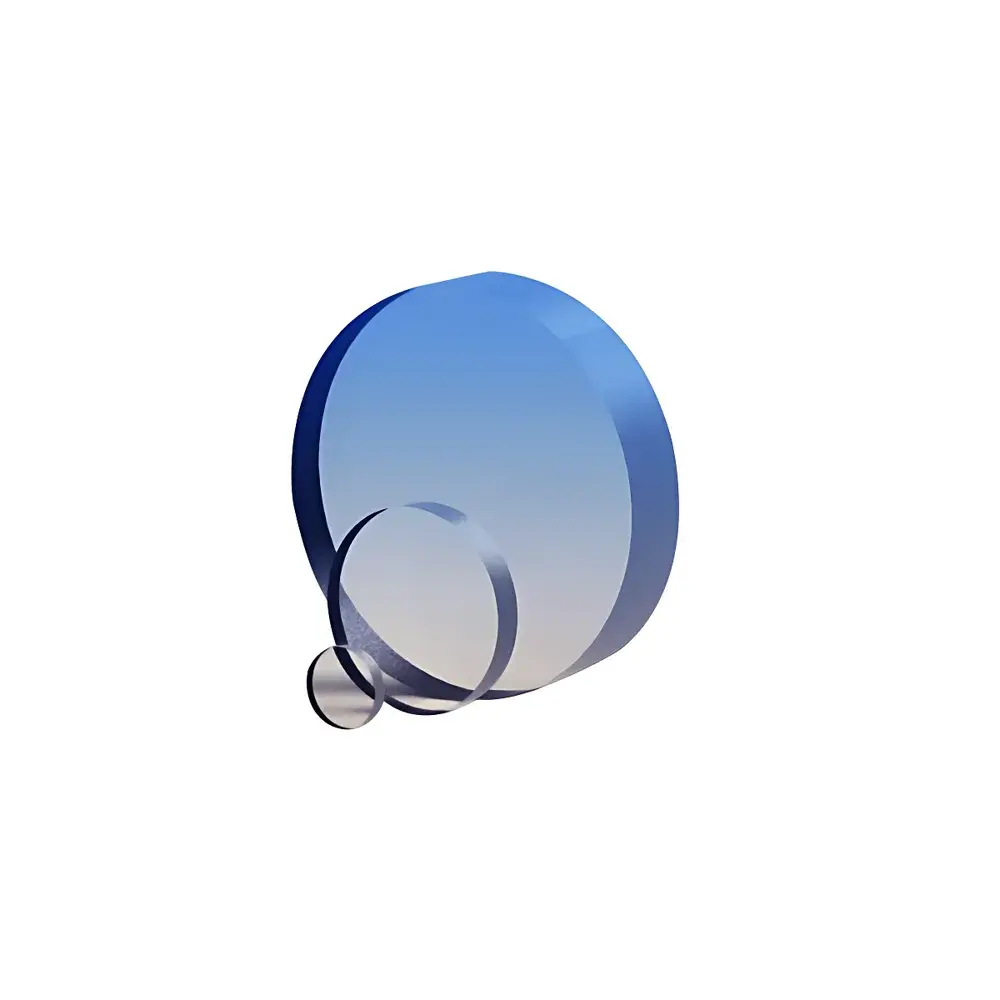
GW11-K9 Precision-Grade Plane Optical Window
| Origin | Beijing, China |
|---|---|
| Manufacturer Type | Authorized Distributor |
| Product Category | Optical Component |
| Model | GW11 |
| Material | K9 Borosilicate Crown Glass |
| Surface Quality | 60-40 Scratch-Dig |
| Surface Flatness | λ/4 @ 633 nm |
| Parallelism | < 3 arcsec |
| Clear Aperture | ≥ 90% of diameter |
| Transmission Range | 350–2200 nm (substrate-dependent) |
| Coating Options | Uncoated |
| Thickness Tolerance | ±0.1 mm |
| Diameter Tolerance | ±0.05 mm |
Overview
The GW11-K9 Precision-Grade Plane Optical Window is a high-stability, low-birefringence optical component engineered for demanding applications in spectroscopy, laser systems, imaging optics, and short-wave infrared (SWIR) instrumentation. Fabricated from certified K9 borosilicate crown glass—a material compliant with ISO 10110-1 and MIL-O-13830 standards—the window delivers excellent transmission uniformity, minimal wavefront distortion, and thermal stability across ambient to moderately elevated operating temperatures (−40 °C to +70 °C). Its uncoated baseline configuration supports broadband use from the near-ultraviolet (350 nm) through the visible and into the SWIR region (up to 2200 nm), while optional anti-reflection (AR) coatings are optimized for specific spectral bands: VIS (350–700 nm), NIR (600–1100 nm), and SWIR (900–1700 nm). Each unit undergoes interferometric verification for surface flatness (λ/4 @ 633 nm) and parallelism (< 3 arcsec), ensuring compatibility with collimated beam paths and polarization-sensitive setups.
Key Features
- Precision-ground and polished K9 substrate meeting ISO 10110-3 surface quality specification (60-40 scratch-dig)
- Controlled thickness tolerance (±0.1 mm) and diameter tolerance (±0.05 mm) for repeatable mechanical integration
- Clear aperture ≥ 90% of nominal diameter, minimizing vignetting in multi-element optical trains
- Low intrinsic stress and negligible birefringence—critical for polarimetric and interferometric applications
- Thermal expansion coefficient of 7.1 × 10⁻⁶ /°C ensures dimensional stability under thermal cycling
- Available in nine standard diameters (Φ5.0 to Φ50.8 mm), all with consistent 2.0 mm or 4.0 mm thickness options
- Traceable metrology documentation provided per batch, including spectral transmittance data at 10 mm path length
Sample Compatibility & Compliance
The GW11-K9 window is compatible with vacuum-compatible mounting fixtures, kinematic lens mounts, and optomechanical breadboards used in R&D and production environments. Its K9 composition exhibits no outgassing under low-pressure conditions (tested per ASTM E595), making it suitable for space-qualified optical subsystems and cleanroom-integrated instrumentation. All AR-coated variants are deposited via ion-assisted electron-beam evaporation, achieving adhesion performance per MIL-C-48497A and environmental durability per ISO 9211-4 (humidity, abrasion, and tape peel testing). The product conforms to RoHS Directive 2011/65/EU and REACH Annex XVII requirements; full material declarations and coating process certifications are available upon request for GLP/GMP-aligned validation protocols.
Software & Data Management
While the GW11-K9 is a passive optical component, its spectral performance data—including measured transmittance curves for uncoated and coated versions—is supplied in standardized ASCII format (.csv) and compatible with optical design platforms such as Zemax OpticStudio, CODE V, and FRED. Each product shipment includes a digital calibration report containing interferometric surface map metadata (Zernike coefficients up to n=6), spectral transmission scans (0.5 nm resolution, 350–2200 nm), and batch-specific refractive index values (nd = 1.51630 ± 0.00005 @ 587.6 nm). These datasets support traceable modeling, Monte Carlo tolerance analysis, and FDA 21 CFR Part 11–compliant documentation workflows when integrated into validated laboratory information management systems (LIMS).
Applications
- Input/output windows for SWIR spectrometers (e.g., InGaAs detector-based systems operating at 900–1700 nm)
- Beam isolation and atmospheric protection elements in ultrafast Ti:sapphire and fiber laser cavities
- Reference substrates for in-situ coating development and thin-film interference characterization
- Calibration artifacts in photometric and radiometric transfer standards laboratories
- Front-surface protection for scientific CMOS and EMCCD imaging sensors in multispectral microscopy
- Optical interface components in semiconductor wafer inspection tools requiring high wavefront fidelity
FAQ
What is the maximum operating temperature for the GW11-K9 window?
The K9 substrate is rated for continuous operation from −40 °C to +70 °C; short-term exposure up to +150 °C is permissible without permanent degradation, though AR coating performance may diminish above 100 °C.
Are custom diameters or thicknesses available?
Yes—custom geometries can be manufactured under NRE agreement, subject to minimum order quantities and extended lead times; tolerances adhere to ISO 10110-2 specifications.
Do SWIR-optimized AR coatings affect UV or visible transmission?
SWIR AR coatings (900–1700 nm) exhibit moderate reflectance (~2–4%) in the visible band but do not compromise structural integrity or induce absorption-related heating under typical irradiance levels (< 1 W/cm²).
Is certification of conformance (CoC) included with each shipment?
Yes—each batch is accompanied by a signed CoC referencing ISO 9001:2015 manufacturing compliance, along with spectral and metrological test summaries.
Can these windows be cleaned using standard optical protocols?
Yes—K9 surfaces are compatible with methanol/isopropanol wipes, CO₂ snow, and filtered dry nitrogen purging; ultrasonic cleaning is not recommended for AR-coated variants.




