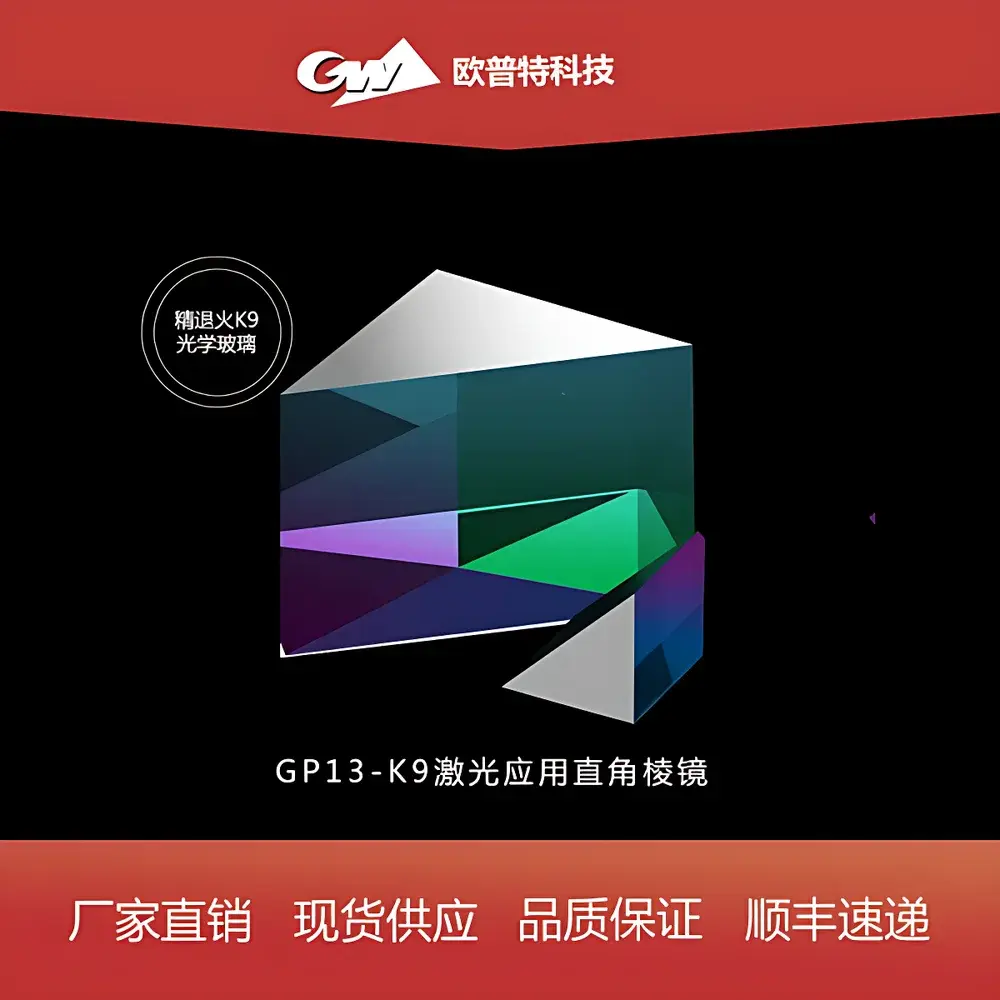

GP13-K9 Right-Angle Prism

| Material | K9 precision-annealed optical glass |
|---|---|
| Dimensional tolerance | +0.0 / −0.1 mm |
| Surface flatness | λ/10 @ 632.8 nm |
| Surface quality | 1–2 scratch-dig |
| Angular accuracy | ±15 arcseconds |
| Beam deviation (tower error) | <5 arcminutes |
| Edge chamfer | <0.25 mm × 45° |
| Coating options | Broadband or laser-line AR coatings per model suffix (e.g., V532, V633, V785) |
| Available sizes | 5.0, 10.0, 12.5, 15.0, 20.0, 25.0 mm (equilateral legs A = B = C) |
Ask about pricing, availability and specifications.
Overview
The GP13-K9 Right-Angle Prism is a high-precision optical component engineered for reliable 90° beam deviation and image reflection in demanding laboratory, industrial, and OEM optical systems. Fabricated from certified K9 borosilicate crown glass—a material meeting ISO 10110-1 and MIL-O-13830 specifications—the prism delivers exceptional homogeneity, low bubble/inclusion content, and thermal stability suitable for alignment-critical applications. Its 90° internal angle enables total internal reflection (TIR) across visible and near-infrared wavelengths when used uncoated, while optional anti-reflection (AR) coatings—optimized for 532 nm, 633 nm, or 785 nm laser lines—minimize Fresnel losses and ghost reflections in interferometric, spectroscopic, and laser delivery setups. The prism’s performance is defined by stringent metrological tolerances: angular deviation controlled to ±15 arcseconds ensures minimal pointing error in beam-steering assemblies; surface flatness of λ/10 at 632.8 nm supports wavefront preservation in coherent optical paths; and surface quality rated 1–2 scratch-dig complies with ISO 10110-7 standards for high-energy laser applications.
Key Features
- Precision-ground and polished equilateral right-angle geometry (A = B = C) with tight dimensional tolerance of +0.0 / −0.1 mm
- K9 optical glass substrate with certified refractive index (nd = 1.5163), Abbe number (νd = 64.2), and low stress birefringence (<5 nm/cm)
- Surface flatness λ/10 @ 632.8 nm, verified via phase-shifting interferometry per ISO 10110-5
- Angular accuracy ±15 arcseconds, measured using autocollimation with calibrated theodolite-grade optics
- Beam deviation (tower error) <5 arcminutes, ensuring minimal lateral displacement in multi-prism stacks
- Controlled edge treatment: 0.25 mm × 45° chamfer on all non-optical edges to prevent chipping and reduce stray light
- Multiple AR coating variants available—V532 (R<0.25% @ 532 nm), V633 (R<0.25% @ 633 nm), V785 (R<0.25% @ 785 nm)—each deposited via ion-assisted e-beam evaporation and qualified per ISO 9211-3
Sample Compatibility & Compliance
The GP13-K9 prism is compatible with standard optomechanical mounts including kinematic mirror mounts, prism tables, and cage system adapters (e.g., Thorlabs SM1-threaded or Ø1″ post holders). It operates within ambient temperature ranges of −10 °C to +60 °C without degradation in optical performance. All units are manufactured under ISO 9001-certified processes and conform to ISO 10110 series standards for optical element specification, testing, and documentation. Coated variants comply with ISO 9211-4 for environmental durability (damp heat, abrasion, adhesion). For regulated environments—including FDA-regulated analytical instrumentation or GLP-compliant optical calibration labs—the prism’s traceable metrology data (including interferometric surface maps and spectral reflectance curves) can be supplied upon request to support audit readiness.
Software & Data Management
While the GP13-K9 is a passive optical component, its integration into automated optical systems benefits from standardized digital asset management. Each product variant (e.g., GP13-015-V633) carries a unique identifier aligned with ANSI/NIST IR 5737-1 part numbering conventions. Spectral performance data (reflectance/transmittance vs. wavelength), interferometric surface maps, and coating durability test reports are archived in secure, version-controlled databases compliant with ISO/IEC 17025 documentation requirements. For customers implementing digital twin workflows or optical design validation pipelines (e.g., Zemax OpticStudio or CODE V), spectral and surface error files (.ZBF, .DAT) are available in machine-readable formats supporting automated import and tolerance analysis.
Applications
- Laser beam steering and path folding in confocal microscopy, OCT systems, and laser scanning cytometers
- Image erection and relay in endoscopic imaging trains and compact spectrometer designs
- Beam combining/splitting in Michelson and Mach–Zehnder interferometers
- Alignment references in gravitational wave detector auxiliary optics and optical clock stabilization cavities
- OEM integration into portable Raman spectrometers, LIDAR receivers, and quantum optics breadboards
- Education and training platforms for geometric optics, polarization analysis, and TIR threshold verification
FAQ
What is the maximum CW laser power density this prism can withstand?
For uncoated K9 prisms operated at room temperature with clean, collimated beams, the damage threshold exceeds 10 MW/cm² at 1064 nm (10 ns pulse); for AR-coated variants, consult the specific coating datasheet—V532 and V633 coatings are qualified to >500 kW/cm² (CW, 532 nm, 1 mm beam).
Can the GP13-K9 be used in vacuum environments?
Yes—K9 glass exhibits negligible outgassing (per ASTM E595) and maintains mechanical stability under 10⁻⁶ Torr; however, AR coatings must be specified as vacuum-compatible (e.g., IAD-deposited layers with no organic binders).
Is metrology data provided with each shipment?
Standard shipments include a certificate of conformance; full metrology packages—including interferometric surface maps, spectral reflectance plots, and angular deviation reports—are available as optional deliverables under QA-102 documentation protocol.
How does tower error affect multi-prism assembly performance?
Tower error accumulates linearly in stacked configurations; for example, three GP13 prisms in series may introduce up to 15 arcminutes of cumulative beam offset—thus, angular tolerance control is critical in high-precision beam combiners or retroreflector arrays.
Are custom coating designs supported?
Yes—custom broadband AR (350–1100 nm), dual-wavelength, or polarization-sensitive coatings can be developed under NRE agreement, subject to minimum order quantities and qualification per ISO 9211-3 Class 2 specifications.