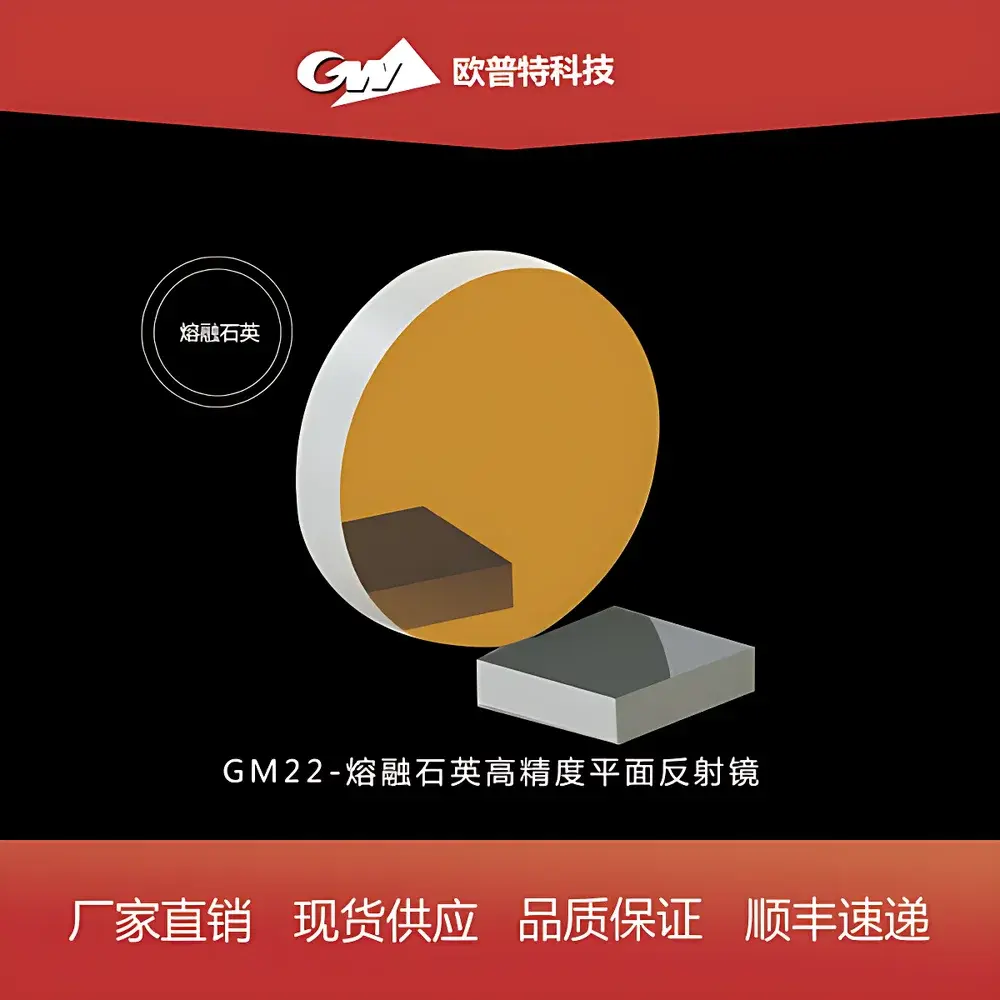
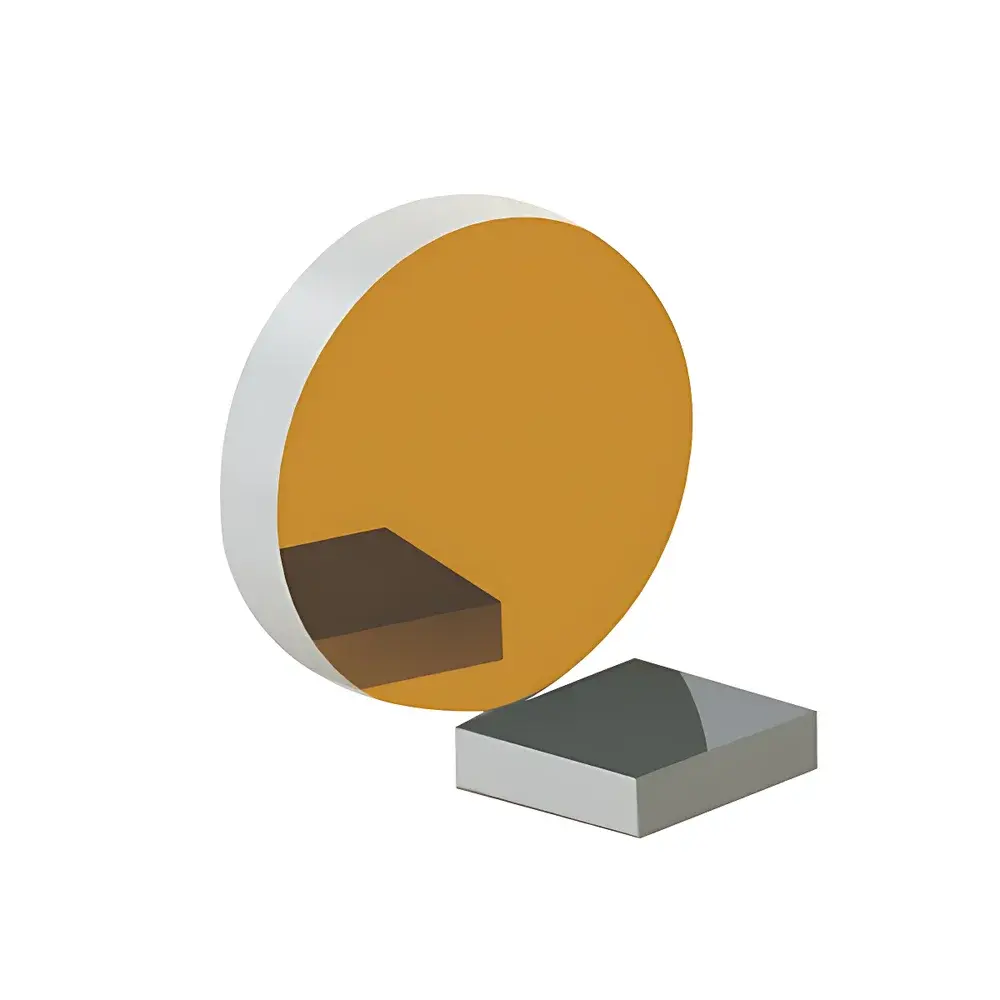
GM22 Fused Silica High-Precision Flat Mirror

| Origin | Beijing, China |
|---|---|
| Manufacturer Type | Authorized Distributor |
| Origin Category | Domestic (China) |
| Model | GM22 |
| Component Category | Optical Element |
| Material | Fused Silica |
| Surface Figure | λ/10 @ 633 nm |
| Parallelism | < 3 arcmin |
| Surface Quality | 10-5 (MIL-PRF-13830B) |
| Back Surface | Fine Ground |
| Dimensional Tolerance | +0.0 / −0.1 mm |
| Thickness Tolerance | ±0.2 mm |
| Edge Treatment | Protective 45° chamfer, 0.2–0.5 mm |
| Coating Options | Uncoated, Protected Aluminum (AL), UV-Enhanced Aluminum (UVAL), Protected Silver (AG), Protected Gold (AU) |
Ask about pricing, availability and specifications.
Overview
The GM22 Fused Silica High-Precision Flat Mirror is an optically engineered component designed for demanding applications in laser systems, interferometry, metrology, and precision optical instrumentation. Fabricated from synthetic fused silica (SiO₂), this mirror offers exceptional transmission stability across the deep ultraviolet (DUV) to near-infrared (NIR) spectrum (185–2100 nm), low thermal expansion (α ≈ 0.55 × 10⁻⁶ /°C), and high resistance to thermal shock and environmental degradation. Its surface figure accuracy of λ/10 at 633 nm—verified via phase-shifting interferometry—ensures minimal wavefront distortion during beam steering or folding, critical for maintaining coherence in Michelson, Mach–Zehnder, or Twyman–Green interferometers. The λ/10 specification corresponds to a peak-to-valley (PV) deviation of ≤63.3 nm, enabling sub-microradian angular stability in alignment-sensitive setups.
Key Features
- Fused silica substrate with certified homogeneity (Δn < 1 × 10⁻⁶) and low bubble/inclusion content per ISO 10110-3
- Optical surface polished to 10-5 scratch-dig specification (per MIL-PRF-13830B), minimizing scatter-induced signal loss
- Parallelism tolerance < 3 arcminutes between front and back surfaces, supporting precise mounting in kinematic or stress-free fixtures
- Controlled edge geometry: protective 45° chamfer (0.2–0.5 mm) mitigates chipping and reduces edge diffraction effects
- Tight dimensional control: diameter/side length tolerance +0.0 / −0.1 mm; thickness tolerance ±0.2 mm—compatible with standard lens mounts and mirror holders (e.g., Thorlabs KM100, Newport UMB1)
- Multiple dielectric coating options deposited via electron-beam evaporation under high-vacuum conditions (base pressure < 5 × 10⁻⁷ Torr), with in-situ monitoring for spectral fidelity
Sample Compatibility & Compliance
The GM22 series is compatible with standard optical breadboards, kinematic mirror mounts, and vacuum-compatible stages (with appropriate mounting hardware). All substrates meet RoHS Directive 2011/65/EU requirements and are manufactured under controlled cleanroom conditions (ISO Class 7). Surface cleanliness conforms to ISO 10110-7 specifications for particulate contamination (< 5 particles ≥5 µm per 25 mm²). While not individually certified to ISO 9001 or ISO 14001, the production facility adheres to documented quality control protocols aligned with ISO 9001:2015 principles—including incoming material inspection, in-process metrology (Zygo GPI XP interferometer), and final verification reports traceable to NIST-traceable standards.
Software & Data Management
No embedded firmware or proprietary software is associated with the GM22 mirror, as it is a passive optical component. However, full metrology data—including interferometric surface maps, spectral reflectance curves (250–1100 nm), and coating performance reports—is supplied digitally upon request in standardized formats (CSV, TIFF, ZMX-compatible .zbf files). Reflectance data complies with ASTM E430-18 for specular reflectance measurement methodology. For integration into automated optical assembly workflows, dimensional and coating identifiers (e.g., GM22-025-UVAL) are structured to support barcode-based traceability in LabWare LIMS or similar GLP-compliant laboratory information management systems.
Applications
- Laser cavity end mirrors and intracavity beam folding in DPSS, Ti:sapphire, and fiber laser systems
- Reference arms in heterodyne and white-light interferometers for nanometer-level displacement sensing
- Beam steering optics in semiconductor lithography alignment subsystems and wafer inspection tools
- Calibration standards for wavefront sensor validation (Shack–Hartmann, lateral shearing interferometry)
- UV spectroscopy accessories requiring high solarization resistance (e.g., synchrotron beamlines, excimer laser delivery)
- High-stability optical benches in gravitational wave detection prototype experiments (e.g., table-top Michelson configurations)
FAQ
What is the damage threshold for the protected aluminum coating under pulsed 1064 nm laser irradiation?
For 10 ns pulses at 10 Hz repetition rate, the typical LIDT is ≥0.5 J/cm²; exact values depend on beam diameter, spot uniformity, and pulse duration—contact technical support for application-specific validation.
Can GM22 mirrors be mounted in vacuum environments?
Yes—fused silica exhibits negligible outgassing (water vapor desorption < 1 × 10⁻⁹ Torr·L/s·cm² after 24 h bakeout at 120°C); coatings are adhesion-tested per MIL-C-48497A.
Is there a certificate of conformance available?
Each batch includes a Certificate of Conformance listing substrate lot number, interferometric test date, and coating deposition run ID; full interferogram archives are retained for 5 years.
Do you offer custom diameters or thicknesses beyond the listed configurations?
Yes—custom geometries (e.g., elliptical apertures, wedge angles < 10 arcsec) are available under NRE agreement with minimum order quantity of 10 units.
How is surface flatness verified, and what uncertainty is reported?
Verified using a Zygo GPI XP interferometer calibrated against NIST-traceable reference flats; expanded uncertainty (k=2) for λ/10 verification is ±0.02λ at 633 nm.