
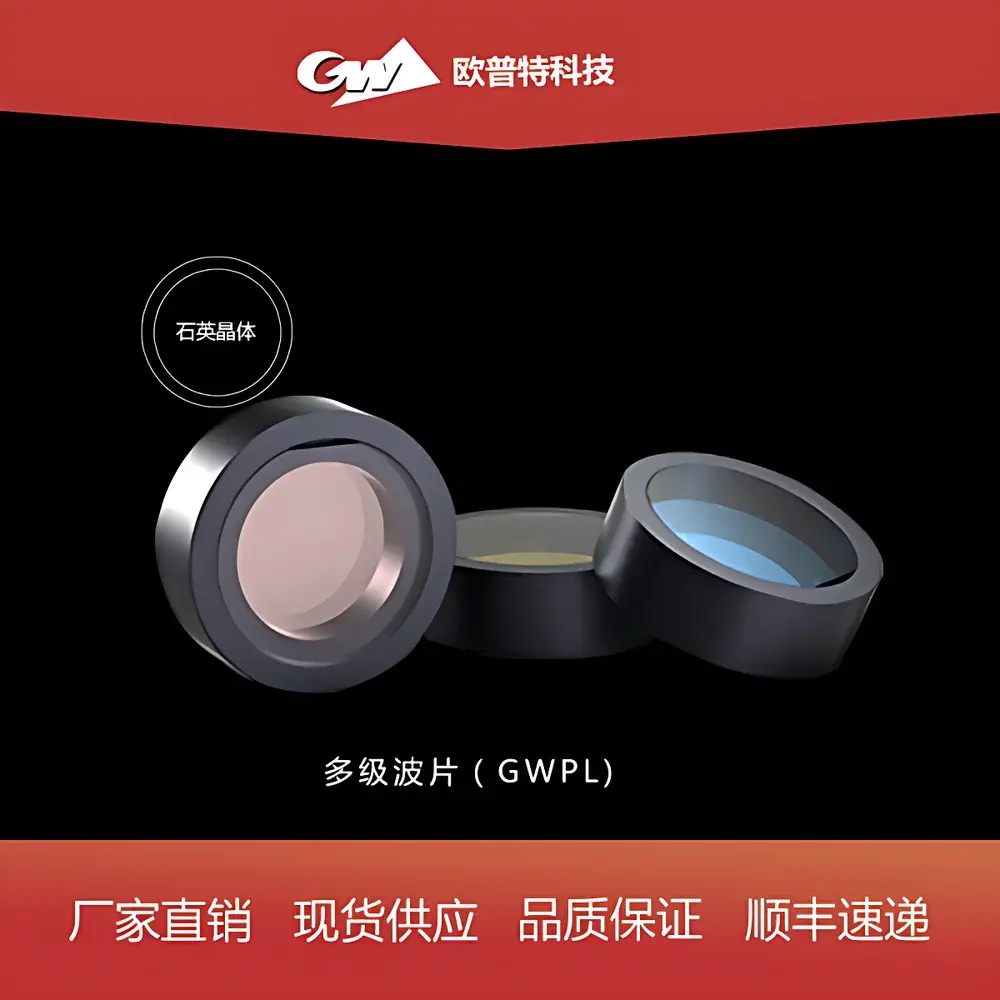
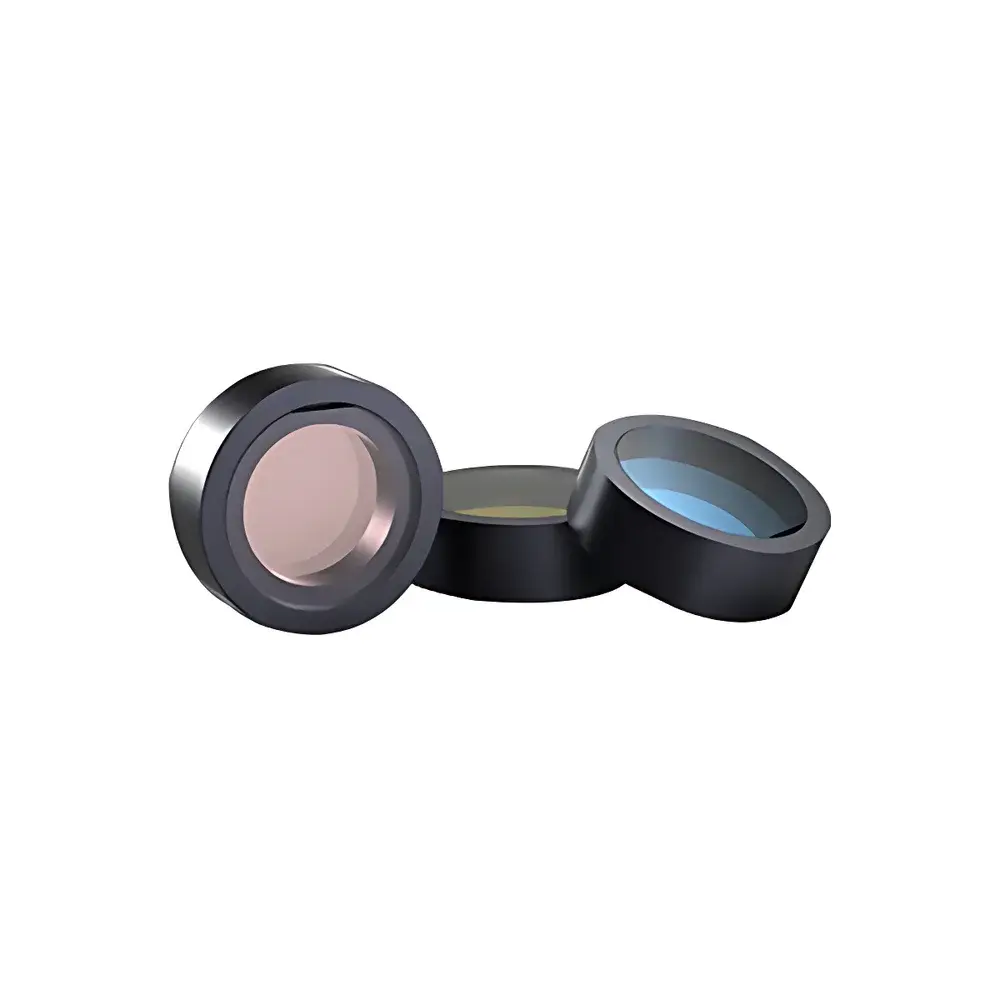
GWPL Series Multi-Stage Wave Plates
| Origin | Beijing, China |
|---|---|
| Manufacturer Type | Authorized Distributor |
| Product Origin | Domestic (China) |
| Model | GWPL |
| Price Range | USD 0.15–75.00 (per unit) |
| Component Category | Optical Element |
| Available Configurations | λ/4 and λ/2 wave plates |
| Diameters | 12.7 mm (0.5") and 25.4 mm (1.0") |
| Wavelength Options | 488 nm, 532 nm, 632.8 nm, 670 nm, 780 nm, 808 nm, 850 nm, 980 nm, 1064 nm, 1550 nm |
Overview
The GWPL Series Multi-Stage Wave Plates are precision optical retarders engineered for high-fidelity polarization control in demanding laser, interferometric, and quantum optics applications. Based on the principle of birefringence in crystalline quartz or magnesium fluoride substrates, these wave plates introduce a controlled phase delay (Δφ) between orthogonal polarization components—specifically designed to achieve exact quarter-wave (λ/4) or half-wave (λ/2) retardation at specified laser wavelengths. Unlike single-layer polymer or air-gap designs, the multi-stage architecture integrates multiple precisely aligned birefringent layers to minimize temperature-induced drift, angular sensitivity, and residual dispersion—thereby ensuring stable retardation across ±5°C operational ranges and incidence angles up to ±2°. Each unit is AR-coated (R < 0.25% per surface) for the designated wavelength band, supporting high-power CW and pulsed laser operation with damage thresholds exceeding 500 MW/cm² (10 ns, 10 Hz, 1064 nm).
Key Features
- Precision-calibrated retardation: Certified λ/4 (±1.5°) and λ/2 (±1.0°) performance at center wavelength, verified via spectral ellipsometry traceable to NIM (National Institute of Metrology, China)
- Dual-diameter standardization: 12.7 mm (0.5″) and 25.4 mm (1.0″) clear apertures with kinematic mounting compatibility (SM1/SM2 threading options available upon request)
- Wavelength-specific optimization: 10 discrete laser lines supported—from visible (488 nm argon-ion) through NIR (1550 nm telecom band)—each with individually optimized crystal orientation and coating stack
- Low wavefront distortion: ≤λ/8 PV (632.8 nm) over full aperture, enabling integration into diffraction-limited systems without beam degradation
- Robust mechanical construction: UV-fused silica or crystalline quartz substrates, laser-verified parallelism (<3 arcsec), and vacuum-compatible housing (optional)
- Compliance-ready documentation: Includes calibration certificate with wavelength-dependent retardance curve, surface quality report (scratch-dig 10-5), and RoHS/REACH declaration
Sample Compatibility & Compliance
The GWPL Series is compatible with collimated free-space beams from continuous-wave (CW) diode, solid-state, and fiber lasers—as well as nanosecond-pulsed sources (Q-switched Nd:YAG, Ti:sapphire oscillators). Mounting interfaces conform to standard optomechanical practices (e.g., Thorlabs SM-series lens tubes, Newport KM-series kinematic mounts). All units meet ISO 10110-7 (surface imperfections), ISO 14997 (laser damage threshold testing), and IEC 61290-4 (optical amplifier component qualification). For regulated environments—including ISO/IEC 17025-accredited calibration labs and GMP-aligned photonics R&D facilities—the supplied calibration certificates support traceability to national standards and satisfy audit requirements for instrument qualification (IQ/OQ/PQ protocols).
Software & Data Management
While the GWPL Series operates as a passive optical element, comprehensive digital asset support is provided: downloadable spectral transmittance and retardance datasets (CSV and MATLAB .mat formats), Zemax OpticStudio-compatible surface files (.zmx), and STEP geometry models for mechanical integration. Calibration reports include machine-readable QR codes linking to secure cloud storage (AES-256 encrypted), enabling automated version control and GLP-compliant record retention. Audit logs track certificate issuance date, metrologist ID, environmental conditions during verification, and uncertainty budgets per ISO/IEC 17025 Annex A.3.
Applications
- Laser cavity polarization control and mode selection in DPSS and fiber lasers
- Optical isolation setups using λ/4 + polarizer configurations (e.g., 532 nm green laser protection)
- Quantum optics experiments requiring deterministic single-photon polarization rotation (e.g., Bell state generation at 780 nm)
- Ellipsometry reference standards for thin-film characterization systems
- Interferometric vibration sensing (e.g., Michelson or Mach–Zehnder configurations at 1064 nm)
- Fiber-to-free-space coupling alignment and polarization-maintaining splicing verification
- Biophotonics instrumentation including polarization-resolved OCT and Mueller matrix microscopy
FAQ
What is the typical retardance tolerance at the design wavelength?
Retardance accuracy is ±1.5° for λ/4 variants and ±1.0° for λ/2 variants, measured at normal incidence under stabilized thermal conditions (23 ± 0.5°C).
Can these wave plates be used with ultrafast femtosecond pulses?
Yes—low group delay dispersion (GDD < 5 fs² over 50 nm bandwidth at 800 nm) enables use with sub-100-fs Ti:sapphire pulses; consult technical datasheet for GDD curves per model.
Is custom coating or substrate material available?
Custom MgF₂ or YVO₄ substrates, broadband AR coatings (e.g., 500–900 nm), and vacuum-deposited metallic backside mirrors are available under OEM agreements with minimum order quantities.
Do you provide mounting hardware or kinematic adapters?
Standard anodized aluminum mounts (SM1-threaded, 1″ outer diameter) are offered separately; custom CNC-machined kinematic platforms with tip/tilt adjustment are available for system integration projects.
How is traceability to national standards ensured?
Each unit’s calibration certificate references NIM Certificate No. NIM-OP-2023-XXXXX and includes expanded uncertainty (k=2) calculated per GUM (JCGM 100:2008), with measurement performed on a JASCO V-770 CD spectropolarimeter validated annually against NIST SRM 2086.



