
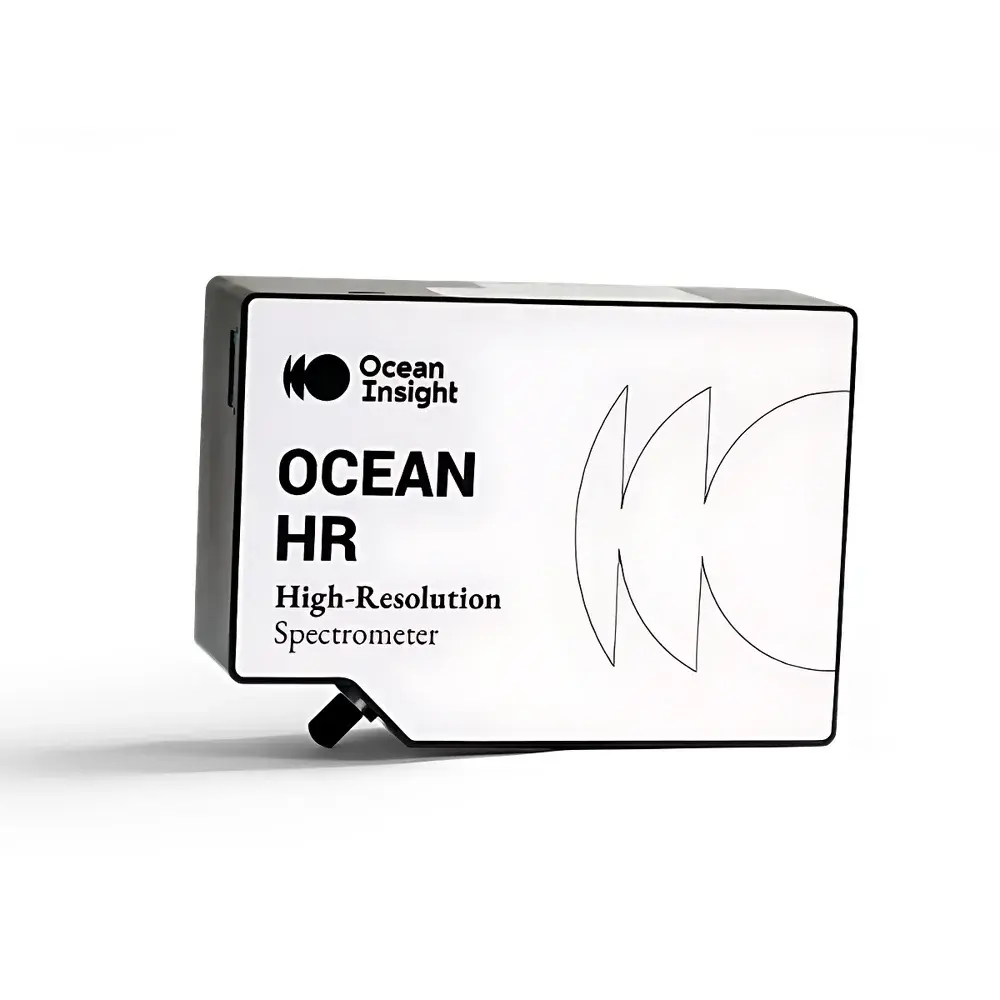
Ocean Optics Ocean HR2 High-Resolution Fiber Optic Spectrometer
| Brand | Ocean Optics |
|---|---|
| Origin | USA |
| Manufacturer Type | Authorized Distributor |
| Product Origin | Imported |
| Model | Ocean Optics Ocean HR2 |
| Spectral Range | 190–1150 nm (configurable) |
| Detector Type | CCD |
| Optical Resolution | <1.0 nm FWHM (configuration-dependent) |
| Sensitivity | 380:1 (single-scan @ 10 ms) |
| System Dynamic Range | 2.46 × 10⁸ |
Overview
The Ocean Optics Ocean HR2 High-Resolution Fiber Optic Spectrometer is a precision-engineered, thermally stable spectroscopic instrument designed for demanding quantitative and qualitative optical measurements across UV-VIS-NIR spectral domains. Based on fixed-grating Czerny-Turner optical architecture coupled with a high-quantum-efficiency linear CCD detector, the HR2 delivers consistent wavelength calibration stability and high signal fidelity under variable thermal and mechanical conditions. Its core measurement principle relies on dispersive spectroscopy: incident light—delivered via standard SMA-905 fiber optic interface—is collimated, diffracted by a ruled or holographic grating, and focused onto the CCD array to generate intensity-vs-wavelength spectra. The spectrometer’s compact footprint (125 × 84 × 35 mm), robust aluminum housing, and internal thermal management enable reliable operation in both benchtop laboratories and embedded OEM systems—including semiconductor process chambers, clinical analyzers, and industrial inline monitoring platforms.
Key Features
- Thermal Wavelength Stability: Achieves ≤0.06 pixel/°C thermal drift—validated over 15–35°C ambient range—ensuring long-term spectral registration integrity without active recalibration.
- Ultra-Fast Acquisition: Supports integration times from 1 µs to 10 s, enabling time-resolved plasma diagnostics, pulsed laser characterization, and real-time reaction kinetics monitoring.
- Configurable Optical Performance: Interchangeable entrance slits (10–200 µm) allow users to balance optical resolution (<1.0 nm FWHM typical) and throughput according to application-specific signal-to-noise requirements.
- Broad Spectral Coverage: Standard configurations span 190–1150 nm; optional order-sorting filters and UV-enhanced coatings extend usability into deep UV (e.g., 190–400 nm) and extended NIR (e.g., 780–1150 nm) regions.
- High Linearity & Dynamic Range: Demonstrates absorbance linearity up to 2.0 AU (R² > 0.9999) and system-level dynamic range of 2.46 × 10⁸ (16-bit digitization + multi-exposure synthesis), critical for quantitative bioanalytical assays and low-concentration trace detection.
- OEM-Ready Architecture: Includes TTL-compatible trigger I/O, USB 2.0 interface with ESD-protected circuitry, and mechanically optimized mounting points for seamless integration into automated instrumentation and cleanroom-compatible hardware.
Sample Compatibility & Compliance
The Ocean HR2 interfaces with a wide range of sample introduction methods—including cuvette holders, flow cells, integrating spheres, reflection probes, and plasma emission collection optics—via standardized 400 µm or 600 µm core diameter optical fibers. It complies with IEC 61326-1 (EMC for laboratory equipment) and meets RoHS 2 directive requirements. While not certified as medical device hardware per ISO 13485, its performance characteristics—including absorbance linearity, photometric repeatability (<0.2% RSD over 1 hr), and wavelength accuracy (±0.5 nm, NIST-traceable calibration available)—support GLP-compliant method validation in pharmaceutical QC labs. When deployed with Ocean Insight’s FDA 21 CFR Part 11–enabled software modules (e.g., OceanView v2.5+ with audit trail and electronic signature), the system satisfies data integrity requirements for regulated environments.
Software & Data Management
The HR2 is fully supported by OceanDirect, a vendor-agnostic, cross-platform SDK (Windows, macOS, Linux) providing native C/C++, Python, MATLAB, LabVIEW, and .NET APIs. OceanDirect enables low-level control of all acquisition parameters—including integration time, boxcar averaging, dark subtraction, and nonlinearity correction—as well as real-time spectral streaming at up to 1 kHz frame rates. All firmware updates, calibration file management, and spectral metadata tagging (e.g., timestamp, temperature, slit width, lamp ID) are handled programmatically. For end-user applications, OceanView spectroscopy software offers intuitive visualization, multivariate analysis (PCA, PLS), peak identification, and export to CSV, HDF5, or ASTM E131-compliant spectral data formats. Raw spectral data retains full 16-bit depth and supports post-acquisition binning, smoothing, and baseline correction without loss of provenance.
Applications
- Semiconductor Process Control: Real-time optical emission spectroscopy (OES) for endpoint detection and plasma composition monitoring during etching and deposition steps.
- Pharmaceutical & Biotech QA/QC: Quantitative protein concentration determination (e.g., Bradford, BCA assays), excipient identification, and dissolution testing via UV-Vis absorbance.
- Environmental Monitoring: Multi-analyte detection in water quality analysis (e.g., NO₃⁻, NO₂⁻, Cr(VI)) using derivative spectroscopy and chemometric modeling.
- Material Characterization: Thin-film thickness measurement via interference fringe analysis and reflectance spectroscopy (300–1000 nm).
- Academic Research: Time-resolved fluorescence lifetime studies, laser-induced breakdown spectroscopy (LIBS), and Raman shift calibration reference.
FAQ
What spectral calibration options are available for the Ocean HR2?
NIST-traceable factory calibration is included; optional user-replaceable calibration sources (e.g., HG-1 mercury-argon lamp) support periodic verification and field recalibration.
Can the HR2 operate in vacuum or controlled-atmosphere environments?
The standard unit is rated for ambient air operation only; custom hermetic sealing and fused-silica windows are available under OEM agreement.
Is OceanDirect compatible with Python 3.9+ and conda-based environments?
Yes—OceanDirect Python bindings are distributed via PyPI and tested against NumPy 1.21+, SciPy 1.7+, and pandas 1.3+.
How is wavelength accuracy maintained over extended measurement sessions?
Through passive thermal design, onboard temperature sensor feedback, and optional software-based pixel-to-wavelength mapping correction using built-in reference lines.
Does the HR2 support synchronized multi-channel acquisition with other Ocean Optics devices?
Yes—via external TTL triggering and shared clock distribution using the Ocean FX synchronization module or third-party DAQ systems.
Related Products




