
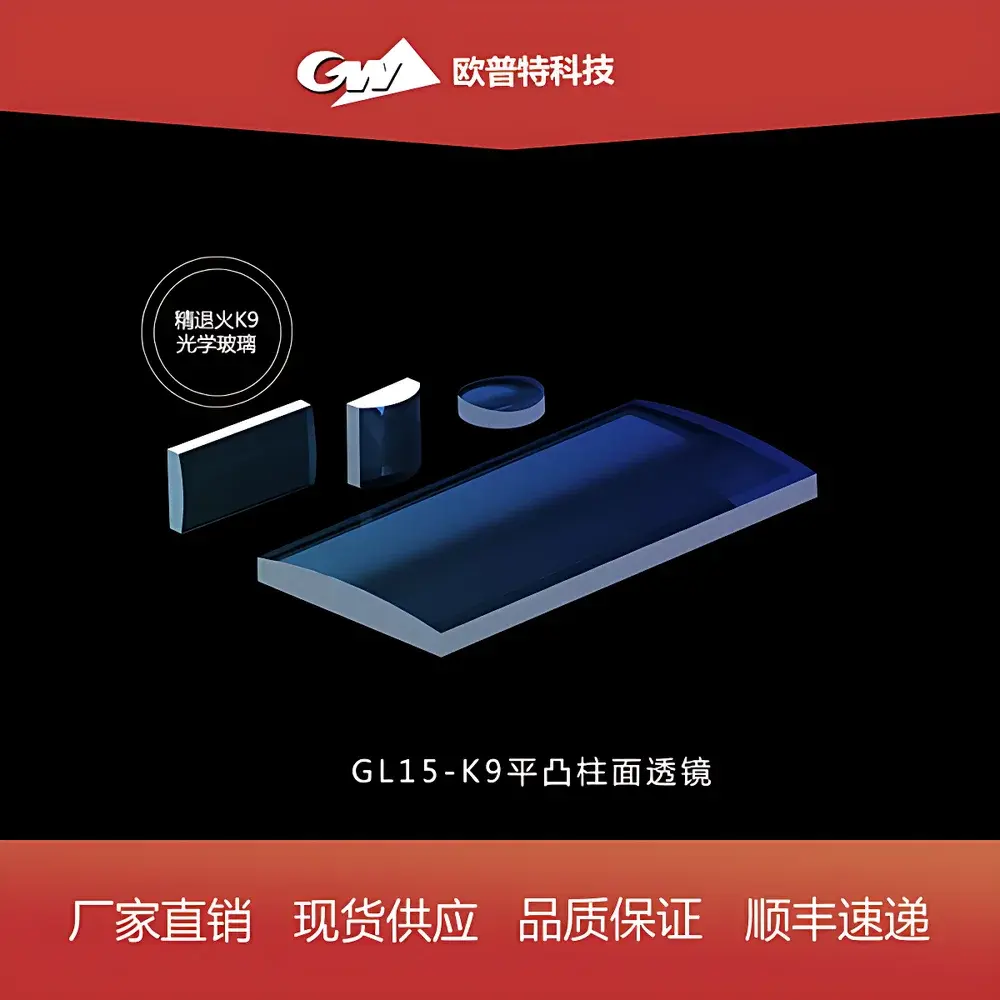
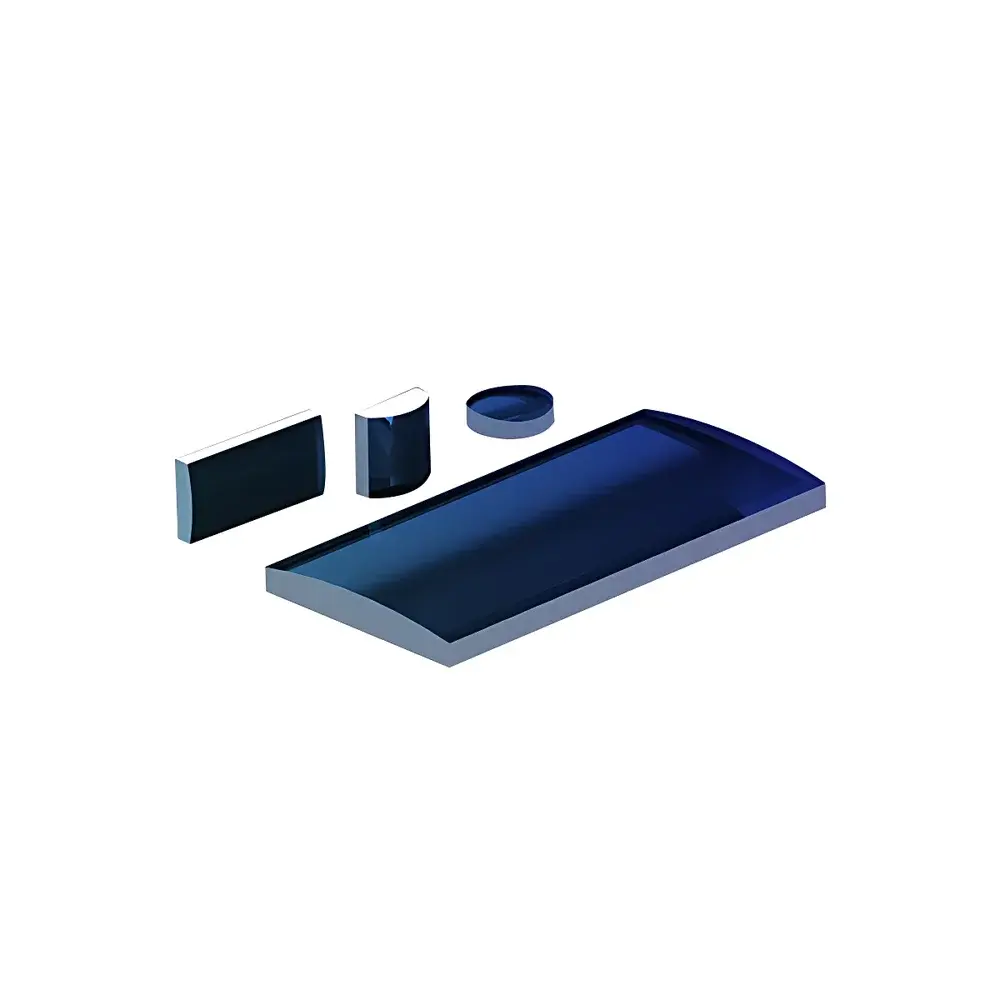
GL15-K9 Plano-Convex Cylindrical Lens with Broadband NIR Anti-Reflection Coating
| Origin | Beijing |
|---|---|
| Manufacturer Type | Distributor |
| Regional Origin | Domestic (China) |
| Model | GL15-NIR |
| Price Range | USD 0.15–75.00 (per unit, depending on configuration) |
| Component Category | Optical Element |
Overview
The GL15-K9 Plano-Convex Cylindrical Lens is a precision optical component engineered for controlled beam shaping in near-infrared (NIR) spectral applications. Fabricated from high-homogeneity K9 borosilicate crown glass (Schott BK7 equivalent), this lens features a plano surface on one side and a convex cylindrical surface on the other—enabling focused line generation or astigmatic correction in laser systems, spectroscopic setups, and optical sensing platforms. The broadband anti-reflection (AR) coating is specifically optimized for the 700–1100 nm wavelength range, achieving average reflectance <0.5% per surface across the NIR band. This performance meets industry requirements for low-loss transmission in fiber-coupled diode lasers, OCT illumination paths, and NIR spectrometer collimation optics. Unlike standard plano-convex spherical lenses, the cylindrical geometry provides asymmetric focusing—converging light only along one axis—making it indispensable in applications requiring line illumination, anamorphic beam expansion, or cylindrical wavefront correction.
Key Features
- K9 optical glass substrate with certified refractive index (nd = 1.5163) and Abbe number (νd = 64.2), ensuring minimal chromatic aberration and high transmission (>99.5% per surface, uncoated; >99% per surface, AR-coated in NIR band)
- Broadband NIR anti-reflection coating deposited via ion-assisted electron-beam evaporation, qualified to MIL-C-48497A and ISO 9211-3 standards for environmental durability (adhesion, humidity, abrasion)
- Surface quality rated at 40-20 scratch-dig per MIL-PRF-13830B; surface flatness ≤λ/4 @ 633 nm on plano side; cylindrical surface radius tolerance ±0.2%
- Customizable dimensions: available in rectangular (e.g., 5.0 × 5.0 mm, 6.0 × 4.0 mm) and circular formats; focal lengths from 4.0 mm to 20.0 mm; center thickness options from 2.0 mm to 3.6 mm
- Back focal length (BFL) and effective focal length (EFL) are calibrated and traceably documented per lens batch, supporting alignment-critical integration into OEM optical assemblies
Sample Compatibility & Compliance
This lens is compatible with standard optomechanical mounts (e.g., SM1-threaded lens tubes, kinematic mirror mounts with adjustable tilt) and integrates seamlessly into ISO-standard optical tables and breadboards. It complies with RoHS 2015/863/EU for restricted substances and conforms to REACH Annex XVII requirements. While not a medical device or IEC 61000-certified instrument, its material composition and coating stability support use in Class 1000 cleanroom environments (ISO 14644-1). For regulated analytical instrumentation (e.g., NIR process analyzers), the lens satisfies optical path qualification criteria under ASTM E1421 (Standard Practice for Describing and Measuring Performance of Fourier Transform Near-Infrared (FT-NIR) Spectrometers) when used within specified thermal and irradiance limits.
Software & Data Management
As a passive optical component, the GL15-K9 cylindrical lens does not incorporate embedded firmware or digital interfaces. However, its geometric and coating specifications are fully parameterized in Zemax OpticStudio™, CODE V®, and FRED optical design libraries (part numbers mapped to GL15-NIR series). Each shipped unit includes a certificate of conformance listing measured surface irregularity, transmitted wavefront error (TWE < λ/8 RMS @ 780 nm), and spectral transmittance curves (200–1200 nm). Batch-level metrology data—including interferometric surface maps and spectrophotometric AR verification—is archived for 10 years and available upon request for GMP/GLP audit trails.
Applications
- Line-generation optics in structured light 3D scanning systems operating at 808 nm or 940 nm
- Anamorphic correction in ultrafast Ti:sapphire oscillator cavities and Yb-doped fiber amplifier pump combiners
- Cylindrical collimation of multimode NIR LEDs in agricultural reflectance sensors and food moisture analyzers
- Beam conditioning for free-space optical interconnects in datacom transceivers (1310/1550 nm bands, using extended NIR variants)
- Reference optics in calibration modules for FT-NIR spectrometers compliant with USP and EP 2.2.25
FAQ
Is this lens suitable for 1064 nm Nd:YAG laser applications?
Yes—when specified with the NIR coating (700–1100 nm), the lens exhibits <0.3% residual reflectance at 1064 nm and CW power handling up to 500 W/cm² (tested at 10 ns pulse width, 10 Hz, per ISO 21254-1).
Can I request custom coating for 1310/1550 nm telecom bands?
Yes—custom AR coatings for O-, C-, and L-bands are available under GL15-NIR-TC designation; lead time extends by 3–4 weeks.
What is the maximum incident angle for optimal AR performance?
The coating maintains <0.8% average reflectance up to ±15° angle of incidence (AOI) for p-polarized light; performance degrades gradually beyond AOI = 20°.
Do you provide mounting adapters or kinematic cells for this lens?
Standard SM1-threaded lens retainers and Ø1″ cylindrical lens holders are available as optional accessories (part numbers GL-MNT-SM1-PCYL and GL-CLAMP-1INCH).
Is there a version with fused silica substrate for UV-NIR broadband use?
Yes—the GL15-FS variant uses Corning 7980 fused silica and supports AR coating from 250–2000 nm; contact technical sales for quoting and lead time.





