
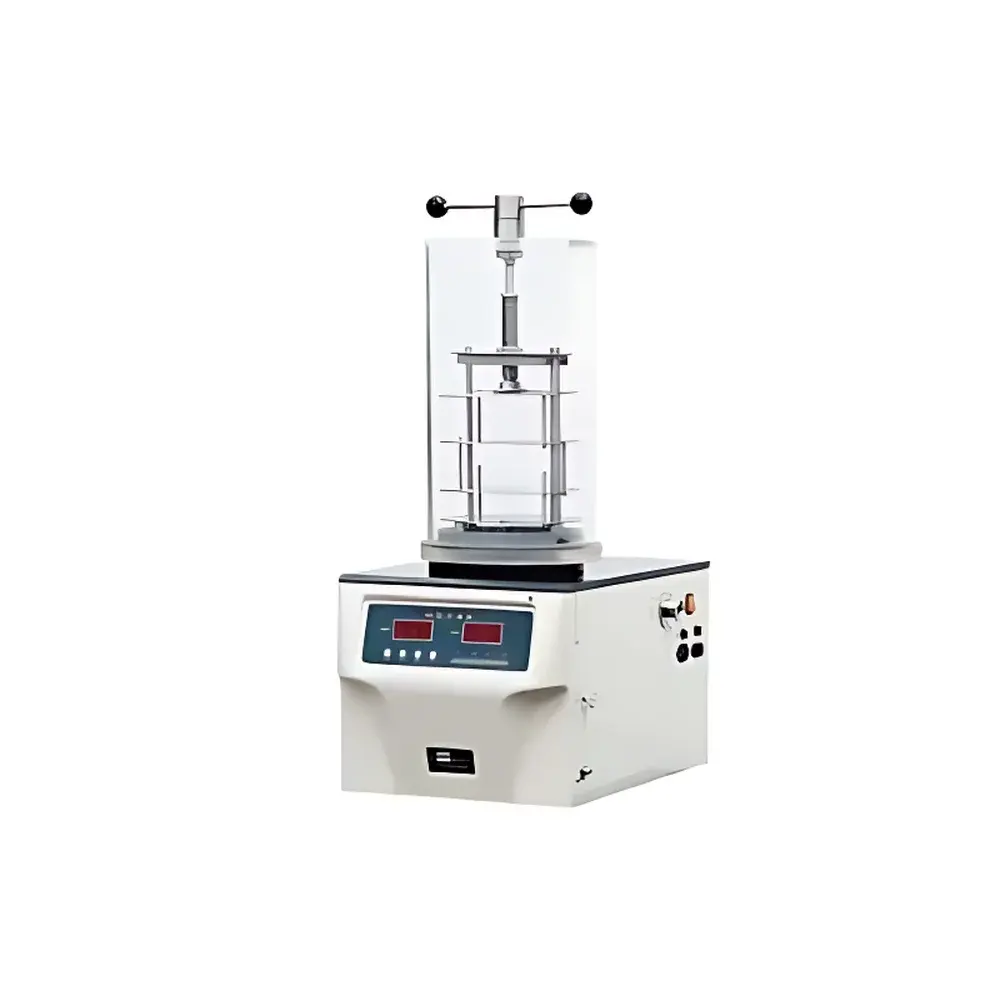
Hanuo FD-1B-50 Benchtop Freeze Dryer
| Brand | Hanuo |
|---|---|
| Origin | Shanghai, China |
| Model | FD-1B-50 |
| Instrument Type | Standard Shelf-Type Freeze Dryer |
| Application Scope | Laboratory Use |
| Freeze-Drying Area | 0.12 m² |
| Ultimate Vacuum | < 20 Pa |
| Condenser Temperature | −50 °C |
| Water Capture Capacity | 3 kg/24 h |
| Dimensions (W×D×H) | 380 × 600 × 345 mm |
| Power Supply | 220 V, 50 Hz, 850 W |
| Sample Tray Configuration | Φ180 mm × 3 layers |
| Tray Capacity | 0.7 L |
| Standard Accessories | Benchtop主机 unit, 2 L domestic vacuum pump, chamber pressure control (stoppering) kit with three sample trays |
Overview
The Hanuo FD-1B-50 is a compact, benchtop shelf-type freeze dryer engineered for reliable primary drying of thermolabile biological and pharmaceutical samples in research laboratories and quality control environments. It operates on the fundamental principle of lyophilization—sublimation of ice under deep vacuum and controlled low temperature—enabling preservation of structural integrity, bioactivity, and long-term stability in sensitive materials such as monoclonal antibodies, plasmid DNA, live attenuated vaccines, and enzyme formulations. Unlike spray or air-drying methods, freeze drying minimizes denaturation, oxidation, and aggregation by avoiding liquid-phase exposure during dehydration. The FD-1B-50 integrates a −50 °C condenser, a high-efficiency refrigeration system, and a vacuum chamber capable of achieving ≤20 Pa absolute pressure—conditions sufficient to support sublimation kinetics for most aqueous-based formulations used in preclinical development and analytical reference standard preparation.
Key Features
- Shelf-based drying architecture with three removable Φ180 mm stainless steel trays, offering uniform heat transfer and direct monitoring of sample behavior during primary and secondary drying phases.
- Integrated −50 °C dual-stage refrigeration condenser with 3 kg/24 h water capture capacity—designed to handle typical batch volumes encountered in small-scale R&D workflows without requiring intermediate defrost cycles.
- Benchtop footprint (380 × 600 × 345 mm) optimized for space-constrained laboratory environments, including biosafety cabinets, cleanroom anterooms, and shared instrumentation suites.
- Standard stoppering (pressure-controlled chamber lid) functionality enables in-situ vial sealing post-drying—a critical requirement for maintaining sterility and residual moisture control in GMP-aligned QC labs.
- 850 W power consumption at 220 V / 50 Hz ensures compatibility with standard laboratory electrical infrastructure across Asia-Pacific and other 220–240 V regions.
- Preconfigured vacuum system includes a 2 L oil-lubricated rotary vane pump, calibrated to achieve stable sub-20 Pa operating pressure within ≤30 minutes after chamber evacuation initiation.
Sample Compatibility & Compliance
The FD-1B-50 accommodates a wide range of sample formats, including bulk solutions in glass Petri dishes, multi-well plates (with optional adapter), and standard 10–20 mL serum vials placed directly on trays. Its 0.12 m² effective drying area supports batch sizes up to 0.7 L total volume—suitable for process parameter screening, formulation optimization, and small-batch lyophilized reference material production. While not certified for full GMP manufacturing, the system meets essential engineering prerequisites for GLP-compliant documentation: stable vacuum repeatability (±2 Pa over 4-h hold test), consistent condenser temperature drift (< ±0.5 °C/h), and mechanical design aligned with ISO 22042-1 (freeze dryer safety) and ICH Q5C (stability testing of biotechnological products). Optional PT100 probe integration allows real-time product temperature logging—supporting FDA 21 CFR Part 11–compliant audit trails when paired with validated third-party data acquisition software.
Software & Data Management
The FD-1B-50 operates via an embedded digital controller with LED interface, supporting manual stage programming (pre-freeze, primary dry, secondary dry, vent) and real-time display of chamber pressure, condenser temperature, and elapsed cycle time. Though it does not include onboard data logging hardware, its analog voltage outputs (0–5 V) for pressure and temperature signals are compatible with industry-standard SCADA platforms (e.g., LabVIEW, DeltaV, or custom Python-based acquisition scripts). Users may archive cycle parameters and environmental logs for internal SOP compliance, method transfer documentation, or regulatory submission packages—including alignment with USP <1211> and Ph. Eur. 2.9.40 requirements for lyophilization process characterization.
Applications
- Stabilization of labile biologics: lyophilization of recombinant proteins, viral vectors, and CRISPR-Cas ribonucleoprotein complexes prior to functional assay or cryo-EM grid preparation.
- Preparation of calibration standards and reference materials for HPLC, ELISA, and mass spectrometry workflows.
- Drying of microbial cultures (e.g., lactic acid bacteria, yeast strains) for long-term archival without liquid nitrogen dependency.
- Dehydration of botanical extracts and nutraceutical powders where thermal degradation must be avoided to preserve polyphenol and flavonoid profiles.
- Supporting DOE-based lyophilization cycle development—especially for determining collapse temperature (Tc′) and eutectic melting points using controlled shelf ramping protocols.
FAQ
What is the maximum allowable sample volume per cycle?
The FD-1B-50 supports up to 0.7 L of aqueous solution distributed across three Φ180 mm trays—assuming a typical fill depth of 5–8 mm to ensure efficient sublimation front propagation.
Is the vacuum pump included in the standard configuration?
Yes, a 2 L domestic oil-sealed rotary vane vacuum pump is supplied as part of the base package, pre-connected and tested for vacuum integrity.
Can the system accommodate vials with rubber stoppers?
Yes—the standard pressure-controlled lid enables manual or semi-automated stoppering after primary drying completion, provided vials conform to ISO 8362 dimensions.
Does the FD-1B-50 comply with ISO or ASTM lyophilization standards?
While not formally certified, its performance envelope aligns with key operational thresholds defined in ISO 22042-1 (safety), ASTM F2373 (lyo cycle validation), and USP <1211> (sterile processing controls).
Is remote monitoring or Ethernet connectivity available?
No native Ethernet or Wi-Fi interface is integrated; however, analog signal outputs allow connection to external PLCs or PC-based DAQ systems for centralized monitoring and alarm triggering.



