
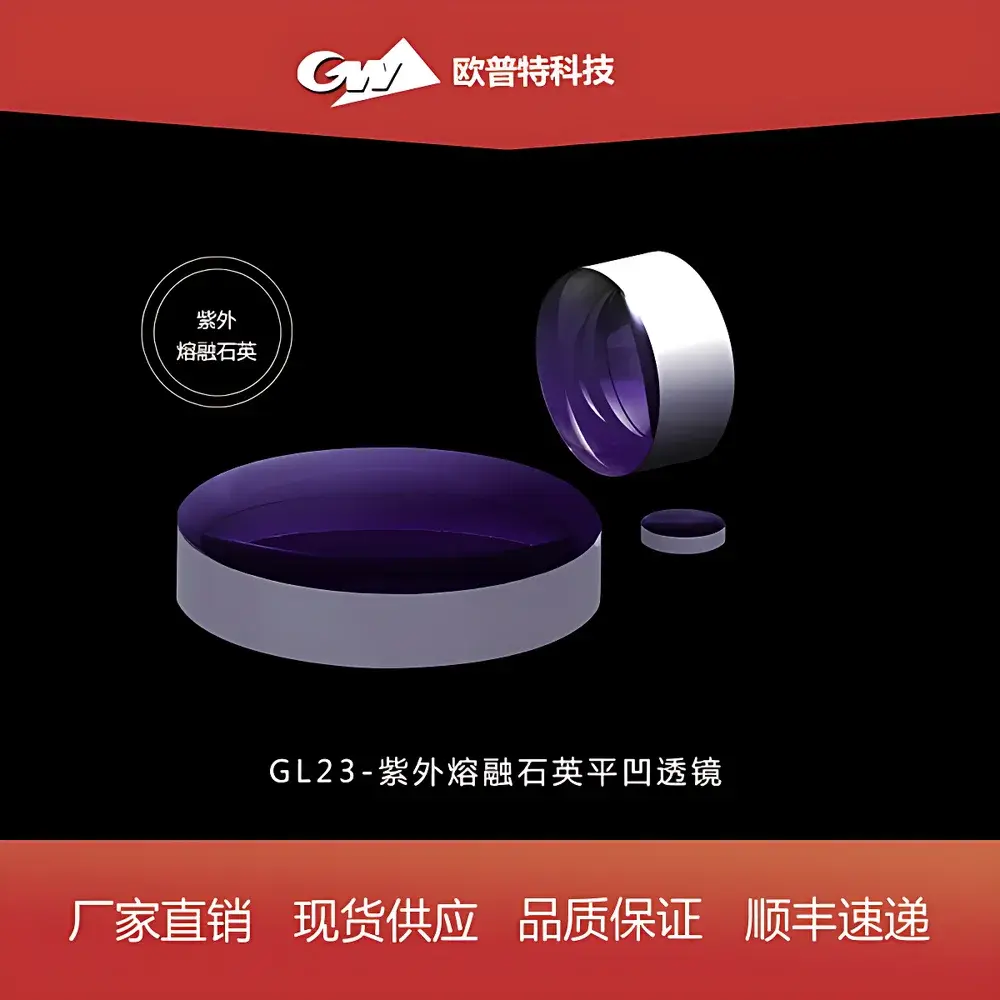
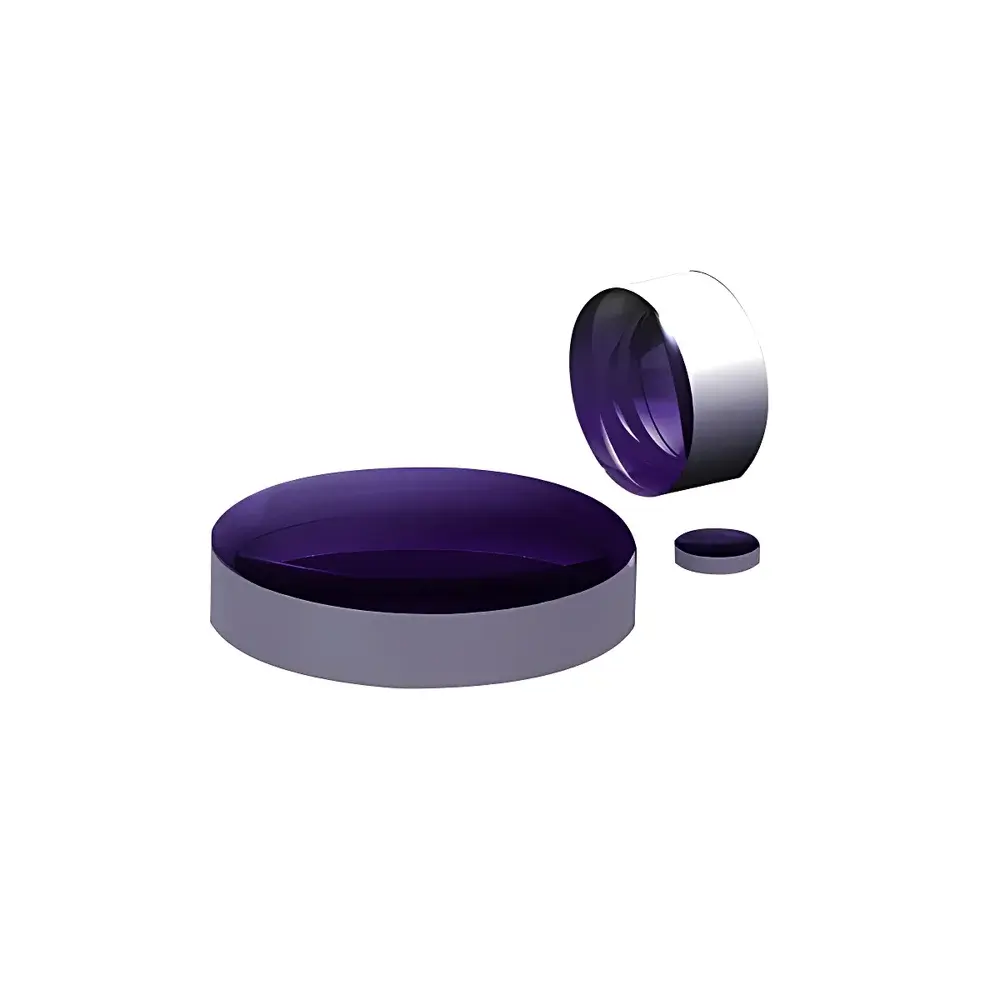
GL23 UV-Fused Silica Plano-Concave Lens (Uncoated & UV-AR Coated Options)
| Origin | Beijing, China |
|---|---|
| Manufacturer Type | Distributor |
| Regional Origin | Domestic (China) |
| Model | GL23 |
| Price Range | USD 0.15–75.00 (per piece) |
| Component Category | Optical Element |
| Material | UV-Fused Silica (Synthetic Quartz, Grade I) |
| Surface Quality | 40–20 scratch-dig |
| Surface Flatness | λ/4 @ 633 nm (plano side), λ/2 @ 633 nm (concave side) |
| Clear Aperture | ≥90% of diameter |
| Coating Option | Broadband UV Anti-Reflection (UV-AR), Ravg < 0.5% over 250–400 nm |
| Transmission | >95% per surface (UV-AR coated), >90% per surface (uncoated) in 250–400 nm range |
| Damage Threshold | ≥5 J/cm² @ 355 nm, 10 ns, 20 Hz |
Overview
The GL23 series comprises precision-engineered plano-concave lenses fabricated from high-purity UV-grade fused silica (SiO₂), optimized for demanding ultraviolet optical applications requiring minimal absorption, high homogeneity, and exceptional transmission below 250 nm. Unlike standard BK7 or N-BK7 optics, UV-fused silica exhibits negligible solarization under prolonged UV exposure and maintains structural stability across thermal cycling—critical for laser beam expansion, collimation correction, and divergent beam shaping in spectroscopic, lithographic, and photochemical systems. Each lens is manufactured to ISO 10110–3 tolerances, with the concave surface ground and polished to a radius of curvature tolerance of ±0.2% and surface irregularity controlled to λ/2 at 633 nm. The plano side is polished to λ/4 flatness, ensuring minimal wavefront distortion when used in low-aberration relay or imaging configurations.
Key Features
- Material: Corning 7980 or equivalent UV-fused silica with OH⁻ content < 1 ppm, refractive index nd = 1.45847 @ 587.6 nm, dispersion (νd) = 67.8
- Two coating options: uncoated (for maximum UV durability in high-vacuum or ozone-rich environments) and broadband UV-AR coating (Ravg < 0.5% across 250–400 nm, measured at 0° AOI)
- Standard diameters: 6.3 mm, 10.0 mm, 12.7 mm, and 25.4 mm; focal lengths range from –12.5 mm to –400 mm (negative sign denotes diverging function)
- Edge thickness control: ±0.05 mm; center thickness specified per design to maintain mechanical stability under mounting stress
- Traceable metrology: Each batch includes interferometric verification reports (Zygo GPI or equivalent) and spectral transmittance data (PerkinElmer Lambda 950 or Shimadzu UV-3600+)
- No adhesives or cementing—monolithic construction ensures compatibility with UHV (<10−9 Torr) and cleanroom Class 100 environments
Sample Compatibility & Compliance
The GL23 lens series complies with ISO 9001:2015 manufacturing controls and conforms to ISO 10110 optical drawing standards for surface form, roughness, and coating specification. All UV-AR coatings are deposited via ion-assisted e-beam evaporation (IAE) in Class 1000 cleanrooms, meeting MIL-C-48497A requirements for environmental durability (humidity, abrasion, thermal shock). Lenses are suitable for integration into systems compliant with IEC 61000-4-2 (ESD immunity), FDA 21 CFR Part 11 (when used in analytical instrumentation with audit-trail-capable software), and ASTM E1331 (for UV-VIS spectrophotometer calibration traceability). No RoHS exemptions apply—lead-free, cadmium-free, and mercury-free construction is verified per IEC 62321-7-2.
Software & Data Management
While the GL23 lens is a passive optical component, its performance parameters—including measured transmission spectra, interferometric surface maps, and coating reflectance curves—are delivered as standardized XML and CSV files compatible with Zemax OpticStudio (ZOS), CODE V, and FRED optical design platforms. Spectral data is calibrated against NIST-traceable standards (SRM 2036, SRM 2068) and includes uncertainty budgets per GUM (JCGM 100:2018). For OEM integration, full parametric CAD models (STEP AP214, SAT) and GD&T annotations are available upon request, supporting automated optical alignment workflows in machine vision and semiconductor inspection tools.
Applications
- Excimer laser beam conditioning (193 nm ArF, 248 nm KrF) in photolithography steppers and mask aligners
- UV Raman spectroscopy collection optics where stray light suppression and high étendue are required
- Fluorescence lifetime imaging (FLIM) and time-resolved UV spectroscopy optical trains
- Vacuum UV (VUV) monochromator collimators operating down to 115 nm (with appropriate purge or differential pumping)
- UV-curable resin curing optics in additive manufacturing systems requiring high irradiance uniformity
- Calibration references for radiometric and photometric transfer standards in national metrology institutes
FAQ
Is the UV-AR coating suitable for 193 nm lithography applications?
Yes—the coating design includes layer stacks optimized for minimal reflectance at 193 nm, with validated LIDT testing per ISO 21254-1 at 193 nm, 10 ns pulse width, and 1 kHz repetition rate.
Can these lenses be used in vacuum environments?
Absolutely. UV-fused silica exhibits negligible outgassing (TML < 0.05%, CVCM < 0.01% per ASTM E595), and the IAE-deposited coating is fully dense with no columnar microstructure.
Do you provide custom focal lengths or non-standard diameters?
Yes—custom geometries, tighter surface specifications (e.g., λ/8 flatness), and alternate coatings (e.g., V-coat at 266 nm or dual-band AR for 250–400 nm + 780–850 nm) are available under NDA.
What is the typical lead time for batch orders exceeding 50 pieces?
Standard lead time is 4–6 weeks from PO confirmation; expedited production (2-week delivery) is available with priority scheduling and engineering review.
Are test reports provided with each shipment?
Yes—each order includes a Certificate of Conformance (CoC), spectral transmittance report, interferogram summary, and coating reflectance curve, all digitally signed and timestamped.




