
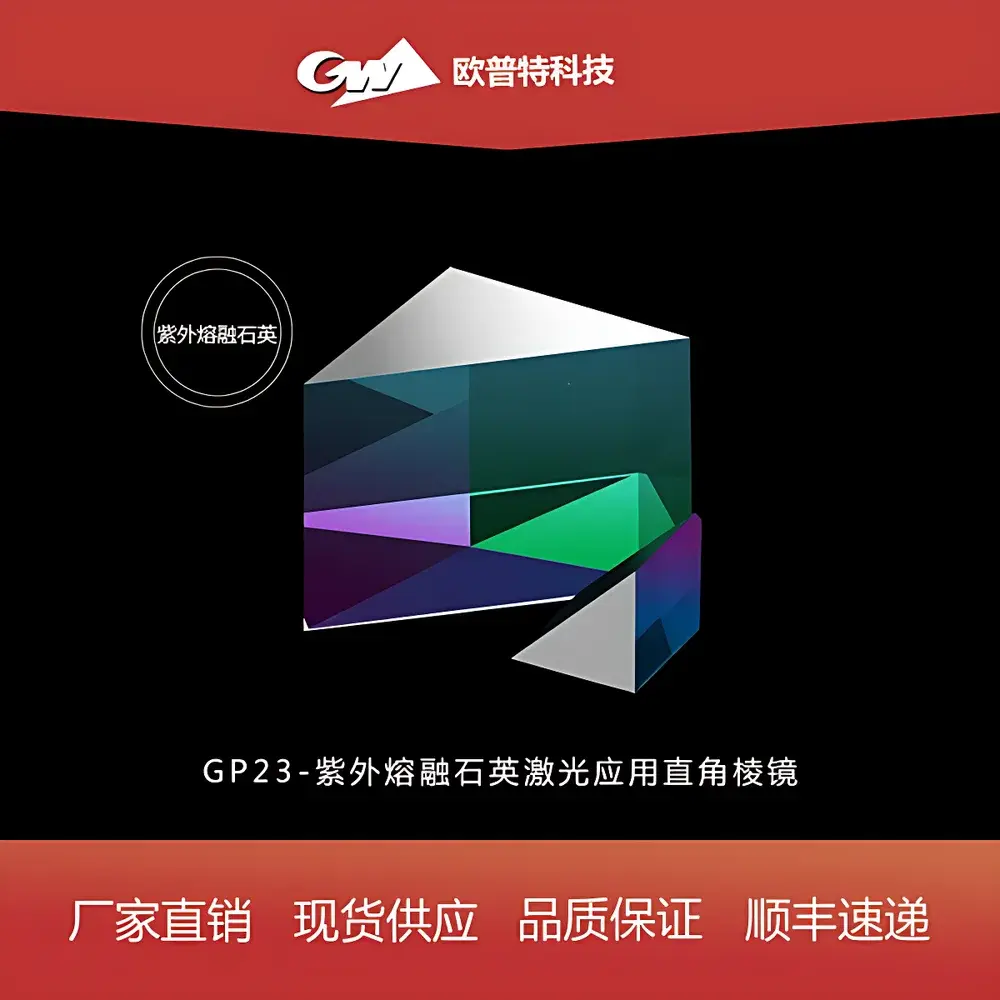

GP23 UV-Grade Fused Silica Right-Angle Prism
| Material | UV-grade fused silica |
|---|---|
| Dimensions tolerance | +0.0 / −0.1 mm |
| Surface flatness | λ/10 @ 632.8 nm |
| Surface quality | 10–5 scratch-dig (MIL-PRF-13830B) |
| Angular accuracy | ±15 arcseconds |
| Beam deviation (tower error) | < 5 arcminutes |
| Edge chamfer | 0.25 mm × 45° |
| Coating options | V-coating @ 355 nm, 532 nm, or 1064 nm (R < 0.25% per surface) |
| Available sizes | 5.0 mm, 10.0 mm, 12.5 mm, and 15.0 mm (equilateral legs A = B = C) |
Overview
The GP23 UV-grade fused silica right-angle prism is a precision optical component engineered for high-stability beam steering, image reflection, and optical path folding in ultraviolet to near-infrared laser systems. Constructed from synthetic fused silica with exceptional transmission down to 185 nm and low thermal expansion (α ≈ 0.55 × 10⁻⁶ /°C), the GP23 prism leverages total internal reflection (TIR) at the hypotenuse face when used in standard 90° deviation configuration—or alternatively supports metallic or dielectric coating on the hypotenuse for enhanced performance at non-TIR angles. Its design conforms to ISO 10110–7 and MIL-PRF-13830B standards for surface form, finish, and angular metrology, ensuring compatibility with demanding applications in ultrafast laser cavities, interferometric alignment systems, and UV lithography beam delivery optics.
Key Features
- Optical substrate: High-purity UV-grade fused silica (SiO₂), certified for ≤1 ppm metallic impurities and hydroxyl content <1 ppm—critical for minimizing solarization under 355 nm irradiation.
- Precision geometry: Equilateral right-angle configuration (A = B = C) with angular tolerance of ±15 arcseconds, verified via autocollimation interferometry traceable to NIST standards.
- Surface fidelity: λ/10 surface flatness @ 632.8 nm (measured via phase-shifting interferometry), surface quality rated 10–5 per MIL-PRF-13830B—ensuring minimal wavefront distortion in collimated beams.
- Controlled edge treatment: Consistent 0.25 mm × 45° protective chamfer applied to all edges, reducing chipping risk during handling and mounting without compromising clear aperture.
- Application-specific coatings: Optional broadband or laser-line V-coatings deposited via ion-assisted e-beam evaporation; each coating achieves R < 0.25% at design wavelength (355 nm, 532 nm, or 1064 nm) with LIDT ≥ 5 J/cm² @ 10 ns, 20 Hz (tested per ISO 21254).
Sample Compatibility & Compliance
The GP23 prism is compatible with standard kinematic mounts (e.g., Thorlabs KM100, Newport UMB1) and vacuum-compatible optical tables. It meets RoHS Directive 2011/65/EU and REACH Annex XIV requirements. For regulated environments—including ISO 13485-certified medical laser systems or FDA-regulated analytical instrumentation—the prism can be supplied with full material certification (including lot-specific UV transmission spectra and refractive index data at 355/532/1064 nm), as well as cleanroom packaging (ISO Class 5). Documentation supports GLP/GMP traceability where required for QC documentation workflows.
Software & Data Management
While the GP23 is a passive optical component, its integration into system-level optical design workflows is supported through native compatibility with Zemax OpticStudio (ZOS), CODE V, and FRED ray-tracing platforms. Each product shipment includes a digital calibration report containing interferometric surface map data (in .ZMX or .DAT format), measured angular deviation, and spectral reflectance curves. Optional API-accessible metadata (via RESTful endpoint) enables automated import into LIMS or PLM systems for batch-level traceability in production environments.
Applications
- Laser beam redirection in DPSS and ultrafast Ti:sapphire oscillators, particularly where UV stability and low birefringence are mandatory.
- Image erector assemblies in compact spectroscopic sensors and endoscopic optical relays.
- Beam combiners/splitters in multi-wavelength fluorescence excitation systems (e.g., simultaneous 355/532 nm pumping).
- Reference elements in high-precision alignment jigs for photolithography stepper calibration.
- Environmental monitoring instruments requiring long-term UV exposure resistance—such as DOAS (Differential Optical Absorption Spectroscopy) spectrometers operating below 250 nm.
FAQ
What is the maximum permissible power density for continuous-wave (CW) operation at 355 nm?
For uncoated GP23 prisms operated in TIR mode, CW power density should not exceed 1 kW/cm² at 355 nm. With V-coated variants, the limit increases to 5 kW/cm², provided thermal management maintains substrate temperature below 40°C.
Can the GP23 be used in vacuum environments?
Yes—UV-grade fused silica exhibits negligible outgassing (per ASTM E595: TML < 0.05%, CVCM < 0.01%). All standard GP23 units are cleaned to ISO 10110–7 Class 5 cleanliness prior to packaging.
Is custom coating available beyond the listed V-coating wavelengths?
Yes—custom HR, AR, or polarizing coatings can be applied upon request; lead time extends by 3–4 weeks and requires minimum order quantity of 10 units.
Do you provide interferometric surface maps for individual units?
Yes—each shipped GP23 includes a calibrated surface figure report (Zernike coefficients and PV/RMS values) generated from a Zygo Verifire™ XP interferometer.
What mounting recommendations do you suggest for minimizing stress-induced birefringence?
Use compliant kinematic mounts with soft indium foil or Viton® gaskets; avoid direct clamping on optical surfaces. Maximum recommended contact pressure: 0.1 MPa.






